A Growing List

2 Peter 1:2-11 (NLT)

May God give you more and more grace and peace as you grow in your knowledge of God and Jesus our Lord.

By his divine power, God has given us everything we need for living a godly life. We have received all of this by coming to know him, the one who called us to himself by means of his marvelous glory and excellence. And because of his glory and excellence, he has given us great and precious promises. These are the promises that enable you to share his divine nature and escape the world’s corruption caused by human desires.

In view of all this, make every effort to respond to God’s promises. Supplement your faith with a generous provision of moral excellence, and moral excellence with knowledge, and knowledge with self-control, and self-control with patient endurance, and patient endurance with godliness, and godliness with brotherly affection, and brotherly affection with love for everyone.

The more you grow like this, the more productive and useful you will be in your knowledge of our Lord Jesus Christ. But those who fail to develop in this way are shortsighted or blind, forgetting that they have been cleansed from their old sins.

So, dear brothers and sisters, work hard to prove that you really are among those God has called and chosen. Do these things, and you will never fall away. Then God will give you a grand entrance into the eternal Kingdom of our Lord and Savior Jesus Christ.

By Chuck Griffin

At the core of the above passage is a spiritual to-do list, a way to grow as a Christian. Each item is strengthened by something else on the list, with the ultimate goal of experiencing a strong, unshakable faith.

Moral excellence, or goodness, undergirds great faith and has to do with whether we choose what God would choose in the same circumstances. But how do we know how to choose?

Well, knowledge helps to prop up moral excellence. The Lord has revealed much to us in the Holy Bible, even if it does sometimes take a little effort and the guidance of the Holy Spirit to tease the information out. What a gift: thousands of years of holy revelation at our fingertips!

Why do we fail to dig out what we need? We have trouble staying focused. We lack self-control. The painful distractions and immediate pleasures of this world draw us away from the rich rewards available to us in the Bible and through direct contact with God in prayer.

Patient endurance marks the beginning of self-control. We see the fiery darts of the enemy coming at us, but regardless of whether and where they stick, we know we can keep moving forward as Christians because God is with us. And if we find ourselves passing through Vanity Fair, we don’t slow down, for we know our real destination.

If that previous paragraph was confusing, I just went all “Pilgrim’s Progress” on you. If you haven’t read it, you really should try it.

Godliness supports endurance, of course. This is a little different from the “goodness” or “moral excellence” that develops down the road in this spiritual journey. At this stage, there is a simple desire to please God, springing from the warmth that is felt when in fellowship with other Christians.

And the beginning of all of this is love. We understand true love when we first comprehend what God has done for us. “For God so loved the world … .” We didn’t deserve God’s love; maybe those around us should receive love regardless of what they deserve, too.

And don’t miss the promise Peter made: “Do these things, and you will never fall away. Then God will give you a grand entrance into the eternal Kingdom of our Lord and Savior Jesus Christ.”

Seems to me like we have a to-do list worth doing.

Lord, thank you for the guidance Peter and other conduits of your holy word offer us. May we grow as we live the lives of disciples. Amen.
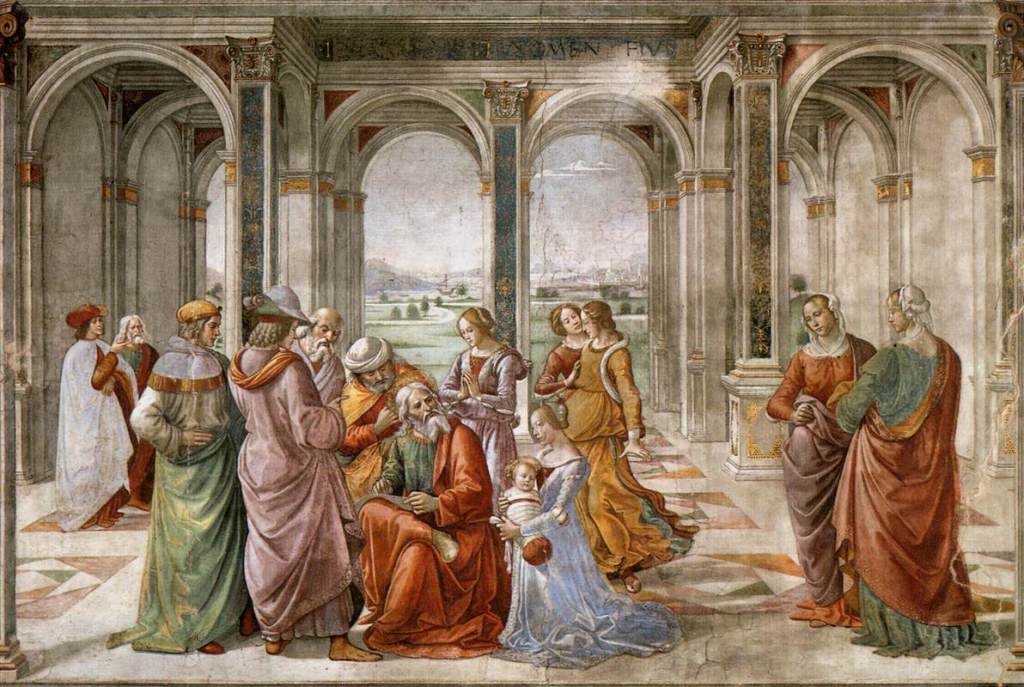
God in Art: Zechariah

Domenico Ghirlandaio, “Zechariah Writes Down the Name of His Son,” 1490

No, that baby in the fresco, found in the Tornabuoni Chapel in Florence, Italy, isn’t Jesus. He is John the Baptist, cousin to Jesus and the one who would announce the coming of the Messiah. Today is a good day to consider the story of his father, Zechariah. In particular, you might want to take time to hear his “song,” the prophetic declaration he makes when his tongue is unleashed.

Confusing to Satan

Philippians 1:12-19 (NRSV)

I want you to know, beloved, that what has happened to me has actually helped to spread the gospel, so that it has become known throughout the whole imperial guard and to everyone else that my imprisonment is for Christ; and most of the brothers and sisters, having been made confident in the Lord by my imprisonment, dare to speak the word with greater boldness and without fear.

Some proclaim Christ from envy and rivalry, but others from goodwill. These proclaim Christ out of love, knowing that I have been put here for the defense of the gospel; the others proclaim Christ out of selfish ambition, not sincerely but intending to increase my suffering in my imprisonment. What does it matter? Just this, that Christ is proclaimed in every way, whether out of false motives or true; and in that I rejoice.

Yes, and I will continue to rejoice, for I know that through your prayers and the help of the Spirit of Jesus Christ this will turn out for my deliverance.

By Chuck Griffin

The words of Paul we find in Romans 8:28, “All things work together for good for those who love God,” were more than just an idea to the apostle. He saw them come true in his own tribulations.

Paul suffered mightily during his service to the Lord, and by the time he was writing to the church at Philippi, he was in prison. And yet, he was able to observe the effect his faithfulness continued to have on those around him, even those charged with keeping him imprisoned.

It’s a story repeated throughout the history of the church. Some who are against Christ attack those who stand for Christ, and the faith exhibited by those brave, Spirit-filled Christians makes strong disciples out of weak ones and believers out of skeptics. Somewhere in their minds, these witnesses to the suffering look at those under attack and think to themselves, “I want what they have.”

These moments surely send Satan into a frenzy. Just when he thinks he has those Christians where he wants them—just when they should be in despair—the Holy Spirit works through them, and he loses more of his minions to the dawning Kingdom of Heaven.

Even those who preach Christ with wrongheaded motives can end up doing good. The growing presence of the kingdom is inexorable. It will not be stopped, and it continues to creep into the world in the oddest ways.

Well, Jesus did tell us the kingdom would be like yeast, eventually permeating the whole loaf.

Lord and Savior, work your way more deeply into our lives so we may withstand any time of trial and draw others to you. Amen.

Living a Lie

Revelation 22:12-16 (NRSV)

“See, I am coming soon; my reward is with me, to repay according to everyone’s work. I am the Alpha and the Omega, the first and the last, the beginning and the end.”

Blessed are those who wash their robes, so that they will have the right to the tree of life and may enter the city by the gates. Outside are the dogs and sorcerers and fornicators and murderers and idolaters, and everyone who loves and practices falsehood.

“It is I, Jesus, who sent my angel to you with this testimony for the churches. I am the root and the descendant of David, the bright morning star.”


By Chuck Griffin

If you were in church last Sunday, you probably picked up on the fact that we are now in the season of Advent, which begins a new church year. With our minds on Christmas, Advent can seem like an odd church season.

For one thing, we begin the church year like people who read the last few pages of a novel before starting the first chapter. Advent is about the end of a great story, one we will spend the rest of the church year hearing and exploring through its cycle of readings.

The ending is pretty straightforward: Jesus Christ will return. Justice will become a visible reality, and the Messiah who died for all will reward those who stand with him and reject those who rejected him.

Today’s text from Revelation references “everyone who loves and practices falsehood,” saying they will be excluded from God’s presence, where the gift of eternal life awaits. Another translation, the New Living Translation, describes these people as those “who love to live a lie.”

Christians do occasionally stray from living as true disciples. We forget what Jesus Christ did to restore us as children of God. We live as if there is no truth to the story.

Usually, we snap back to reality as defined by God, the maker of all that is real. We resume that effort to live as he would have us live. We conform our lives to God’s will out of gratitude for the great gift we have been given.

Like Lent, the church season preceding Easter, Advent is a good time to ask ourselves what lies we might be living and how we can return to the truth. Recognizing our errors and turning from them amount to what we call repentance; growing in truth and love then becomes a powerful work God’s Spirit can perform in us.

Eventually, we may be so blessed that we can show the truth to those who have never known anything but life as a lie.

Lord, reveal where we lie to ourselves, and show us how the truth really does set us and others free. Amen.

Happy Thanksgiving!

Devotions from Methodist Life will return next week.

Psalm 34:1-8

I will bless the Lord at all times;
    his praise shall continually be in my mouth.
My soul makes its boast in the Lord;
    let the humble hear and be glad.
O magnify the Lord with me,
    and let us exalt his name together.

I sought the Lord, and he answered me,
    and delivered me from all my fears.
Look to him, and be radiant;
    so your faces shall never be ashamed.
This poor soul cried, and was heard by the Lord,
    and was saved from every trouble.
The angel of the Lord encamps
    around those who fear him, and delivers them.
O taste and see that the Lord is good;
    happy are those who take refuge in him.

Do Not Forget the Lord Your God

Deuteronomy 8

By Chuck Griffin

In this season of Thanksgiving—this coming long weekend where we count our blessings and look toward God in gratitude—we Americans find ourselves in a good land.

Some would call such an assertion debatable, citing a pandemic, inflation, a strange job market, and social unrest as their evidence. And these problems do exist, causing suffering.

We still live in a good land, however. If for no other reason, it is good because it remains a place where we can freely remember and worship God. I also think there are many other reasons it remains a good land. Despite the current gloom, I’m an optimist, and I’m mindful that we’ve faced much worse as a nation.

To me, the parallels between our situation and the situation the Israelites were in as they prepared to enter the Promised Land are striking. The book of Deuteronomy largely is Moses reminding the people of their history and their relationship with God, preparing them for Moses’ imminent death and their first steps into a long-anticipated future.

“For the Lord your God is bringing you into a good land, a land with flowing streams, with springs and underground waters welling up in valleys and hills, a land of wheat and barley, of vines and fig trees and pomegranates, a land of olive trees and honey, a land where you may eat bread without scarcity, where you will lack nothing, a land whose stones are iron and from whose hills you may mine copper,” Moses told them, his words recorded in the eighth chapter. “You shall eat your fill and bless the Lord your God for the good land that he has given you.”

With a few modifications to the types of crops and some additions to the minerals, this could serve as a description of North America.

There also is a warning: “Take care that you do not forget the Lord your God,” Moses said. After reminding them once again of all the perils God had brought them through, Moses added, “Do not say to yourself, ‘My power and the might of my own hand have gotten me this wealth.’ “

I would not go so far as to describe the United States as some kind of new Promised Land. Our nation was not designed to relate to God through a direct covenant. It is, however, structured so that individuals can enter into any kind of covenant with God, assembling with those of like mind without fear of persecution. That freedom has allowed Christianity in all its variations to thrive here.

Yes, we debate loudly about politics, and the price of a Thanksgiving meal is up; yes, gas is once again over $3 a gallon where I live, and as high as $6 a gallon in other parts of the country. But this land remains a great blessing to its inhabitants and the world as long as our principles of freedom remain. Less stuff would not diminish our connection to God.

The lesson from Deuteronomy is simple, and as relevant to us as it was to those desert people longing for a little variety in their diets and a constant water supply. Remember God—remember the one you follow, the one you have declared to be above all creation.

Worshiping God in good times and bad is our primary task.

Dear Lord, your first blessing was to give us life; help us to use our lives as ongoing acts of thanksgiving and praise. Amen.

A Josiah Moment

2 Kings 22:11-20 (NLT)

By Chuck Griffin

It’s always a shock to discover we’ve strayed from the Lord’s plan.

In today’s Bible passage, we hear how a young, good king, King Josiah, was introduced to the basics of how his people were supposed to be living, via a rediscovered Book of the Law. A proper understanding of how God was to be worshiped had been lost during the reign of prior evil kings, men who allowed paganism to creep into the land.

When Josiah realized how far his flock had strayed from their very reason to exist, he grieved so powerfully that he tore his clothes. Disaster loomed large. Fortunately, there still were priests and prophets in the land, and the king learned that God’s just response to the rampant unholiness would be delayed until Josiah’s righteous reign had ended.

We live under an expanded, improved version of the plan, of course. Strict adherence to the law was the closest the Israelites could come to establishing a relationship with God. We live in the time after Jesus Christ, knowing that his willingness to die in our place for our sins now makes that relationship possible. All we have to do is believe, allowing God’s Spirit to go to work in our lives.

And yet, we stray.

In many ways, we can be like those ancient children of God, called to serve and worship but distracted to the point of forgetting who God is. One generation fails to adequately tell great truths to the next generation. The shiny things of the world and the worries of the world begin to dominate our thinking.

God’s call on us is powerful, though. It breaks through, and we can have a Josiah moment, grieving for ourselves individually and the people around us collectively. Dawning awareness of how wonderful it is to be in communion with God is an exciting and wonderful experience to have.

I have experienced such a moment in a big way in my life, and I continue to experience similar little moments as I exist with one foot in a time-bound world and the other in eternity. Let’s grieve over what we lose when we take our eyes off God, but let’s rejoice at how God offers to restore us when we lock our eyes on the throne once again.

Lord, help us to keep our eyes eternally fixed on you, and with your guidance and strength, may our lives be conformed to your will. Amen.

God in Art: Last Words

Sunday’s sermon at Holston View United Methodist Church will be “Last Words,” based on 2 Samuel 23:1-7. We also will be acknowledging Thanksgiving, and yes, the two concepts will tie together.

The founder of Methodism, John Wesley, is remembered in part for his last words, “The best of all is, God is with us.” He actually said the phrase twice before dying. The second time, we are told, he raised his hand and waved it in triumph. Below is a book engraving of his passing, artist unknown. (If you can help me find a proper attribution, please pass it along.)

Lord, may we always sense that you are with us. Amen.

Children of the Aramean

Deuteronomy 26:1-11

By Chuck Griffin

When we think of Old Testament texts on giving, our minds often go to the tithe, the giving of 10 percent of the harvest or income to support what would eventually become the work of the temple, work that included care for the poor. Today’s Deuteronomy text really doesn’t take us into the concept of the tithe, however.

What we hear is a recitation, a declaration of what God had done to help his chosen people. From a practical perspective, the offering brought to the altar was a mere token, but theologically it was huge. The head of a family was acknowledging that all he had truly came from God.

I believe in hard work. I believe in the idea that if we are to succeed in life, there is a need to use our bodies and minds to the best of our abilities.

But at the same time, as people who acknowledge we were made by God and saved from sinful brokenness by God, we have to be the first to say we are dependent on God.

If we think about it, we do owe everything to God, even if we’ve done all we can to succeed. If we’re intelligent enough to make the right choices, it’s because God made us so. If we have been able to succeed through hard physical labor, it is because God at some point graced us with healthy bodies.

And we can never forget that there is at least some randomness in how well we do or don’t do in life. If we’re not careful, we will simply stumble into success and then start thinking we are brilliant.

A good Jew acknowledged these truths with his recitation and offering. We do much the same when we declare ourselves followers of Christ—for example, if we recite the Apostles’ Creed in worship. We declare God Creator. We then retell the story of Christ’s life, sacrifice and resurrection, following that with the story of God continuing to work in the world up to this very day through the Holy Spirit.

That true understanding—that perspective regarding who God is and who we are—should shape every nook and cranny of our lives. For many, that deepest, hardest to reach cranny is where we store our attitude about income and possessions.

As I said before, this text isn’t really about tithing. Tithing was a powerful Old Testament concept, of course, but a text like we have today shows us that tithing was just a beginning point, a rule designed to lead a person to a right way of relating to God through our income and possessions.

John Wesley preached that God provides for the roof over our heads, food, and other basic needs, allowing us to ensure the well-being of our families and even a business we may operate. Beyond those provisions, everything we are given counts as riches, and they have been given to us to use “to the glory of God.” Often, this means using our riches to help those who are less blessed materially, playing a role in God’s provision for people’s basic needs.

Even for a tither, this is a concept that requires thought. It forces a reassessment of every decision we make regarding how we handle our income and possessions, simply because we learn to say, “It’s not really mine, anyway.”

If you find this idea a little daunting, be encouraged. Look back to today’s verses; notice how our little scene at the altar closes. There is celebration in the house of God, the kind of joy to be shared even with the dependent and disenfranchised people among us.

I wonder what we miss when we fail to embrace such a powerful attitude about income and possessions.

Lord, give us the spiritual strength to turn every aspect of our lives over to you, and may the celebration that follows be most rewarding. Amen.

God in Art: Christ’s Lament

This Sunday at Holston View United Methodist Church, we will hear Mark 13:1-8, where Jesus foretells the destruction of the Temple in Jerusalem by the Roman Empire. In this passage, Jesus is straightforward about what would happen.

There are other passages, however, where his pain regarding the future of Jerusalem is evident. In Matthew 23:37, he says, “O Jerusalem, Jerusalem, the city that kills the prophets and stones God’s messengers! How often I have wanted to gather your children together as a hen protects her chicks beneath her wings, but you wouldn’t let me.” In Luke 19:41, we are told Jesus at one point wept over the city.

In 1892, the artist Enrique Simonet imagined this emotional moment.

Lord, like chicks who know their mother, may we in faith huddle beneath your wings. Amen.