Those Wonderful Sheepdogs

Psalm 16

A psalm of David.

Keep me safe, O God,
    for I have come to you for refuge.

I said to the Lord, “You are my Master!
    Every good thing I have comes from you.”
The godly people in the land
    are my true heroes!
    I take pleasure in them!
Troubles multiply for those who chase after other gods.
    I will not take part in their sacrifices of blood
    or even speak the names of their gods.

Lord, you alone are my inheritance, my cup of blessing.
    You guard all that is mine.
The land you have given me is a pleasant land.
    What a wonderful inheritance!

I will bless the Lord who guides me;
    even at night my heart instructs me.
I know the Lord is always with me.
    I will not be shaken, for he is right beside me.

No wonder my heart is glad, and I rejoice.
    My body rests in safety.
For you will not leave my soul among the dead
    or allow your holy one to rot in the grave.
You will show me the way of life,
    granting me the joy of your presence
    and the pleasures of living with you forever.

By Chuck Griffin

God is our ultimate protector. When we believe in Jesus Christ as Savior, we are protected even as we experience death, carried into eternal life by God’s great plan. The final verses of today’s psalm are a prophecy of that plan, revealing how it culminates in the resurrection of Jesus.

A desire for safety in this earthly life and the idea that godly people can be heroes are two other concepts that come together in this psalm. And as I write this devotion knowing it will be published on Veterans Day, I cannot help but think of those who took time out of their lives to serve the United States of America in a military role to protect us.

I give particular thanks for those who take on such difficult roles while clinging to godliness, the pursuit of what God would have them do.

Sometimes you hear certain people described as having “sheepdog” personalities—friendly, gentle and loyal, but a force to be reckoned with when evil threatens. Many such people are naturally drawn to military service. I love the way the sheepdogs fit into the pastoral image of the Great Shepherd, the one responsible for the flock as a whole.

A good sheepdog becomes an extension of the shepherd’s hand, sensitive to the call of the master and following commands without allowing fear to get in the way. What a comfort sheepdogs should be to the flock!

Think of the sheepdogs around you today and offer them words of affection and thanks. Let them know they are loved and welcomed among us. We need their experiences and attitudes in the midst of our churches.

Lord, pour a special blessing out today on those who have chosen to form that thin line protecting us from disaster. Amen.

Charity and Triage

1 Timothy 5:3-16 (NLT)


By Chuck Griffin

Some of Paul’s writings can seem difficult to process or even irrelevant because they are so tightly bound to cultural circumstances that seem far behind us. In today’s example, a reader might want to explore what it meant to be a widow in the early church as it existed in Ephesus, and what particular challenges the church faced at that time.

A trustworthy commentary or study Bible can help a reader uncover some of these important details of history, and such a learning process is always useful. That’s not where I am going today, though. Instead, I want to see if this seemingly anachronistic passage might hold some general principles that remain valuable now.

Let’s begin with a common point every church through time shares: Some churches may seem rich and some may seem poor, but all churches ultimately have finite resources. This means some care must be taken in how resources are distributed among people in need.

If we are to be good stewards, a form of charitable triage is required. In medicine, triage is a process where the wounded or ill are ranked for treatment so as to maximize the number of survivors. I see a kind of triage happening in this passage.

Of lowest priority would be those who demonstrate or express a need, but who also clearly have the ability to resolve their problems on their own. When encountering these situations, a church’s efforts should focus largely on education, showing people the path to independence.

In 2 Thessalonians 3:10, Paul gave this very direct comment regarding idleness: Even while we were with you, we gave you this command: “Those unwilling to work will not get to eat.”

In situations where people cannot resolve their problems on their own, church leaders still need to carefully analyze the family dynamics, exploring whether some sort of healing needs to happen in  the relationships there. The continuing importance of the family unit within the church comes through clearly in what Paul wrote to Timothy.

Where there is family, church support of people in need would again have to be somewhat conditional. As a pastor, I have seen families try to pass along responsibility for an impoverished or ill relative to the church, wanting to be free of the stress caused by the family member.

The family as a whole could very well need financial and spiritual assistance in supporting the relative. But the family still should take a demonstrably active role in the process, particularly if that family claims to abide by Christian values.

Of highest priority would be those who are truly alone and unable to help themselves. With careful stewardship of resources, a church should be able to offer these people God’s love in powerful and comforting ways.

In all of these situations, grace and gentleness should prevail, of course, with the goal of bringing everyone closer to God constantly in mind.

Dear Lord, may your Holy Spirit help us navigate the often difficult circumstances surrounding charitable work, and may your kingdom be glorified in all we do. Amen.

God in Art: The Widow

This Sunday at Holston View United Methodist Church, the sermon will draw from Mark 12:38-44, where Jesus again causes us to think about our spiritual relationship with money. If you cannot join us in person, join us online at 11 a.m., or watch a recording later.


As we prepare for Sunday, James Tissot’s “The Widow’s Mite” is offered for your consideration. Much of the artwork developed around this story shows the widow with a child in her arms. While the addition of the child is an elaboration, going beyond what we find in the text, these depictions do remind us of the basic call to care for “widows and orphans,” the most vulnerable people in Jesus’ day. Note in particular the expression captured on the widow’s face.

Tissot, circa 1890, courtesy Brooklyn Museum through Wikipedia

Lord, keep us mindful that in your eyes, treasure is stored in the heart. Amen.

Risky Business

This Sunday at Holston View United Methodist Church, the sermon will draw from Mark 12:38-44, where Jesus again causes us to think about our spiritual relationship with money. If you cannot join us in person, join us online at 11 a.m., or watch a recording later.

Today’s Preparatory Text:  1 John 3:16-24 (NLT)


By Chuck Griffin

When preaching, I occasionally reference the biblical concept of hospitality. As we prepare for this Sunday’s sermon, I want us to further explore this tame-sounding idea that actually is quite radical.

In the letter of 1 John, we hear what real love is, our eyes drawn to the death of Jesus on the cross. This is the same author who wrote in the Gospel of John, “For God so loved the world that he gave his only Son, so that everyone who believes in him may not perish but may have eternal life.” Later in the Gospel of John, in the 15th chapter, he also quoted Jesus as saying this: “No one has greater love than this, to lay down one’s life for one’s friends.”

With the idea in mind that we might need to die for each other, it’s no stretch to say that living the Christian life requires us to take risks. We should never be foolish with our lives, but it’s possible our lives could be endangered as we work on behalf of our savior and the world around us. It takes spiritual courage not to pull away when such risks arise.

In my opinion, American Christians can be a little short on this kind of courage, in part because we are so affluent compared to the rest of the world. When you have stuff, you get used to guarding your stuff from others who might want it.

Our concern for our stuff makes our tolerance for risky interactions with others low. I’m generalizing, of course, but I feel comfortable that I just described our group average, and I acknowledge I often am more a part of the problem than the solution. A risk-averse people have difficulty solving many of the social problems around them simply because they cannot, as a group, step up and do the hard work that has to be done.

For an example, let’s look at helping the homeless. This kind of hospitality ministry invites us to make sacrifices in our own lives so we can dramatically impact the lives of others. Individually, some Christians go so far as to maintain “Elisha rooms,” creating simple spaces for people in need. (The Bible story behind the name is in 2 Kings 4:8-17.)

Again, there is risk, particularly when we engage with people we don’t know that well, and with risk comes fear. But when we dwell in a Holy Spirit-inspired community, we can help each other with hospitality, reducing risk and fear.

Sometimes the solution is as simple as modifying our church spaces with hospitality in mind. At my first appointment out of seminary, the church was expanding its facilities. The church leaders plopped the blueprints down in front of me one day and asked if I had any input.

“Just one,” I said. “Maybe a shower somewhere? Then if people in the community have an emergency, we could use the building for short-term housing.”

The church members liked the idea so much they put in two shower facilities. They now regularly house and feed homeless guests through a program providing temporary help to displaced families.

Sadly, not enough American churches have a hospitable mindset. Many churches, perhaps most churches, have yet to embrace this very scriptural work. They even are willing to pass that responsibility on to the government, distancing themselves from the powerful call God places upon us in Scripture.

Where do we get the spiritual strength to take radical risks as we make ourselves more hospitable? Well, we begin with small, communally shared risks, and we grow in strength over time.

It is my prayer that one day the American church, regardless of its denominational lines, will fully be the hospitable church described in the Bible. When that happens, the government’s intractable problems will prove to be no problem for God and his people.

Lord, take us down paths requiring courage, filling us with your Holy Spirit as we go. Amen.

The Simple Approach

Micah 6:6-8 (NRSV)

“With what shall I come before the Lord,
    and bow myself before God on high?
Shall I come before him with burnt offerings,
    with calves a year old?
Will the Lord be pleased with thousands of rams,
    with ten thousands of rivers of oil?
Shall I give my firstborn for my transgression,
    the fruit of my body for the sin of my soul?”
He has told you, O mortal, what is good;
    and what does the Lord require of you
but to do justice, and to love kindness,
    and to walk humbly with your God?

By Chuck Griffin

I just returned to work after taking a couple of weeks’ vacation, something I highly recommend. “Duh,” some of you might be saying, but you would be surprised how hard it is for a lot of pastors to make the decision to take a vacation, or even an appropriate amount of time off during the week.

If for no other reason, it is important that we take that time so we maintain perspective. And so often, it seems that perspective is largely a matter of remembering what is important, and then focusing on what is important by employing the “KISS” principle—Keep It Simple, Stupid.

My first Monday back at work was a good example of how my vocation, like a lot of jobs, can become a series of unexpected, frustrating exercises. I’ll not go into a lot of detail, but when I got home, I invoked the memory of an old ’80s commercial when I said to my wife, “I’m not a lawyer, but I apparently play one at church. I’m also not an IT guy, a psychologist, a human resources director or a financial planner, but I play those at church, too.” I did manage to teach a Bible study on Monday.

Vacation is good because it allows us to get our heads out of the swirl of the extraneous for a while and remember who we truly are. As children of God, we always will have distractions, but our service to God has to be a priority.

Micah reminds us that serving God doesn’t have to become an overly elaborate or painfully ritualized activity. Mainly, it’s about getting our hearts right. Countering injustice, showing kindness, and humbly remembering who we are in relation to God are God-honoring ways to live.

I’ll try to remember that as the work week progresses.

Lord, whatever we are doing, please let us find ways to make what we do about you and your plan of salvation. Amen.

Dodging the Cross

This Sunday’s sermon at Holston View UMC will be “A Piercing Truth,” drawing on Hebrews 4:12-16. If you cannot be with us in person, please join us online live or to watch a recording later.

Today’s Focus Text: Mark 8:27-38


By Chuck Griffin

Like most preachers,  I tend to mention God’s grace a lot. This makes sense; the fact that God loves us despite our sinfulness serves as the basis of salvation.

Grace is a heart-warming joy. We need to remember, however, that while God gives us grace freely, grace is by no means cheap, having been purchased at a terrible price.

Grace comes to us primarily through Jesus Christ, of course. In Mark 8:27-38, Jesus speaks in no uncertain terms about its price.

Jesus asks his disciples, “Who do you say that I am?” Peter has the good sense to declare Jesus to be Messiah.

Jesus then begins to teach his followers exactly what this means. As Messiah, Jesus must suffer, be rejected by religious authorities, be killed, and rise from the dead.

Peter cannot stand it. He goes so far as to rebuke Jesus for saying such things.

“Get behind me, Satan!” is Jesus’ response. “For you are setting your mind not on divine things but on human things.”

Despite his moment of brilliance, Peter has proven to be wilfully blind to the cross in Jesus’ future. Informed of the cross, he still refuses to see it. To Peter, half the story is better than the whole story; he wants the joy of Christ’s presence and power without the pain required to redeem the world from sin.

Even after hearing Jesus’ teachings on this matter, the disciples still refuse to understand. They never understand until after Jesus’ resurrection.

Modern Christians, myself included, are so often like the pre-resurrection disciples that I want to cringe. We like grace and the warm, secure feeling it provides us. Now, if we could just avoid the idea of the cross.

It’s particularly difficult because Jesus spoke not only about his own cross, but the cross his followers must bear, too. Our cross usually proves to be more metaphorical, but we hardly find it more pleasant to consider.

But can the requirements of a Christian be any more clear? “If any want to become my followers,” Jesus says, “let them deny themselves and take up their cross and follow me.”

When Jesus says “deny themselves,” he is telling us to set aside our own worldly interests. When he tells us to take up our cross, he is telling us to make God’s will, the establishment of his kingdom on earth, our top priority.

Such thinking turns our lives upside down. Suddenly, even our own well-being does not matter so much as loving God with all our heart, soul, mind and strength, and loving our neighbors as if their interests precede our own.

Fortunately, such thinking also turns the world upside down. And the more we think this way, the more visible God’s kingdom becomes.

We may even learn to like our cross, understanding it to be the proper response to the sacrifice Christ made on his cross.

Lord, show us our crosses, and may we bear them in gratitude for the eternal life we have received. Amen.


The editor of Methodist Life’s Lifetalk blog will be on vacation through the end of October, so the blog will be on hiatus, too.

Conquerors

This Sunday’s sermon at Holston View UMC will be “A Piercing Truth,” drawing on Hebrews 4:12-16. If you cannot be with us in person, please join us online live or to watch a recording later.

Today’s Focus Text: 1 John 5:1-6


By Chuck Griffin

This scripture meditation may sound a little old-fashioned.

Lately, a lot of clergy are more prone to talk about new ideas—clever ways to connect with the lost, or new trends in communication, which is all good stuff, of course. We have to remember, however, that the core truth about Jesus Christ doesn’t change. The author of 1 John brings us back to that core.

First, there is belief, specifically believing that Jesus is the Christ, God’s chosen redeemer for the world. In particular, we are to believe Christ’s death on the cross defeated sin, and that the resurrection is both proof of that fact and a promise regarding what is to come.

People come to believe in various ways. It is important for the converted to remember the unconverted may come to Christ in ways we don’t expect. I’m reminded of the story of the man who went to a hotel room to commit suicide, but instead opened a Gideon Bible and met Jesus in its pages.

Another favorite conversion story is of a man sitting in a Chicago church as a worship service opened with a full processional down the center aisle. As the crucifer—for those of you unfamiliar with more formal worship, that’s the person carrying the cross at the top of a long pole—went by, the man said he looked up, saw the cross and believed. No sermon, no prayer, he said. He just knew. Sounds strange to me, but it worked for him.

What is important, of course, is that we come to believe, and then live into our belief.

Belief allows us to be incorporated into a new family, 1 John also tells us. Again, it’s a little old-fashioned sounding, but we are “brothers and sisters.” The family metaphor doesn’t work for everyone. If Momma ran off when you were a baby and Daddy was a drunk, the word “family” probably sounds terrible. We’re supposed to think of the ideal version of family, however.

The author of 1 John goes on. In a healthy family, we abide by certain standards; for Christians, it is the commandments, the Ten Commandments and the other guidance God gives us in Scripture regarding right and wrong. In summing up the law, Jesus kept matters simple. Love the Lord with all your heart, soul, mind and strength, and love your neighbors as yourselves. Right remains right, and wrong remains wrong, but love controls how we deal with sin when it is before us.

I thought about how love fits into the conversion equation when I drove by some placard-waving Christians at an intersection. The signs covered a range of issues. One asked God to bless Israel; another said homosexuality is still a sin, while a third noted, “Drunkards shall not enter the kingdom of heaven.”

Sitting at a red light watching them, I was struck by an odd dichotomy. Scripturally they were correct, but from a kingdom-building perspective, being right doesn’t always mean you are helping. They mostly appeared to be an example of like attracting like and repelling those who needed a deeper relationship with Christ. Right (or perhaps simple self-righteousness) was present, but I did not see love offered.

I do like the way we as traditional Methodists handle some of the more difficult issues requiring both law and grace. Human sexuality, for example—we call sin a sin, and we recognize that defiantly unrepentant sinners shouldn’t be leaders. At the same time, however, we acknowledge that in God’s eyes, all people are worthy of grace and need access to that grace through Christian community and worship. It’s a more complicated position than many Christians try to live out, but it’s easy enough to understand, if we try.

Once we get all these core concepts right, there is much to celebrate. As 1 John tells us, there is victory; we win! We conquer the world, ripping it from the grasp of evil and restoring it to its rightful owner. That in itself should be enough to draw people to Christ.

Yes, these ideas are old-fashioned, but in them there is good news, the kind of news that can transform anyone forever.

Lord, keep us grounded in the faith that has sustained the church and changed the world for centuries. Amen.

God in Art: Justice

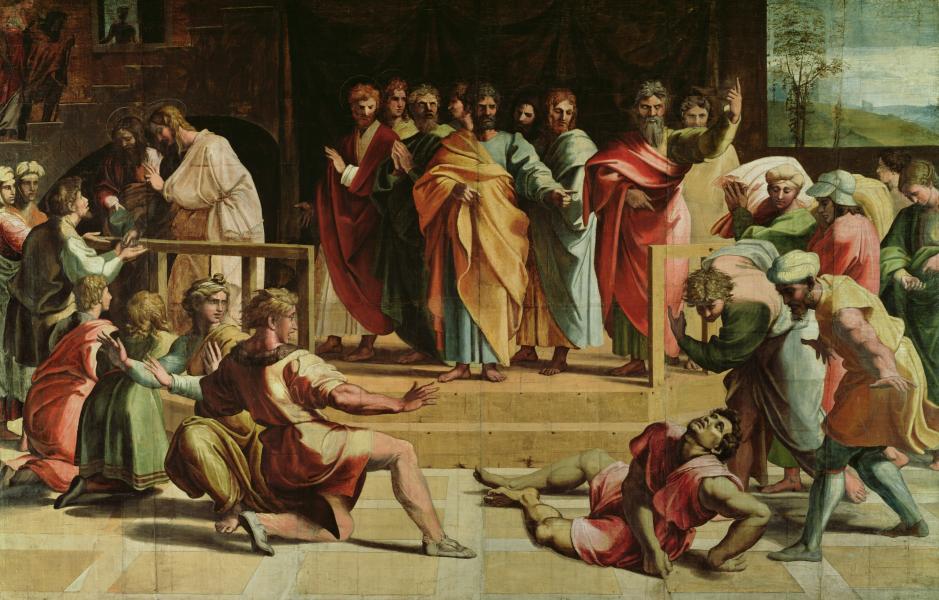
The painting below, Raphael’s “Death of Ananias,” depicts a moment when God’s justice fell upon a husband who was part of a deceptive couple in the early church. (The wife receives her portion soon after.) The story is found in Acts 4:32-5:11. Does the story and its depiction shock you? Why might we be shocked that God’s justice could be so swift?

Lord, we thank you for the mercy and grace you continually shower upon us. We know that without Jesus Christ, your justice would be swift, righteous and terrible. Amen.

Justice Is a Holy Word

This Sunday’s sermon at Holston View United Methodist Church, “Justice in the Gate,” will explore Amos 5:6-15. If you cannot be with us in the sanctuary Sunday, you are welcome to join us online at 11 a.m., or view a recording later.

Today’s focus text: Matthew 5:38-42 (NRSV)

“You have heard that it was said, ‘An eye for an eye and a tooth for a tooth.’ But I say to you, Do not resist an evildoer. But if anyone strikes you on the right cheek, turn the other also; and if anyone wants to sue you and take your coat, give your cloak as well; and if anyone forces you to go one mile, go also the second mile. Give to everyone who begs from you, and do not refuse anyone who wants to borrow from you.”


By Chuck Griffin

“Justice” fits into all sorts of slogans: Justice is blind. Justice will prevail. No justice, no peace.

Here’s what I and a lot of other Bible-focused people might add. Justice is about relationships; perfect justice requires holy relationships. From a Christian perspective, God’s justice is constantly trying to expand its influence in our sin-wracked societies as we better learn to relate to one another as children of God.

Thousands of years ago, “an eye for an eye and a tooth for a tooth” was a radical expansion of justice. Before that concept developed, only the rich and powerful had anything resembling justice. The weak and poor just lost a lot of teeth and eyes. What sounds like Old Testament vitriol to us now was in fact an attempt to guarantee everyone would be treated the same.

Sure, there often was a gap between intent and implementation, and we still see unequal applications of justice today. Dear Lord in heaven, did I even need to say that after these last few years? We harden our hearts against one another because of race or economic status, and we fail to offer a holy relationship to someone we think of as “other.”

And by the way, no, I did not just offer a wholesale restatement of the progressive left’s justice message. We are all guilty as we peer at each other from our various vantage points in the public square. When it comes to ensuring justice for all, most of us remain in the stage where we shout across the pavement, “You go first.”

Jesus’ difficult-to-accept description of kingdom justice is largely about deciding to go first, and it is hard to embrace because he asserts that change can happen when a victim begins the process. The great hope is that when people turn the other cheek, give the litigious more than they sought, and freely help beggars and borrowers, they trigger life-changing responses from these recipients of unexpected grace.

I know, I know. It’s so hard to follow Jesus’ teachings consistently. These recipients of grace often take advantage of the giver. They don’t seem to change, and we find ourselves constantly compromising when it comes to reaching out to really difficult people.

Let’s remember that it took centuries for most of humanity to be able to agree that “an eye for an eye and a tooth for a tooth” sounds primitive—that there might be a better way. It may be a little longer before Christ’s vision of justice fully prevails. I suspect Christ will have to return to make his work complete.

That doesn’t mean we stop striving for justice now, though, establishing new, holy relationships wherever we can.

Lord, where we see injustice, give us the words and actions you would use if standing in our place, and then fill us with your courage. Amen.

A Bunch of Do-Gooders

By Chuck Griffin

As we enter the last quarter of the year and what we typically think of as the “holiday season,” I’m sure many of you feel as frustrated as I do. This pandemic is still with us, despite many of us thinking in the middle of the year that the situation would be more normal by now.

Worship attendance is down, and despite having had what seemed like some very powerful worship experiences recently, I long for the weekly church participation we used to see. At the same time, I understand where most people are. Within my own family, we have a lot of concerns regarding what could be carried to the unvaccinated and vaccinated-but-vulnerable people among us.

Galatians 6:8-10 offers us a straightforward strategy to bear us through these tiresome times: “If you sow to your own flesh, you will reap corruption from the flesh; but if you sow to the Spirit, you will reap eternal life from the Spirit. So let us not grow weary in doing what is right, for we will reap at harvest time, if we do not give up. So then, whenever we have an opportunity, let us work for the good of all, and especially for those of the family of faith.”

How can we continue to do good in the world, focusing in particular on the good of our fellow church members? Or perhaps I should pose the question in the singular: How can I do good … how can you do good? This isn’t a new concept for Christians, of course. Each of us needs to arise in the morning and think, “I want to do something that counts as good today, something that makes a difference.”

Thinking such thoughts raises our level of alertness, which is critical if we are to get our timing right. Some of you know I have practiced karate for years, and we who do so have these pithy little sayings that are translations from what is known as the “Karate Code.” One of my favorites is, “The time to strike is when opportunity presents itself.”

We strike at evil whenever we do good. But we have to keep our eyes open for those limited windows of opportunity. And then we have to be bold enough to move quickly.

We may be more constrained in how we move about the world right now, but as we move about, let’s keep our eyes open for those places where a kind word, a prayer or our resources can go to work right away.

Even a pandemic isn’t powerful enough to keep us from consciously doing good. And never forget that as we do good, we are planting for the future. God promises we will reap mightily for the kingdom.

Lord, we ask that you do more than just bring us through this difficult time. May we make good use of the time we are in now. Amen.