Even the Worst

1 Timothy 1:12-20 (NLT)

I thank Christ Jesus our Lord, who has given me strength to do his work. He considered me trustworthy and appointed me to serve him, even though I used to blaspheme the name of Christ. In my insolence, I persecuted his people. But God had mercy on me because I did it in ignorance and unbelief. Oh, how generous and gracious our Lord was! He filled me with the faith and love that come from Christ Jesus.

This is a trustworthy saying, and everyone should accept it: “Christ Jesus came into the world to save sinners”—and I am the worst of them all. But God had mercy on me so that Christ Jesus could use me as a prime example of his great patience with even the worst sinners. Then others will realize that they, too, can believe in him and receive eternal life. All honor and glory to God forever and ever! He is the eternal King, the unseen one who never dies; he alone is God. Amen.

Timothy, my son, here are my instructions for you, based on the prophetic words spoken about you earlier. May they help you fight well in the Lord’s battles. Cling to your faith in Christ, and keep your conscience clear. For some people have deliberately violated their consciences; as a result, their faith has been shipwrecked. Hymenaeus and Alexander are two examples. I threw them out and handed them over to Satan so they might learn not to blaspheme God.


If you’ve spent much time trying to lead people to Jesus Christ, you may have encountered an unexpected problem.

A lot of lost people reflect on their worst sins, and they think Christianity simply sounds too easy. “How could God ever forgive that,” they ask, referencing the sin. Others consider the sins of infamous evil people and then struggle with the simplicity of salvation.

All we have to do is confess and turn away from our sins and believe? Really? Regardless of who we are or what we’ve done?

Yep. Believe that Christ’s work on the cross is effective and you’re saved from eternal death, the appropriate result of sin. Instead, receive eternal life, a gift so joyous it benefits this life now.

Over time, all who take this initial step do need to understand the proper response to this great gift of salvation, a response driven by the ongoing gift of the Holy Spirit in believers’ lives. They should find themselves moving into full alignment with God, which is mostly about allowing God to go to work.

But salvation itself really is that simple.

Once saved—to use the Methodist term, “justified”—that ongoing alignment is important because it keeps us from backsliding. Paul made it clear that a believer’s faith can be “shipwrecked.” Having escaped the power of sin, we don’t want to steer toward the rocks and end up in the clutches of Satan once again.

Believers, simply keep in mind that God is always close. Open your Bible. Open your hearts to your savior in prayer. Take time to worship. Satan will flee.

Lord, thank you for how easy you have made salvation. Help us to communicate the simplicity of your plan to those who have yet to accept it for themselves. Amen.


We See You!

Mark 3:7-12 (NLT)

Jesus went out to the lake with his disciples, and a large crowd followed him. They came from all over Galilee, Judea, Jerusalem, Idumea, from east of the Jordan River, and even from as far north as Tyre and Sidon. The news about his miracles had spread far and wide, and vast numbers of people came to see him.

Jesus instructed his disciples to have a boat ready so the crowd would not crush him. He had healed many people that day, so all the sick people eagerly pushed forward to touch him. And whenever those possessed by evil spirits caught sight of him, the spirits would throw them to the ground in front of him shrieking, “You are the Son of God!” But Jesus sternly commanded the spirits not to reveal who he was.


The religious phrase “Great Awakening” has been borrowed by some who badly abused it in secular settings the last couple of years. Today’s text reminds us of what it means for people to leap to their feet and respond to the clear presence of God.

Jesus’ ministry, of course, was the ultimate Great Awakening, as he first revealed an expanded understanding of God’s plan and then, in his crucifixion, resurrection, ascension and sending of the Holy Spirit, made an ongoing, living connection to God possible.

Any later Great Awakening simply was or will be a revival, a renewed understanding of what has come before. As in Jesus’ day, when such an event happens, people more easily recognize miracles past and present. They may travel great distances to hear what God has to say, even though these truths have long been available to them in God’s word.

I particularly like the idea that the spiritual world in contention with God trembles at the idea of such moments that lead to movements. Unseen evil beings trouble us all the time. Why should they not be troubled, too?

Hear the Good News: Jesus Christ is Lord! The evil in this world is in retreat and the brokenness of creation is being healed. It is a truth established for you and for me. It is simultaneously personal and global; it will change our lives forever.

Lord, may we see such an Awakening in our day, to the benefit of our families, friends, neighbors, enemies, and of course, ourselves.

On Task

Acts 15:36-41 (NLT)

After some time Paul said to Barnabas, “Let’s go back and visit each city where we previously preached the word of the Lord, to see how the new believers are doing.” Barnabas agreed and wanted to take along John Mark. But Paul disagreed strongly, since John Mark had deserted them in Pamphylia and had not continued with them in their work. Their disagreement was so sharp that they separated. Barnabas took John Mark with him and sailed for Cyprus. Paul chose Silas, and as he left, the believers entrusted him to the Lord’s gracious care. Then he traveled throughout Syria and Cilicia, strengthening the churches there.


There’s no real way to determine who was right in the argument Paul and Barnabas had about taking John Mark along on a second journey. In searching for an answer, I could spend all day discussing topics like immaturity, loyalty, grace, forgiveness and unity, and I would never get to the important point.

The mission of the church comes first.

The disagreement these two apostles had was so sharp that their basic tasks of growing the church and encouraging continuing discipleship were imperiled. Remember, there were vast territories needing to hear about Christ and infant churches full of questions, but very few apostles to do the work.

Rather than letting the disagreement slow them further, they went their separate ways, Barnabas taking his cousin John Mark, and Paul choosing Silas to travel with him.

I have no doubt both men felt great pain as they separated. They had, after all, been through much together.

But again, the mission of the church comes first.

Why the Holy Spirit did not intervene in some way in a dream, a vision or a miracle, I cannot say. In some ways it is comforting to know that in the earliest days of the church, God sometimes left people to experience their emotions, think matters through and come up with difficult answers on their own. In terms of kingdom building, something about this process must be valuable.

It’s not hard to see how this passage relates to the current situation of the United Methodist Church and its internal argument over scriptural authority and application. We are at an impasse, sometimes a sharp one. And the mission of the church still has to come first.

Be encouraged, however. What we’ve heard from Acts today is not the end of the story. Christ somehow managed to bring Paul and John Mark together later in life.

Writing from prison in Rome nearly two decades later, Paul asked Timothy, “Bring Mark with you when you come, for he will be helpful to me in my ministry.” (2 Timothy 4:11.) This brief request is clear evidence something changed as John Mark grew up and Paul grew old.

As painful as conflict can be, people genuinely dedicated to the mission of the church will find themselves restored in their relationships, in this life or the next. I feel certain this is true.

Lord, may we always remain dedicated to the Great Commission, the need to lead people to a belief in Jesus Christ and grow them as disciples. We give thanks for all who make this their first priority. Amen.

Most Hospitable

2 Kings 4:8-17 (NRSV)

One day Elisha was passing through Shunem, where a wealthy woman lived, who urged him to have a meal. So whenever he passed that way, he would stop there for a meal. She said to her husband, “Look, I am sure that this man who regularly passes our way is a holy man of God. Let us make a small roof chamber with walls, and put there for him a bed, a table, a chair, and a lamp, so that he can stay there whenever he comes to us.”

One day when he came there, he went up to the chamber and lay down there. He said to his servant Gehazi, “Call the Shunammite woman.” When he had called her, she stood before him. He said to him, “Say to her, Since you have taken all this trouble for us, what may be done for you? Would you have a word spoken on your behalf to the king or to the commander of the army?” She answered, “I live among my own people.” He said, “What then may be done for her?” Gehazi answered, “Well, she has no son, and her husband is old.” He said, “Call her.” When he had called her, she stood at the door. He said, “At this season, in due time, you shall embrace a son.” She replied, “No, my lord, O man of God; do not deceive your servant.”

The woman conceived and bore a son at that season, in due time, as Elisha had declared to her.


One of my favorite seminary classes was on the subject of hospitality. Hospitality is much more than setting out tea and cookies—it is a powerful theological concept.

Today’s story wonderfully illustrates scriptural hospitality. Simple acts of caring and concern tap into the ever-flowing grace of God, and lives are changed for the better.

And yes, “simple” is an important part of godly hospitality. Note that the wealthy woman didn’t build a house for Elisha after she saw him passing through her town regularly. She began by feeding him, and then she moved on to establishing for him a small rooftop shelter furnished with just a few basic items.

Keeping hospitality simple takes away the pressures that so often can keep us from being open and welcoming to others. Hospitality is much easier when we’re not worried about our stuff or how our actions will be judged.

Hospitality also makes possible new relationships where remarkable events can happen. There is no indication the wealthy Shunammite woman thought she might gain something from her hospitality, but out of it came a blessing money could not buy, the child she and her husband wanted.

The blessings from such encounters aren’t always so dramatic, but they can be uplifting. A few years ago, I was traveling alone to Indianapolis, and I checked the Airbnb listings. I wound up renting the most modest arrangement available—what was essentially a walk-in closet with a cot, and access to a bathroom, for $30 a night. I thought of Elisha’s little room as I lay there.

The room may have been tiny, but I got to know a couple of wonderful Indiana University grad students, one of whom owned the old house, which he was renovating. Both students were from other countries and wanted to know about me, and I got to hear about the research they were doing.

One was studying music’s effects on brain waves, with a possible benefit for autistic children, and I heard a miniature concert of the work he had done. The other was exploring third-world economic policies. I think I enjoyed my brief time with them more than the convention I attended. I felt I was in the presence of two young adults who could change the world for the better.

Hospitality is about new relationships and the hope they bring, and what church doesn’t want those? I’ve barely touched on the subject here. For those wanting to explore the concept further, a great place to start is Dr. Christine Pohl’s “Making Room: Recovering Hospitality as a Christian Tradition.

Studying hospitality now will ready us for the day when the pandemic is behind us. People are craving simple, genuine relationships and the blessings that flow from them.

Lord, guide us in our understanding of how to reach out to others, making ourselves available through acts of kindness and openness. Amen.

The Return

Psalm 147:1-11 (NLT)

Praise the Lord!

How good to sing praises to our God!
    How delightful and how fitting!
The Lord is rebuilding Jerusalem
    and bringing the exiles back to Israel.
He heals the brokenhearted
    and bandages their wounds.
He counts the stars
    and calls them all by name.
How great is our Lord! His power is absolute!
    His understanding is beyond comprehension!
The Lord supports the humble,
    but he brings the wicked down into the dust.

Sing out your thanks to the Lord;
    sing praises to our God with a harp.
He covers the heavens with clouds,
    provides rain for the earth,
    and makes the grass grow in mountain pastures.
He gives food to the wild animals
    and feeds the young ravens when they cry.
He takes no pleasure in the strength of a horse
    or in human might.
No, the Lord’s delight is in those who fear him,
    those who put their hope in his unfailing love.

I would never make direct comparisons between our year-long Covid-19 situation and the decades of exile the people of Israel experienced. As we start to see a return to something like normal lives, however, it is easy to borrow a little of their exuberance.

At the church I pastor, Holston View United Methodist, we are resuming in-person worship this Sunday, with safety precautions, of course. (Masks, social distancing, etc.) Several congregants have expressed their joy at the news.

I am looking forward to preaching to a significant number of people, rather than mostly focusing on a distant black lens. Not that I will forget those of you who are out there watching the worship live on the internet, or the recordings. I know many of you will not be able to return to the sanctuary just yet because of Covid concerns, and we always have a population of folks who are homebound. It’s just nice to get back to a good mix of online and in-person worshipers.

The opening of Psalm 147 certainly guides our response as we return to our sanctuaries and other church activities in phases through 2021. We have much to rebuild: our commitment to the Great Commission, the small groups and social networks that sustain us, and our willingness to unabashedly praise God all come to mind.

He is our great and glorious God! Even in places where we cannot yet shout this truth, may our hearts be filled with it.

We also are reminded of our need to approach God with humility. We enter church understanding we are the broken ones, lacking any perfectly pure knowledge. We enter seeking wisdom and correction, knowing we will be blessed in our encounter with the eternal mind.

As we return, let’s continue to put our hope in his unfailing love, expressed perfectly in Jesus Christ’s sacrifice for our sins on the cross.

Lord, as church people we are in different stages of return to our places of worship, depending on our locations and individual situations. As Christians, however, we are bound together by your Holy Spirit, and we pray you empower us to worship you well, wherever we may be. Amen.

Seeing the Plan Play Out

Jeremiah 29:10-14

For thus says the Lord: Only when Babylon’s seventy years are completed will I visit you, and I will fulfill to you my promise and bring you back to this place. For surely I know the plans I have for you, says the Lord, plans for your welfare and not for harm, to give you a future with hope. Then when you call upon me and come and pray to me, I will hear you. When you search for me, you will find me; if you seek me with all your heart, I will let you find me, says the Lord, and I will restore your fortunes and gather you from all the nations and all the places where I have driven you, says the Lord, and I will bring you back to the place from which I sent you into exile.


Just before these verses, the political leaders, craftsmen and other fine minds of Jerusalem, living in captivity in their conqueror’s homeland, received bad news from the prophet Jeremiah. They were not going home from Babylon any time soon—they might as well build houses and gardens and settle down.

God’s chastisement of his chosen people, caught up in sin, would ultimately lead to restoration and the continuation of his plan to bring salvation to the world through them. We are reminded, however, that God’s plan plays out over generations, centuries, and even millennia. God plays a long game, one so long that even the devil cannot keep track of it all.

I am struck by how blessed most of us reading this are, living as we have lived. Alignment with God does not automatically mean having a comfortable life. Throughout history, it’s been common for people to have the opposite, forced to live according to the whims of powerful, ungodly people.

We particularly are blessed to live in the time after Christ, making a fully restored relationship with God individually possible through simple faith. On top of that, most of us are blessed to live in places where we have the freedom to worship as we want and live as we want.

Yes, this is another one of those “count your blessings” devotionals. As you make your way through the day, appreciate what you have, and remember how we are called to seek God with all our hearts, using our freedoms to play a part in God’s great plan to redeem all of creation.

Lord, help us through faithfulness and devotion to you to preserve the great gifts we have in this life. May exile never be our state, and may those who find themselves in it also find rescue by your hand. Amen.

Going It Alone

1 Corinthians 7:32-40 (NLT)

I want you to be free from the concerns of this life. An unmarried man can spend his time doing the Lord’s work and thinking how to please him. But a married man has to think about his earthly responsibilities and how to please his wife. His interests are divided. In the same way, a woman who is no longer married or has never been married can be devoted to the Lord and holy in body and in spirit. But a married woman has to think about her earthly responsibilities and how to please her husband. I am saying this for your benefit, not to place restrictions on you. I want you to do whatever will help you serve the Lord best, with as few distractions as possible.

But if a man thinks that he’s treating his fiancée improperly and will inevitably give in to his passion, let him marry her as he wishes. It is not a sin. But if he has decided firmly not to marry and there is no urgency and he can control his passion, he does well not to marry. So the person who marries his fiancée does well, and the person who doesn’t marry does even better.

A wife is bound to her husband as long as he lives. If her husband dies, she is free to marry anyone she wishes, but only if he loves the Lord. But in my opinion it would be better for her to stay single, and I think I am giving you counsel from God’s Spirit when I say this.


You may have heard jokes about unmarried marriage counselors not being particularly useful. As a man married for more than three decades, I similarly may not be of much use as I try to explore what Paul has to say about celibacy. I’ll do my best, though.

Perhaps the biggest problem any of us will face when processing this text is that our culture sees little value in celibacy, which is the voluntary decision to forgo a sexual relationship. As a people so deeply immersed in the idea that sexuality defines our very being, we see celibacy as a negative state rather than something positive.

Paul clearly was taking early Christians in the other direction. He certainly affirmed marriage and the sexual relationship naturally occurring within a marriage, but he also saw high value in the decision to put aside the sexual aspect of life in order to better serve God. This assumed, of course, that people choosing celibacy were convinced of their ability to live without this powerful drive taking them down the path of sin.

I wonder if that kind of certainty was more easily achieved in a time when sex was not so heavily a part of daily experience, when the world had no advertising or other media so determined to draw our attention through an appeal to our most basic drives.

That is mere speculation. I don’t know the answer. The story that Thomas Aquinas needed a special waist cord brought to him by angels so he could avoid sexual temptation might argue otherwise.

I do know this. People who find themselves drawn to celibate lives because of their love for Jesus Christ have much to offer the kingdom, and should be highly valued in any church setting. They have received a special gift from God, and they may astonish us with their works.

Lord, we thank you for the gifts you pour out on our church, especially the ones we sometimes have a hard time recognizing. Amen.

Fight My Enemies

“The Angel Michael Binding Satan,” W. Blake, circa 1805

Psalm 35:1-10

I hope you’ll take time to read these verses from Psalm 35, which can be found by clicking the above link. You can examine the psalm in different translations, if you want.

If you are someone who believes others are working against you, acting as your enemies, this psalm makes an excellent prayer to God for assistance. It creates a stirring mental picture when read; imagine the eternally powerful and wise Lord of All arming himself for battle and coming to your aid.

A word of caution, though. Praying this psalm is no magic trick, no casual incantation. Our God cannot be trapped and contained the way people believed (and still believe) pagan, little “g” gods can be controlled.

There are some serious actions that must accompany such a prayer. First and foremost, people who would lift it need to do some deep soul-searching, examining whether they have aligned themselves with the Lord. Scripture would be their best source of guidance, of course. Is what they desire precisely what God desires?

Do their tormentors, as unrighteous as they may seem, have anything resembling a valid point to make? Might they, too, be in at least partial agreement with God, and might that mean there is a place for reconciliation, for middle ground?

As Paul reminds us in Romans 3:10-12, “There is no one who is righteous, not even one; there is no one who has understanding, there is no one who seeks God. All have turned aside, together they have become worthless; there is no one who shows kindness, there is not even one.”

We are all dependent on Jesus Christ and his sacrifice on the cross for salvation. Any righteousness we have flows from our belief in the cross. Any success we might have in praying this Psalm 35 prayer would be rooted in our faith, and a willingness to also pray for our enemies, just as Jesus taught us.

Dear Lord, as we meditate on our relationship with you, may we find ways to escape hostility and be rejoined to our enemies, seeking peace. Amen.

Psalm 30 People

This is the last LifeTalk devotional for January, so I thought I would be forward-thinking and mention a couple of opportunities we have to focus on the power of love in February.

The first is obvious. Feb. 14 is, of course, Valentine’s Day. It falls on a Sunday this year, so don’t let it creep up on you. Guys, we never want to be part of that sad sight at the pharmacy on a Feb. 13 evening, desperately picking through the cards and candy no one else wanted.

The second opportunity comes three days later. Feb. 17 may not bring immediate images of love to mind, but this year, it is the date for Ash Wednesday, the beginning of the season of Lent, which prepares us for the Good News of Easter April 4.

Ash Wednesday is somber, of course, a time for remembering how we have sinned, failing our creator. We traditionally have ashes smeared on our foreheads in the shape of a cross as a sign of our sorrow.

In remembering our brokenness and mortality, however, we also are encouraged to repent, and repentance from sin and restoration to God are possible only because of the most dramatic expression of love the world has ever seen. God loves us first, and through Jesus Christ, God has saved us from the eternal death we deserve.

Christ’s death on the cross makes it possible for us to be Psalm 30 people:

I cried out to you, O Lord.
    I begged the Lord for mercy, saying,
“What will you gain if I die,
    if I sink into the grave?
Can my dust praise you?
    Can it tell of your faithfulness?
Hear me, Lord, and have mercy on me.
    Help me, O Lord.”

You have turned my mourning into joyful dancing.
    You have taken away my clothes of mourning and clothed me with joy,
that I might sing praises to you and not be silent.
    O Lord my God, I will give you thanks forever!

We can repent of sin and turn back toward God at any time, accepting the love continually offered. We’re approaching a special time, though, a season when the liturgies and Scripture readings will call us repeatedly to put sin behind us and embrace what lies ahead.

Lord, search us and show us what is not of you. Help us to be aligned with your will, revealed powerfully and clearly in Scripture. In the coming Lent, may we experience an awakening that changes everything. Amen.

The Chosen Ones

Mark 3:13-19 (NLT)

Afterward Jesus went up on a mountain and called out the ones he wanted to go with him. And they came to him. Then he appointed twelve of them and called them his apostles. They were to accompany him, and he would send them out to preach, giving them authority to cast out demons. These are the twelve he chose:

Simon (whom he named Peter),
 James and John (the sons of Zebedee, but Jesus nicknamed them “Sons of Thunder”),
 Andrew,
 Philip,
 Bartholomew,
 Matthew,
 Thomas,
 James (son of Alphaeus),
 Thaddaeus,
 Simon (the zealot),
 Judas Iscariot (who later betrayed him).

What an odd mix.

Among them are fishermen, a tax collecting bureaucrat, a rebel who under different circumstances might try to kill the tax collector, some loud, pushy brothers, and a petty thief who would eventually prove to be a traitor. Their de facto leader, functioning like a senior student, is one of the fishermen, good old foot-in-mouth Peter.

Other than being Jews, the common denominator in the group was that they would all abandon Jesus after his arrest. I once knew a seminary professor who referred to them as the “duh-sciples.”

Out of the larger crowd of people following Jesus, these were the 12 deemed worthy to be part of the inner circle, the ones charged with spreading the Good News about Jesus, proclaiming to the world that salvation is available.

In them, I see what has been evident far too often in me: inattentiveness, dull wit, self-centeredness, impatience, insecurity, striving, and yes, the failure to perceive what is godly and right in front of me. And when I consider these flawed men, I take great comfort.

As we assess these men charged with the role of apostleship—the spread of the Good News and the growth of the church—here’s what’s incredible: They got the job done! The fact that there are more than 2 billion people calling themselves Christians nearly 2,000 years later is the proof.

Well, let me rephrase that a little. God got the job done through them, and through many who followed them. The key, it seems, is that the apostles who remained after Jesus’ resurrection were willing to let the Holy Spirit fill them and guide their work. Grace began to pour forth from these badly cracked earthenware vessels, and it just kept on pouring.

Never doubt for a moment that God can work through any of us.

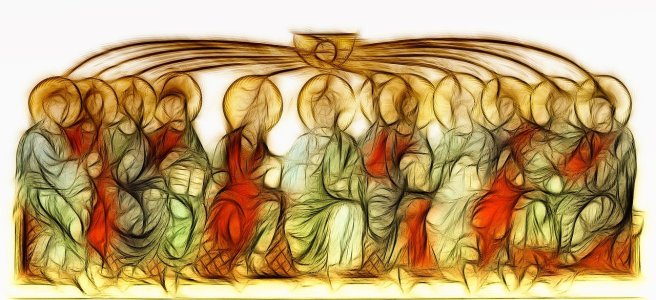
Lord, thank you for the blessing of broken people who give themselves over to you. Amen.