Merry Christmas!

Luke 2:1-20 (NRSV)

In those days a decree went out from Emperor Augustus that all the world should be registered. This was the first registration and was taken while Quirinius was governor of Syria. All went to their own towns to be registered. Joseph also went from the town of Nazareth in Galilee to Judea, to the city of David called Bethlehem, because he was descended from the house and family of David. He went to be registered with Mary, to whom he was engaged and who was expecting a child. While they were there, the time came for her to deliver her child. And she gave birth to her firstborn son and wrapped him in bands of cloth, and laid him in a manger, because there was no place for them in the inn.

In that region there were shepherds living in the fields, keeping watch over their flock by night. Then an angel of the Lord stood before them, and the glory of the Lord shone around them, and they were terrified. But the angel said to them, “Do not be afraid; for see—I am bringing you good news of great joy for all the people: to you is born this day in the city of David a Savior, who is the Messiah, the Lord. This will be a sign for you: you will find a child wrapped in bands of cloth and lying in a manger.” And suddenly there was with the angel a multitude of the heavenly host, praising God and saying,

“Glory to God in the highest heaven,
    and on earth peace among those whom he favors!”

When the angels had left them and gone into heaven, the shepherds said to one another, “Let us go now to Bethlehem and see this thing that has taken place, which the Lord has made known to us.” So they went with haste and found Mary and Joseph, and the child lying in the manger. When they saw this, they made known what had been told them about this child; and all who heard it were amazed at what the shepherds told them. But Mary treasured all these words and pondered them in her heart. The shepherds returned, glorifying and praising God for all they had heard and seen, as it had been told them.

Getting Christmas

John 1:1-5

In the beginning was the Word, and the Word was with God, and the Word was God. He was in the beginning with God. All things came into being through him, and without him not one thing came into being. What has come into being in him was life, and the life was the light of all people. The light shines in the darkness, and the darkness did not overcome it.


If we are able to pause here and “get it,” we’ll have a proper understanding of the meaning of Christmas. I’ll be the first to admit, however, that these can seem like dense and lofty words.

In short, Jesus is God. Yes, we sometimes call him the “Son of God,” recognizing he is as fully human as he is divine. But he is God, and the divine aspect of Jesus has always existed—before the birth in Bethlehem and the manger, before the virgin conception, even before the universe and time existed.

If you agree with this assertion about Jesus, you are Christian in a scriptural, orthodox sense.

If you disagree, you stand outside that traditional understanding, even if you call yourself Christian. You at a minimum disregard or modify key portions of Scripture, particularly the early chapters of John.

This aspect or essence of God is called the “Word” in most English versions of John. “Word” is a translation of the Greek word “logos,” used by philosophers of the day to describe God’s wisdom. This logos was believed to hold the universe together, like stitches giving cloth its shape.

“And the Word became flesh and lived among us,” John 1:14 asserts, “and we have seen his glory, the glory as of a father’s only son, full of grace and truth.”

The power that made all things and holds all things together lived in this world as one of us, an event we call the incarnation. We call this God-man Jesus Christ, and he surprised us with much of what he said and did, like forgiving his enemies and dying among criminals on a cross.

As we move through Christmas toward Easter, we will once again watch how Jesus lived and hear what Jesus taught. We should be constantly mindful that in doing so, we are experiencing a kind of wisdom far deeper than anything that could be contrived by human minds.

If we get it, we may find Christmas and much of the rest of the Christian year to be a serious challenge to how we live.

Lord, what a remarkable truth, that you came among us to teach us, love us, call us to obedience and die for our sins. This Christmas, may we celebrate well that moment of arrival. Amen.

God’s Stepfather

Poor Joseph, husband of Mary and earthly step-dad to the son of God. Even today, his situation seems awkward, what with God placing a baby directly in the womb of his wife-to-be.

It had to be embarrassing for him. We can tell from the first chapter of Matthew, where we find an account of how Jesus’ birth came about.

When Joseph discovered Mary was pregnant, he initially planned “to dismiss her quietly,” knowing he had not touched her in anything resembling an intimate way, but assuming some other man had.

And even after an angel told him the child was the direct work of the Holy Spirit, the circumstances still had to be embarrassing. People would have noticed Mary’s pregnancy was out of sync with her marriage to Joseph.

The gossip mongers would have speculated on some ugly possibilities: Maybe Mary was in love with some village boy. Maybe she was raped by a Roman soldier. Maybe Joseph couldn’t control himself until the wedding night.

Joseph doesn’t need our pity, however. People face such quandaries from time to time, situations where what is right before God may not look right before the world. We should all hope to handle such dilemmas as well as Joseph.

Matthew describes Joseph as a “righteous” man, but we can miss just how righteous he was. He proved himself to have the kind of righteousness Jesus would talk about as an adult, a “Sermon on the Mount” kind of goodness about him.

That righteousness was in Joseph even before the angel came to him in a dream. You would think that a man who believed he had been made a cuckold would lash out. It’s surprising he didn’t embarrass Mary and her family, and perhaps even demand serious punishment for what was a crime in their society.

Yes, as a righteous Jew, Joseph would have known the Jewish law and how it worked to his advantage. But he also seems to have understood that the root of the law is love. Thus, the plan to dismiss her quietly.

I’m reminded of Jesus’ teachings that occurred more than three decades later. He would begin a lesson with, “You have heard that it was said,” and finish by demonstrating how the law actually calls us to sacrificial levels of love for God and neighbor.

And that superbly righteous behavior continued after the angel came. Having awakened from his dream, Joseph leaped into immediate action.

He took Mary as his wife, and proceeded to follow God’s instructions. He obediently let God use him as a trustworthy tool, one capable of keeping the Christ child out of the reach of murderous kings.

In Joseph, we see a righteous and obedient man for every age, a model for those who would follow God regardless of what the world thinks.

Lord, thank you for the remnants of righteousness, the ones who were able to take part in your great plan to save humanity from sin. Amen.

The God Bearer

It’s time to think about Mary, Mother of Jesus Christ, which means it’s time to think big about faith and courage.

God chose Mary, it seems, because she had the right soul for the task. She was young, but Luke 1:46-55 records her remarkable understanding of the meaning of Christ’s coming.

“My soul magnifies the Lord, and my spirit rejoices in God my Savior, for he has looked with favor on the lowliness of his servant,” Mary said. She was rejoicing with her much older cousin Elizabeth, who carried in her womb John the Baptist, the prophet who would announce the coming of Jesus’ ministry in adulthood.

As Mary continued in her prophetic rejoicing, she laid out the radical mission of Christ. He brings mercy to those who believe and follow God. He scatters the proud. He brings down the powerful. He lifts up the lowly and the hungry. He does all of this as a fulfillment of a promise made to the world through Abraham long ago.

Christ is, in a word, revolutionary.

Governments and armies still seem to have power, but none can help you establish a relationship with God. At best, they can keep the relationship freely available. Christ on the cross is what changes everything for us.

Mary’s song also serves as a call for us to magnify the Lord. The baby in her womb would reveal God’s nature to all. As the body of Christ on earth today, Christians similarly exhibit God’s Spirit to a hurting world.

Oh, to magnify the Lord in every moment of our lives, to allow revolution to occur in every choice we make. It isn’t easy, of course.

Fortunately, the baby who grew to be a man and live out his mother’s prophecies did not shrink from the difficult task of the cross. May God grant us similar courage in this season.

Lord, thank you for turning the world upside down. Help us to live as people who believe the change is real and ongoing. Amen.

Love

The last of the four Advent themes is love. If we were detectives, we might say, “Now we’ve found the motive!”

The motive, that is, for everything God does. The principle is laid out for us in 1 John 4:7-11:

Beloved, let us love one another, for love is from God, and whoever loves has been born of God and knows God. Anyone who does not love does not know God, because God is love. In this the love of God was made manifest among us, that God sent his only Son into the world, so that we might live through him. In this is love, not that we have loved God but that he loved us and sent his Son to be the propitiation for our sins. Beloved, if God so loved us, we also ought to love one another.

Why would God unilaterally decide to come among us and save us from our sins, suffering as Christ to give us hope, peace and joy? It was an act of undeserved, unreserved love. Love exists because God exists, and love is integral to God’s being, God’s nature.

The circumstances could be different. We’ve imagined gods completely lacking in love, disinterested, dismissive or even hostile toward human beings. But the One True God is driven by love.

Even when God chastises us, it is a loving act, one designed to bring us into alignment with our creator. When we walk with God, we walk toward life. When we walk away from God, we walk toward death.

God loves us so much he wants to dwell among us. God did this in flesh, as Jesus Christ, carrying out the work necessary to save us from our sins. He resides in us and among us now, as the Holy Spirit. And he will dwell among us in full.

I think I’m about ready to celebrate the incarnation—Christmas!

Lord, sometimes we simply need to stop and give thanks for who you are. We are blessed to be the creation of a loving being, one who looks out for us eternally. Thank you for the love shown to us on the cross. Amen.

Joy

Yesterday, I mentioned how biblical peace describes the current relationship between God and humanity, a state made possible by Jesus’ sacrifice on the cross. Bliss is a perfectly appropriate response to that peace.

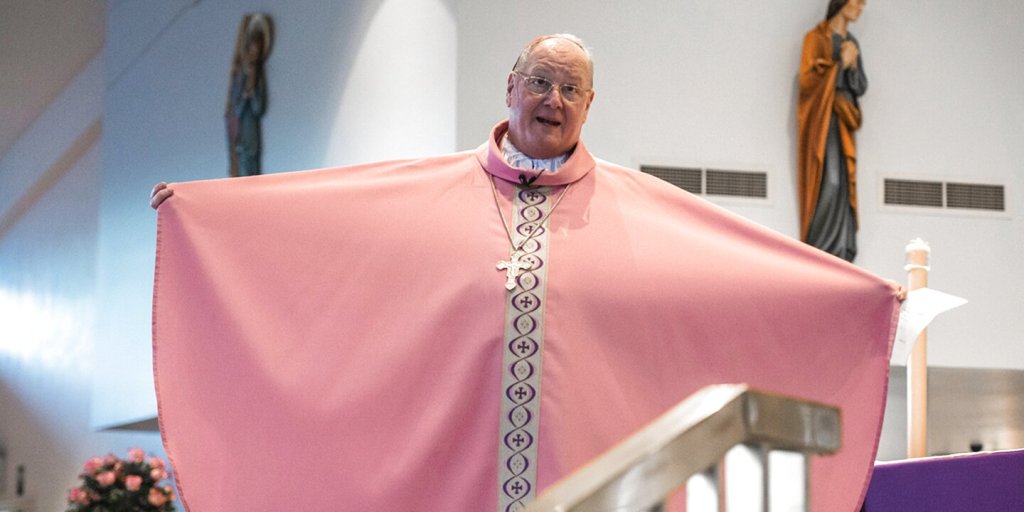
There is a more exuberant emotion, too, the third theme of Advent. There is joy! It is so important, many churches use a pink- or rose-colored candle to mark the third Sunday of Advent. In some traditions the clergy even wear matching vestments, like these:

Just in case you’re wondering, I don’t want to wear that.

I do, however, want to celebrate joy! And when we talk about biblical joy, we mean an emotion that resides in us in all circumstances, even when we are experiencing what otherwise might be thought of as “bad times.”

“Rejoice in the Lord always; again, I will say, rejoice,” Paul told the church at Philippi. (Philippians 4:4.)

Why? Think what we have been given:

Eternal life!

The promise that all that has gone wrong, is going wrong and will go wrong will be made right.

The experience of God in this life, now.

Therein lies our joy. We are able to look at any negative situation and say, “You know what? That has already been defeated.”

Lord, may our experience of joy be as emotional as it is intellectual. And again, may others see in us what you are offering them. Amen.

Peace

Romans 5:1: “Therefore, since we have been justified by faith, we have peace with God through our Lord Jesus Christ.”

Let’s continue exploring the four big themes of the season of Advent. Today, we will consider the concept of peace.

When we talk about biblical peace, we don’t just mean a feeling of bliss. Biblical peace is more akin to peace between nations that have been at war. When they agree to peace, they end hostilities and seek new possibilities for their relationship.

Through his sacrifice, Jesus ended the state of war between God and humanity. Humans brought on this terrible situation by sinning against God, creating a state of unholiness that called for our destruction. Through Jesus Christ, God made a unilateral offering of peace, restoring our ability to relate to our creator.

To accept the offer, we simply look to the cross and believe, accepting that the work done there is complete and irrevocable.

Now, don’t get me wrong, a state of peace does also bring a feeling of bliss. The threat of destruction is removed.

In terms of emotional responses, there’s more, too. But that’s for tomorrow.

Lord, thank you for the tremendous offer of peace made to us when you had all the power and divine privilege. Amen.

Hope

For the rest of this week, let’s consider the four themes of the Advent season—hope, peace, joy and love—which are usually captured in readings during the lighting of candles on the Advent wreath each Sunday.

As odd as it might seem, Romans 5:1-4 ties hope among the believers to suffering:

“Therefore, since we have been justified by faith, we have peace with God through our Lord Jesus Christ. Through him we have also obtained access by faith into this grace in which we stand, and we rejoice in hope of the glory of God. Not only that, but we rejoice in our sufferings, knowing that suffering produces endurance, and endurance produces character, and character produces hope, and hope does not put us to shame, because God’s love has been poured into our hearts through the Holy Spirit who has been given to us.”

I find it helpful to realize that suffering can have a point, so long as we continue in our faith that God’s promises have come true and will continue to come true.

Whatever we are experiencing, we learn to say in stronger and more authoritative ways, “Yes, this situation is bad, but it is temporary. God has promised that evil and all of its effects will be overcome.”

The light at the end of the tunnel isn’t a train. There’s no trick in store for us. The light of Christ is bearing down on us, coming to our rescue.

Hope also serves as a great evangelism tool. When people look at a Christian and say, “I want what that person has,” odds are the believer is exhibiting hope. People long to know that there is a potential happy ending to every story, and they particularly want to know how to ensure they can take part in that ending.

It is the basic role of every Christian to project hope where people may find themselves in despair. Where will we demonstrate hope today?

Lord, we don’t like to suffer, but thank you for being there in the midst of suffering, helping us to turn it into something good on behalf of your kingdom. Amen.