Troubled Church

By Chuck Griffin
LifeTalk Editor

1 Corinthians 6:1-11 serves as an excellent reminder of how far churches can drift from their reason for existing.

It is a very old problem, reminding us of the lament in Ecclesiastes 1:9-11. “History merely repeats itself. It has all been done before. Nothing under the sun is truly new. Sometimes people say, ‘Here is something new!’ But actually it is old, nothing is ever truly new.”

The young church in Corinth was troubled, although probably no more troubled than large portions of the American church are today, constantly struggling with the secular pressures around them. Gordon Fee, in his 1987 commentary “The First Epistle to the Corinthians,” wrote that the Corinth of Paul’s day “was at once the New York, Los Angeles and Las Vegas of the ancient world.”

Paul was blunt about how the Christians in Corinth kept jumping with both feet back into the world, rather than living as people bound together in Christian discipleship. They sued each other when they had disputes—Paul said it would be better for them to accept injustice than to provide such a poor witness about the church to nonbelievers.

Paul also left a list of sins, many of them sexual in nature, that were creeping into the church from the world.

Paul was making a straightforward point. The church should be different. We should be distinguishable from what is going on around us. Once we blend into the part of our culture that does not acknowledge Jesus Christ as Lord and Savior, our ability to act as witnesses to Christ’s redeeming, life-change work in the world vanishes.

We should not cut ourselves off from the world—Jesus’ mandate for the church at the end of Matthew makes that clear. But the holy nature of the church, which is dependent on the holy nature of the individuals within, has to be maintained.

We are the primary way the Holy Spirit is at work to move the world toward a complete relationship with God. We are to permeate the world, not vice versa.

As church members, it’s good to always be asking, “How different are we from the world? Do we stand together in holy ways, changing our own lives and then the people around us?”

Lord knows, we need more people willing to treat the church as their primary, life-altering community, studying God’s word together, worshiping together, and holding one another accountable in loving ways. Do that as a church, and others will notice.

Lord, where we are weak, give us a renewed vision of what it means to be a church. Amen.

Healing and Belief

By Chuck Griffin
LifeTalk Editor

Matthew 8:1-13

Like yesterday, I hope you’re clicking the Scripture link and taking time to absorb some powerful stories about faith and healing. Also like yesterday, our verses reference leprosy and a soldier who desires something from God.

Today we are in the New Testament, and Jesus Christ, Lord and Savior, provides the healing, a foreshadowing of the healing he later would offer all the world on the cross.

Two key points from the story of the leper who comes seeking healing:

First, the man, an outcast from society because of his disease, phrases his request with a particular nuance: “If you are willing, you can heal me and make me clean.” The leper makes clear his understanding that he is subject to the will of God, seen at work in Jesus, whom we understand to be God in flesh. The leper’s hope is that God has a loving, restorative character—that he is the kind of God who wants to overcome sickness in the world, which is part of the brokenness of creation caused by human sin.

Jesus’ response brings us to the second point. Not only is he willing to grant healing, he touches the leper in doing so. This technically should have rendered Jesus unclean. It is a powerful gesture, one reminding us of just how personally God engaged with humanity to make eternal healing possible. The cross later would bring far greater shame and humiliation than this ritual uncleanliness.

The second story, the one about the soldier who seeks healing for a beloved servant, reminds us of the immediate power of straightforward faith. In short, the officer, drawing on his military background, makes an assertion.  Just say the word, and it will happen, Jesus. Even our savior is astonished.

In other places in the gospels, Jesus talks about the power of having the tiniest bit of faith. We can, however, be gifted early in life with an unusually confident faith—or over time, we can grow into such confidence as we live our lives with God more and more.

Such faith seems to bring astonishing results. What an incentive to walk daily with God!

Lord, meet us in the faith we have, and through the presence of your Holy Spirit, grow us in our faith so we may better join in the work of your present and growing kingdom. Amen.

Too Easy

By Chuck Griffin
LifeTalk Editor

2 Kings 5:1-14 (NLT)

I hope you’ve taken a few moments to read the above story of two kings, a slave girl, a powerful leper named Naaman, and a healing so simple that Naaman almost refused to accept a life-changing gift from God.

I think of this story as the Old Testament preparing us for New Testament grace. I’ve known people who actually refused to accept Christ as Savior because they thought the path to salvation sounded too easy, like religious pablum spooned out to calm the masses.

According to the 2 Kings story, the Prophet Elisha didn’t even bother to go outside his house when Naaman the Great arrived with his entourage. Instead, Elisha sent a servant out to tell the army commander to wash seven times in the Jordan River, and he would be healed.

Easy peasy!

Naaman was suspicious, though. He was very specific in describing what he had expected to happen.

“I thought he would certainly come out to meet me!” he said. “I expected him to wave his hand over the leprosy and call on the name of the Lord his God and heal me! Aren’t the rivers of Damascus, the Abana and the Pharpar, better than any of the rivers of Israel? Why shouldn’t I wash in them and be healed?”

Arrogance, preconceived notions, and a little ethnocentrism all got in the way. He almost walked away in a huff from a healing. He was blessed to be surrounded by trusted advisers who convinced him to give the prophet’s offer a try.

I’m no Elisha, but if you’re spiritually broken, let me offer you similarly simple advice. Believe Christ died on the cross to save you. You will be healed of your brokenness, your pain and your shame.

That’s it. Believe. Trust. At that point, you will be made right with God. If you’ve not been baptized, you’ll also want to be washed in the water.

You will still have to think through your new situation. You’ll have to work through some complications. Naaman had to do all that. Humbled and grateful, he decided to focus on worshiping in the right way. He also had to learn to navigate the worldliness around him while honoring the God who had healed him.

That’s all very doable, though. Trust me.

Lord, thank you for making salvation simple. We know it was not easy for Jesus; he did the work, he had to bear the pain. Let us never forget the price he paid so we may have access to healing and eternal life. Amen.

Prayer of Ascent

By Chuck Griffin
LifeTalk Editor

I try not to dwell on Covid-19 day after day in these devotionals. The pandemic is serious and it is often on our minds, but I hope to keep the message of Jesus Christ ahead of all other messages, regardless of our circumstances.

If you follow the daily lectionary, however, you might notice that the readings for today, Tuesday and Wednesday use the same psalm reading, Psalm 130. I’m hoping we can join together and pray this psalm over three days as a cry for relief from this disease.

Covid-19 is not as devastating as many plagues and famines experienced through history, but its effects are certainly bad enough, and it is wise to root ourselves in the same prayerful attitude as our spiritual ancestors.

As you read through this psalm, along with a little commentary I’m providing, hold in your hearts a request for a miracle. We seek a powerful, global sign from God as Covid-19 is driven out of our lives globally.

A song for pilgrims ascending to Jerusalem.

The psalm’s heading places us on a spiritual journey. I know we have work, school, doctors’ appointments and such—even with our world partially shut down, we remain such busy people. But can we adopt the pilgrim mindset for just a few days? Can we make our own ascent toward a holy place, toward a shared memory of Christ on the cross?

All three days, let’s take a few extra moments to settle into a time of quiet, saying to ourselves, “Right now, even if it’s only in my imagination, I’m going up to see the one who saves the world.”

From the depths of despair, O Lord,
    I call for your help.
Hear my cry, O Lord.
    Pay attention to my prayer.

This is a fervent petition, one lifted by a broken people, a people who have seen the troubling effects of their own sins and the broad effects of sin on the world. As we pray, we should be like the Canaanite woman in Sunday’s Gospel reading, desperately persistent, trusting that the tiniest crumbs of grace will make all the difference.

Lord, if you kept a record of our sins,
    who, O Lord, could ever survive?
But you offer forgiveness,
    that we might learn to fear you.

As Christians, we have a particular understanding of how this forgiveness is granted. See that cross; see the weight of the world’s sins on Christ’s shoulders. The record of our sins is expunged, and we undeservedly are found to be holy and worthy of eternal life with God. The stone is rolled away from the tomb, the resurrection is proof! Sin and death are defeated! Finding ourselves in a renewed relationship with God, we know all kinds of restoration are possible now.

I am counting on the Lord;
    yes, I am counting on him.
    I have put my hope in his word.
I long for the Lord
    more than sentries long for the dawn,
    yes, more than sentries long for the dawn.

Knowing what has been done for us, we should experience a deep longing for the Lord. In his word, recorded in his Scripture, we are able to discern right from wrong, and we simultaneously begin to see a bare outline of what a remarkable experience it must be to live in the full light of God.

Let’s root our longing for healing from Covid-19 in that deeper longing to be in the full presence of the risen Savior. And let us trust that dawn is coming—that the long night will end.

O Israel, hope in the Lord;
    for with the Lord there is unfailing love.
    His redemption overflows.
He himself will redeem Israel
    from every kind of sin.

Lord, Covid-19 is a sign of the world’s brokenness. As you drive it away, may we also see a clear sign of your unfailing love and your desire for our redemption, and may we have the courage to declare what we see. Amen.

Candy Kingdom

By Chuck Griffin
LifeTalk Editor

lot of people hate the advertising on their web browsers, but I’ve been unusually happy with mine the last few days. Earlier in the week, a relative was trying to remember what a circus peanut looks like, so I searched for a picture of one on my phone.

The software that pokes around in my browser took note that I had an interest in candy. Now I’m getting ads for candy of all kinds. My web pages regularly come decorated with bright jelly beans, gumdrops, gummy bears, nonpareils, and of course, circus peanuts in pink, yellow, white and classic orange.

I’m so happy with this result, I make sure I click on the ads from time to time, just so they will continue popping up. Thanks, Criteo!

Last night, I was showing my wife an unusually pretty offering of brightly colored “fruit slice” jelly candies for sale. It reminded me of the sleeve of fruit slices my mother would buy me at the candy counter in Sears before we went to a movie.

“Remember how candy was a very serious, very important subject when we were kids?” I asked my wife. “As I get older, I realize just how right we were.”

I know: Waistline, risk of diabetes, tooth decay, etc. But those concerns aside, there is simple joy—bright primary colors, explosive flavors, the heady rush of sugar. They all draw you very much into the present moment.

And being a pastor, I’m reminded of Jesus’ words in Mark 10:14-15: “Let the children come to me. Don’t stop them! For the Kingdom of God belongs to those who are like these children. I tell you the truth, anyone who doesn’t receive the Kingdom of God like a child will never enter it.”

The Kingdom of God is, after all, the sweetest truth. This broken world can really hurt us, but there’s a new way dawning, an eternal life free from the havoc wrought by sin, and we can taste that new life now. When we sense the Kingdom of God breaking into this world—perhaps in a song, a story, or a relationship—that moment can be a real rush, and we naturally want more.

Christianity is exhilarating stuff, and like a child, we should take what we’re being offered very seriously.

Lord, thank you for those moments when your plan becomes so evident, all we can do is smile. Amen.

Being Immediate

By Chuck Griffin
LifeTalk Editor

Revelation 15:1-4 (NLT)

Then I saw in heaven another marvelous event of great significance. Seven angels were holding the seven last plagues, which would bring God’s wrath to completion. I saw before me what seemed to be a glass sea mixed with fire. And on it stood all the people who had been victorious over the beast and his statue and the number representing his name. They were all holding harps that God had given them. And they were singing the song of Moses, the servant of God, and the song of the Lamb:

“Great and marvelous are your works,
    O Lord God, the Almighty.
Just and true are your ways,
    O King of the nations.
Who will not fear you, Lord,
    and glorify your name?
    For you alone are holy.
All nations will come and worship before you,
    for your righteous deeds have been revealed.”

When exploring ideas about the end of time, thoughtful Christians have to piece together a lot of Scripture from various books of the Bible.

As we see in today’s text and the verses further into Revelation, we are promised there will be an end to the influence of evil, a completion of Christ’s work on the cross. Sin and death have already been defanged by Jesus’ sacrifice, but they still have to be put down completely, rabid dogs of Satan that they are.

Much of the Book of Revelation is highly symbolic, the images depicting events in the past, present and future. Complicating interpretation further, the reader’s perspective in Revelation keeps changing between heaven and earth.

As we study and process what is written there, one conclusion seems certain to me. We should sense a responsibility to let people know that heaven and earth will be remade one day, for the better, after terrible birth pangs. God is very much at work in the world.

Simultaneously, we should understand that we cannot know with any real certainty the what, where and who of Revelation, the apocalyptic sections of the Book of Daniel, or other biblical references to the last days, and we certainly cannot know the when.

“No one knows when these things will happen, not even the angels in heaven or the Son himself,” Jesus said. “Only the Father knows.” (Matthew 24:36.)

To process and live out what we are taught about the end times, I find it useful to cling to “immediacy,” the idea that God’s redemptive work in this world could end and Christ could return at any moment.

In the same section of Matthew, Jesus’ words continue:

When the Son of Man returns, it will be like it was in Noah’s day. In those days before the flood, the people were enjoying banquets and parties and weddings right up to the time Noah entered his boat. People didn’t realize what was going to happen until the flood came and swept them all away. That is the way it will be when the Son of Man comes.

Matthew 24:37-39

I think it’s dangerous when people claim certain events have to happen before Christ returns in full—even as believers, we can be lulled into apathy by such thoughts. The Apostle Peter had this in mind when he wrote, “Stay alert! Watch out for your great enemy, the devil. He prowls around like a roaring lion, looking for someone to devour.” (1 Peter 5:8.)

A proper understanding of our own mortality should also give us a sense of immediacy about conforming to the will of God. None of us truly knows whether a particular day might be our last. We tend to imagine observing the end of days with an earthly view, when there’s a significant chance we will have a very different perspective.

So, what to do? Well, today’s text has one image that should give us inspiration and joy. This side of heaven or the other, let’s be sure that first, we are praising God, who through Jesus Christ has saved us from what should have been the eternal grip of sin and death.

Let’s praise God here on earth with our voices and whatever musical instruments we may have on hand, just as we will praise him one day in a new heaven and earth. Perhaps we will even lift these praises with harps in hands, standing on something like a brilliant sea of fire-imbued glass.

Lord, let today be about you, and then let each day that follows be the same. Amen.


Website image courtesy FantasyStock at fantasystock@deviantart.com.

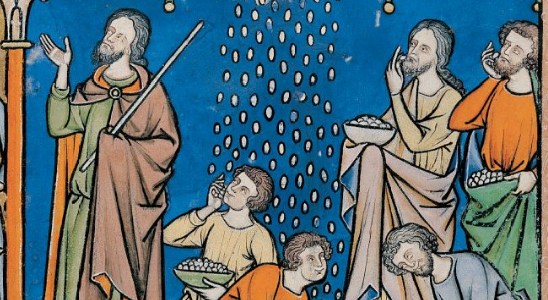
The Meaning of Manna

By Chuck Griffin
LifeTalk Editor

Exodus 16:1-8 (NLT)

God gave the Israelites a lot of signs and miracles in Egypt and on their way out of Egypt—plagues on their captors, a pillar of cloud and fire to lead and guard their exit, the parting of the Red Sea and the drowning of the Egyptian army. We might think they would have been ready to trust God once in the desert. Trust faded as soon as they got really hungry, however.

God faithfully responded with the promise of provision. The Israelites didn’t even need to carry food with them on their journey. Instead, food rained down as quail and manna, described as a substance that makes me think of Frosted Flakes. (I like cereal, so my interpretation may be biased.)

The lesson was simple: God will provide. In fact, God wanted the Israelites to go to bed every night trusting his provision would be there for them the next day—no long-term planning needed on this journey. There was work to be done in the gathering of the food, but they always had enough. The weekly exception was when God sent them enough food for two days in anticipation of the Sabbath. God also wanted them to rest!

God still seeks the same kind of trust from us today. Pray this prayer with me: “Our father, who art in heaven, hallowed be thy name. Thy kingdom come, thy will be done, on earth as it is in heaven. Give us this day our daily bread … .” Stop right there just a second.

Do we mean it? Do we live it? What does it mean to live as if we trust our bread will come on a daily basis?

The idea certainly conflicts with our 401K/pension plan/Roth IRA mindsets. We’re taught to store provisions for use 40 years or more into the future, with all of that planning affecting when we can retire. We’re sometimes even left with the strange concern that we might live too long, running out of money in the process. Can we reconcile these two very different world views?

As I ponder this, I’m first reminded of one of Jesus’ parables. He begins telling it at Luke 12:16:

“A rich man had a fertile farm that produced fine crops. He said to himself, ‘What should I do? I don’t have room for all my crops.’ Then he said, ‘I know! I’ll tear down my barns and build bigger ones. Then I’ll have room enough to store all my wheat and other goods. And I’ll sit back and say to myself, ‘My friend, you have enough stored away for years to come. Now take it easy! Eat, drink, and be merry!’

“But God said to him, ‘You fool! You will die this very night. Then who will get everything you worked for?’

“Yes, a person is a fool to store up earthly wealth but not have a rich relationship with God.”

Then, turning to his disciples, Jesus said, “That is why I tell you not to worry about everyday life—whether you have enough food to eat or enough clothes to wear.”

Luke 12:16-22 (NLT)

As bad as his hoarding was, the rich man’s real problem was the way he deluded himself about how much control he had, in the process failing to understand his basic relationship to God.

Preparation is prudent, but we should never let go of this basic truth: We don’t control the future. Planning  and stored provisions cannot eliminate our need for God.

There also is the issue of how we use the resources we are given. Do we live as if this life is the only one that counts? Or do we live as people who believe something greater is happening? After all, we believe that God’s kingdom is truly arriving, and that the kingdom is where we store our true treasures and live out eternity.

John Wesley had a sermon, “The Danger of Riches,” that explained his idea of how to balance proper planning and trust in God. (Wesley was working from 1 Timothy 6:9.)

In the sermon, Wesley said that God provides for the roof over our heads, food, and other basic needs. We should even save to ensure the well-being of our families and businesses we may own. Beyond those provisions, everything we are given counts as riches, and they have been given to us to use “to the glory of God.” Often, this means using our riches to help those who are less blessed materially, playing a role in God’s provision for people’s basic needs.

Even for a tither, this is a concept that requires thought. It forces a reassessment of every decision we make regarding how we handle our income and possessions, simply because we learn to say, “It’s not really mine, anyway.”

When we learn to make decisions about money and other resources in the light of God’s dawning kingdom, we not only trust God daily, we begin to participate actively in the kingdom’s growth. We let God work through us so others see their daily bread arrive.

When all Christians adopt such an attitude, God’s presence will be as visible in this world as a pillar of cloud in the sky and manna on the ground.

Lord, give us this day our daily bread, and let us be content with your gracious provisions. Amen.

The Well-Guarded Path

By Chuck Griffin
LifeTalk Editor

Psalm 1 (NRSV)

Happy are those
   who do not follow the advice of the wicked,
or take the path that sinners tread,
   or sit in the seat of scoffers;

but their delight is in the law of the Lord,
   and on his law they meditate day and night.

They are like trees
   planted by streams of water,
which yield their fruit in its season,
   and their leaves do not wither.
In all that they do, they prosper.
The wicked are not so,
   but are like chaff that the wind drives away.

Therefore the wicked will not stand in the judgment,
   nor sinners in the congregation of the righteous;

for the Lord watches over the way of the righteous,
   but the way of the wicked will perish.

Understand God’s will and live according to it, and you will find joy, prospering in all you do. Ignore God’s will, and life will be misery and loss. It is a classic theme of wisdom literature from the Near East.

On the surface, these are beautiful ideas, concepts that fit our desire for justice. Without further development, though, they can at times seem quite empty.

If Psalm 1 represented the only theme of Scripture, I would have long ago discarded my study of the Bible. The idea being expressed does not consistently match the reality of what we observe.

Too often, seemingly good people suffer. Too often, the wicked flourish. Fortunately, Psalm 1 is just one part of an elaborate picture.

The Book of Job is an equally ancient piece of wisdom literature, and it takes us in a whole different direction. You may remember the story of Job. As it begins, he fits the pattern described in Psalm 1. He is a righteous man, walking with God and prospering mightily in terms of family and wealth.

The problem arises when Satan goes to God and speculates that Job is righteous simply because life is so good for him. Let me strike at him, Satan says, and Job will curse you, God. First, Satan is allowed to strike Job’s possessions and family. Later he’s allowed to strike at Job himself, afflicting him with terrible diseases.

In all of this, Job does not curse God, and he does not relent in his assertion to friends that he has done nothing wrong. He does complain mightily at times, though, and once he begins, he moves beyond his own problems and complains about how the wicked flourish and abuse the righteous, including orphans and widows, and God seems to do nothing.

You reach a story like Job’s in Scripture, and you realize the Bible deals with some very deep subjects. We may not find satisfying answers in Job to these deep questions about evil’s persistence, but at least the questions are asked. (There is a hint in Job 19 regarding the answer to come centuries later.)

This is why it is so important for us to engage with the Bible continually throughout our lives. If we hear what seem like simple stories and lessons as children, but never return to the Bible as we experience more complex lives, we will think Scripture is irrelevant. And in the process, we will miss so much that is useful as we grow older.

When Jesus arrives in the Bible story, his teachings help us wrestle with the deeper questions while simultaneously emphasizing the early truths we have learned.

Parables are a good example. Jesus uses them to perplex us until we ponder for a while, and in pondering we discover powerful new truths. Through Jesus, we learn that God loves us in ways the Jews had scarcely imagined. God pours out on the world what seems, from our perspective, to be a most illogical love, a love unearned and undeserved.

At the same time, Jesus teaches us to never let go of what we learned from the start. We are to come to God with the faith of a child.

Thanks to Jesus’ sacrifice on the cross, it is possible for us to be placed on God’s holy path simply by believing. That alone is enough to align us with God. We are made righteous and good even though we don’t deserve these labels, and all we have to do is remain firmly planted in the grace God offers. And by the way, in the end, right and wrong will be sorted out.

Psalm 1 is true. It simply needs to be read in the context of the whole Bible story.

Lord, may we rest in a secure understanding that you are the source of righteousness, and then live accordingly. Amen.

Keep Reading

By Chuck Griffin
LifeTalk Editor

Psalm 149 (NLT)

Praise the Lord!

Sing to the Lord a new song.
    Sing his praises in the assembly of the faithful.

O Israel, rejoice in your Maker.
    O people of Jerusalem, exult in your King.
Praise his name with dancing,
    accompanied by tambourine and harp.
For the Lord delights in his people;
    he crowns the humble with victory.
Let the faithful rejoice that he honors them.
    Let them sing for joy as they lie on their beds.

What a lovely little psalm. There is singing and dancing, the air alive with the sound of instruments. Day and night, the people rejoice. The psalm continues, too!

Let the praises of God be in their mouths,
    and a sharp sword in their hands—
to execute vengeance on the nations
    and punishment on the peoples,
to bind their kings with shackles
    and their leaders with iron chains,
to execute the judgment written against them.
    This is the glorious privilege of his faithful ones.

Praise the Lord!

Hmmmm. Suddenly, Psalm 149 is a little less lovely. Swords, shackles and vengeance bring a kind of darkness to this psalm we might not have expected.

The Bible is full of sudden turns like this. A lot of devotionals and sermons deal with these startling disparities simply by stopping short, ending the selection of verses before the disturbance brought on by the new thought begins. I understand why—for the sake of brevity, and in an effort to get one clear point across without muddying the devotional or sermon too much, stopping short is sometimes necessary.

We still need, however, to learn to deal with these incongruities, so we are better equipped as believers to help seekers who naturally may be put off by such passages.

Perspective is important. Remember, these texts are very old, meaning they were written in a time when a lot of our ideas about what constitutes civilized behavior had yet to develop. The psalm we’re reading today is at least 2,500 years old, and maybe older.

Understanding this, we’re starting in the wrong place if we critique these texts from a modern viewpoint. Texts like our psalm carry within them what were at the time new revelations about how God’s people should relate to their creator and to one another.

Many of those ideas grew to become the basis of what we now think of as modern, civilized behavior. We should not be critical of the people who first began to comprehend revelations of God’s holiness and God’s desire to save a remnant from the effects of sin.

As Isaac Newton said, “If I have seen further than others, it is by standing on the shoulders of giants.”

When Jesus came on the scene centuries after this psalm to expand our understanding of God’s love and grace, he was not afraid to draw on what had been taught through his Jewish culture thus far. God is over all things and above all things. God redeems his people, and Jesus came as God in flesh to prove this point.

And yet, even in gentle Jesus’ teachings, it is clear that what is opposed to God ultimately will face God’s wrath. God has never wavered on that point.

Jesus used a metaphorical sword, and he expected us to pick it up and use it against the enemies of God. I am talking about speaking the truth of who God is and what God is doing through Jesus Christ to restore a broken world. This truth cuts through the political machinations and outright lies of the worldly nations.

This “sword of truth” imagery is most vivid in the final book of the Bible, Revelation, where the author has a vision of Christ completing his work in the world.

“Then I saw heaven opened, and a white horse was standing there. Its rider was named Faithful and True, for he judges fairly and wages a righteous war. His eyes were like flames of fire, and on his head were many crowns. A name was written on him that no one understood except himself. He wore a robe dipped in blood, and his title was the Word of God. The armies of heaven, dressed in the finest of pure white linen, followed him on white horses. From his mouth came a sharp sword to strike down the nations. He will rule them with an iron rod. He will release the fierce wrath of God, the Almighty, like juice flowing from a winepress. On his robe at his thigh was written this title: King of all kings and Lord of all lords.” (Revelation 19:11-16.)

The ancient Israelites felt called to take up their swords and impose shackles in obedience to God, delivering primitive lessons about holiness in what we now consider primitive times. We are called to do similar work with restorative words and sacrificial acts, following Jesus’ lead as the bringer of truth. And God’s truth shall reign.

Lord, thank you for the revelations you have given humanity about your nature since before recorded history began. May the truth of Jesus Christ as Lord and Savior be evident to all very soon. Amen.

Snakes, Stones and the Answer Is No

By Chuck Griffin
LifeTalk Editor

Matthew 7:7-11 (NLT)

“Keep on asking, and you will receive what you ask for. Keep on seeking, and you will find. Keep on knocking, and the door will be opened to you. For everyone who asks, receives. Everyone who seeks, finds. And to everyone who knocks, the door will be opened.

“You parents—if your children ask for a loaf of bread, do you give them a stone instead? Or if they ask for a fish, do you give them a snake? Of course not! So if you sinful people know how to give good gifts to your children, how much more will your heavenly Father give good gifts to those who ask him.”


If we’ve ever asked God for something and not received what we wanted, we might struggle a little with Jesus’ words. But we have to ask ourselves—do we always know what’s good for us?

Something cannot be good if it is not aligned with God’s will. It would be ridiculous for us to expect God to fulfill requests that go against his larger plan. If we accept that as true, suddenly the “no” we receive in prayer is as valuable as any “yes.” The “no” gives us a clearer understanding of God’s will, which I think is one of the major purposes of prayer.

If God were to grant a bad request, I would be very concerned for the recipient. It would mean God has finally tired of prayers raised in a “My will be done” manner, rather than the recommended “Thy will be done.” It can never be a good thing for God to say, “Fine. Your will be done.”

Hey, that might be the basis for how hell works.

The bread/stone-fish/snake example makes clear how Jesus’ “keep on asking” recommendation is rooted in the concept of goodness. The children in the example are asking correctly, and the parents, flawed as they are, respond correctly.

It is possible for children to ask incorrectly, of course. Had the children asked for a stone or a snake to eat, good parents would have automatically said no, even if the children were certain they needed stones or snakes for dinner. (If this is getting too far afield from reality, or simply unappetizing, think about jawbreakers and gummy worms, instead.) And once the children grew up a little, they likely would be grateful their parents were so wise.

I think these verses become easier to understand as we age. It helps to be able to look back on our lives, remember what we wanted decades ago, and then give thanks to God we did not receive all the stones and snakes we thought were attractive.

Lord, as we pray, attune us more closely to your desire for our lives. And thanks for watching over us even when we’re a little stupid. Amen.