He Is Risen!

John 20:1-23 (New Living Translation)

Early on Sunday morning, while it was still dark, Mary Magdalene came to the tomb and found that the stone had been rolled away from the entrance. She ran and found Simon Peter and the other disciple, the one whom Jesus loved. She said, “They have taken the Lord’s body out of the tomb, and we don’t know where they have put him!”

Peter and the other disciple started out for the tomb. They were both running, but the other disciple outran Peter and reached the tomb first. He stooped and looked in and saw the linen wrappings lying there, but he didn’t go in. Then Simon Peter arrived and went inside. He also noticed the linen wrappings lying there, while the cloth that had covered Jesus’ head was folded up and lying apart from the other wrappings. Then the disciple who had reached the tomb first also went in, and he saw and believed— for until then they still hadn’t understood the Scriptures that said Jesus must rise from the dead. Then they went home.

Mary was standing outside the tomb crying, and as she wept, she stooped and looked in. She saw two white-robed angels, one sitting at the head and the other at the foot of the place where the body of Jesus had been lying. “Dear woman, why are you crying?” the angels asked her.

“Because they have taken away my Lord,” she replied, “and I don’t know where they have put him.”

She turned to leave and saw someone standing there. It was Jesus, but she didn’t recognize him. “Dear woman, why are you crying?” Jesus asked her. “Who are you looking for?”

She thought he was the gardener. “Sir,” she said, “if you have taken him away, tell me where you have put him, and I will go and get him.”

“Mary!” Jesus said.

She turned to him and cried out, “Rabboni!” (which is Hebrew for “Teacher”).

“Don’t cling to me,” Jesus said, “for I haven’t yet ascended to the Father. But go find my brothers and tell them, ‘I am ascending to my Father and your Father, to my God and your God.’”

Mary Magdalene found the disciples and told them, “I have seen the Lord!” Then she gave them his message.

That Sunday evening the disciples were meeting behind locked doors because they were afraid of the Jewish leaders. Suddenly, Jesus was standing there among them! “Peace be with you,” he said. As he spoke, he showed them the wounds in his hands and his side. They were filled with joy when they saw the Lord! Again he said, “Peace be with you. As the Father has sent me, so I am sending you.” Then he breathed on them and said, “Receive the Holy Spirit. If you forgive anyone’s sins, they are forgiven. If you do not forgive them, they are not forgiven.”
The Grace of Good Friday

Thursday: What Matters


Wednesday: The One Who Betrays


Tuesday: A Deep Truth


Over-the-Top Monday


Good Friday

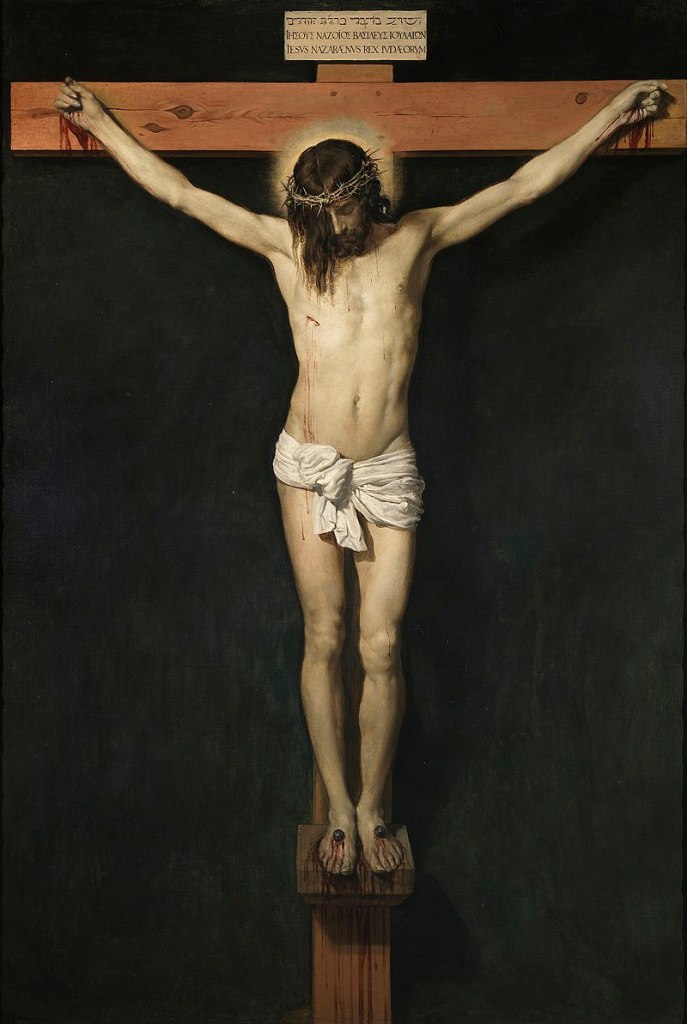
“Jesus Christ Crucified,” Diego Velázquez, 17th century.

Now it gets deeply serious. Today is about Jesus’ suffering and death, the events that make eternal life for us possible. We again will use our pattern of daily prayer to sink deeper into this powerful story.

Morning

Praise: See how very much our Father loves us, for he calls us his children, and that is what we are! (1 John 3:1.) He loves us so much that he would send his Son, God in flesh, to die for our sins, bearing the punishment we deserve. As much as we can, let’s consider for a few moments what an incredible gift we have been given—eternal life rather than death, which is eternal separation from this grand and glorious love.

Praise God from whom all blessings flow; praise him all creatures here below; praise him above ye heavenly host; praise Father, Son and Holy Ghost! Amen.

Confession: We know we have fallen short of God’s expectations, failing to follow his will for us and in the process, committing sins. Let’s take time to search ourselves and confess those sins, today bringing them before a cross we know to have been soaked in our Savior’s blood. Those of us who take part in a Good Friday service should have powerful reminders of the work done on our behalf.

Time in Scripture: John, Chapters 18 and 19.

Noon

Take time to recite the Lord’s Prayer. Because of the season we are in, it also is a good time to consider the words of the Apostles’ Creed.

Night

If you’re not able to attend an evening Good Friday service, try to find some time for meditative quiet, listening to what God has to say.

Holy (Maundy) Thursday

Easter approaches, but as we wrap up this season of Lent, we want to be sure we are appropriately absorbing what makes the celebration of Christ’s resurrection possible. First, we have to walk with our Savior as he moves through suffering and death.

If you have lost the pattern of prayer we rehearsed together last September and during the season of Advent, today and tomorrow are good days to try to recover them.

Morning

Praise: Let’s first take time to consider who God is and acknowledge that truth appropriately. He is Creator, Savior and Comforter, revealed to us as Father, Son and Holy Spirit. Let’s praise God for the love poured out on us! Let’s also give thanks for the blessings we can see in our lives. Try to say a few out loud.

Confession: We know we have fallen short of God’s expectations, failing to follow his will for us and in the process, committing sins. Let’s take time to search ourselves and confess those sins. Those of us who take part in a Holy Thursday communion service tonight will find ourselves better prepared for that experience as we confess and remember this: Because we believe in Christ’s work on the cross, we are forgiven!

Time in Scripture: John 13 (NLT). Again, those of us in a Holy Thursday service are likely to hear this story tonight. Jesus teaches much simply through his actions; how do we imitate him?

Noon

Take time to recite the Lord’s Prayer. Because of the season we are in, it also is a good time to consider the words of the Apostles’ Creed.

Night

If you’re not able to attend an evening Holy Thursday service, try to find some time for meditative quiet, listening to what God has to say.

Cheering a Slave

Let’s prepare ourselves for a shift in the Lenten season. If you’re in a worship service this Sunday, you likely will hear a story that moves us into “Holy Week,” a chance to walk toward the cross with Jesus.

We are about to arrive at Palm Sunday, the Sunday before Easter. The main point of Palm Sunday is to remember Jesus’ final entry into Jerusalem, the trip taking him toward death on a cross.

Crowds cheered Jesus as he rode along, hailing him as a conquering king. In our Palm Sunday worship, we mimic them, singing “Hosanna!” and waving palm fronds. (Luke 19:28-40 and John 12:12-15 record this celebration.)

The scene in Jerusalem was a raucous one, a rally in danger of becoming a revolt against the Promised Land’s Roman rulers. But let’s try to shift our viewpoint a little, looking into Christ’s mind as he traveled through the crowd.

In the second chapter of Philippians, the Apostle Paul wrote about this entry-into-Jerusalem moment and the days that followed, when Jesus made our salvation possible.

“Let the same mind be in you that was in Christ Jesus, who, though he was in the form of God, did not regard equality with God as something to be exploited, but emptied himself, taking the form of a slave, being born in human likeness,” Paul wrote. “And being found in human form, he humbled himself and became obedient to the point of death—even death on a cross.”

The people hailed Jesus as a king, and indeed, he had more power available to him than any earthly leader has ever held. In Matthew 26, which contains one record of Jesus’ arrest, he stops his followers from resisting the soldiers and police by noting he could call down 12 legions of angels if he wanted to do so.

But this power did not go to his head; in fact, Jesus understood the use of such power to be counterproductive where salvation was concerned. Only a perfect sacrifice could save humanity from sin and death.

As Jesus rode by the people along the road entering Jerusalem, they unknowingly cheered a slave, one who had completely submitted himself to the horror to come. He did this for our sakes, of course, expressing a kind of love that is hard to comprehend.

From this story, with a little help from Paul, we learn what it means to be a Christian with power, be it power in a big setting, like a nation, or a small setting, like an office. As Paul wrote, we need to carry within us the mind of Christ, living sacrificially for others.

There’s also a lesson here about assuming knowledge of other people’s motives. A lot of backbiting seems to begin with phrases like, “I know why he did that” or “I know what she was thinking.”

Actually, you don’t. One of the hardest things to understand is another person’s motivation.

Those palm-waving crowds certainly didn’t understand what was in Jesus’ mind. That’s why they abandoned him when he didn’t behave as they thought he should, using power to establish a worldly throne.

As you prepare for worship this Sunday, pay close attention to how people exercise power around you or in the broader world. How would our world be different if people mimicked the mind of Christ as they wielded power?

Surprisingly Simple

In this Lenten season, we’ll call this “Back to Basics Day.” Let’s begin by considering exactly what Abram (later to be called Abraham) gave up when he listened to God and moved toward an unspecified land.

This initial call in Genesis 12:1-4 is written in a rather matter-of-fact tone, but the risk must have seemed huge for an aging man. He had property and people around him, including slaves, the mark of a comfortable, wealthy man. We don’t know how long Abram had been in Haran—we only know his father Terah had moved the family from far-away Ur some time earlier—but as the family had been able to grow their wealth while there, we can assume life in Haran had been good for them.

Now Abram was to pack his family and possessions and make a journey that ultimately would prove to be more than 500 miles, about the same distance as walking from from Upper East Tennessee to Jacksonville, Fla. For them, it was a dangerous month-long one-way trip, assuming the animals in their caravan were in good shape. A return visit to Haran or the true family homeplace, Ur, might be a once-in-a-lifetime event, perhaps when someone needed a bride of proper bloodlines.

And yet, Abram went, without question, without comment. He would have questions later, but not in this initial act of faith, this huge, trusting leap toward God.

It’s easy to get caught up in what Abram did rather than focusing on the importance of what was in his heart. The Apostle Paul uses Abram in the fourth chapter of Romans to illustrate that it’s the trust we exhibit that saves us, not any work we do. When God sees we trust him, he goes ahead and calls us righteous, even though we don’t deserve it. Paul made clear he was talking about the God we know best through Jesus Christ, the one who made all things and then restored all things to holiness despite sin.

So, we’re invited to a simple act of faith. But at the same time, we’re also called to remember that it’s so simple it can be confusing, particularly for the uninitiated. When we’ve turned away from God and are caught up in sin, we feel like we’re trapped in that Harry Potter hedge maze, the one where the turns and dead-ends seem endless and the roots and branches grab at us. We have to figure the maze out, right? To survive, we have to beat back what entangles us, right?

Wrong. All we really have to do is look up and say, “Lord Jesus, I believe you can pluck me out of this.”

In the third chapter of John’s gospel, we see the Pharisee Nicodemus desperately wanting to follow Jesus, but at the same time struggling in his rigid, legalistic mind with how to do so. Accept what is from above, Jesus told him. Trust God. Trust God’s love for his creation.

“For God so loved the world that he gave his only Son, so that everyone who believes in him may not perish but may have eternal life,” Jesus said. And then came the real kicker, particularly for a legalist striving to make himself righteous: “Indeed, God did not send the Son into the world to condemn the world, but in order that the world might be saved through him.”

What, God doesn’t seek to punish us first? I don’t have to clean up my act to accept God’s gift of salvation?

We have Nicodemus types around us, perhaps even among us in church. They want to make that first step toward God much more difficult than it is, trying to resolve personal angst and the global problem of evil in one fell swoop. Often, they expect a requirement to crawl at least halfway back toward the one they’ve offended before being accepted.

As Christians, our job is to keep simple what can be misunderstood as complicated. The God of Abraham, the God who walked among us and died for our sins, loves us. He’s been reaching down to humanity for thousands of years and continues to do so today.

Sure, once we accept God’s offer, there’s more to do. It’s only natural that we want a developing, continuing relationship with the one who gives us eternal life in place of death. We pray, we study, we joyfully respond to his simple requests, the first being, “Go and tell others.”

That initial act of accepting God’s outstretched loving hand remains simple, however.