Into 2021!

John 3:16 (NLT)

For God loved the world so much that he gave his one and only Son, so that everyone who believes in him will not perish but have eternal life.


If there’s anything we’ve learned from 2020, it’s that we have no idea what a year might have in store for us. With one exception.

I have no insight regarding when the pandemic will end. I do have high hopes for the vaccine, and I’m praying for something resembling normal worship during the Easter season. (Easter Sunday will be April 4.)

I’m also praying that wonderful events during 2021 will lift us up globally. Perhaps a powerful outbreak of the Holy Spirit, another true Great Awakening regarding Jesus Christ’s work in this world? I would so like to see that happen.

About that exception I mentioned: I can promise you this, the grace poured out on us by God will remain available. It has remained available in 2020, and it will always be available, until we turn off the calendar and simply stand before God in full, rejoicing and worshiping our savior into eternity.

By “grace,” I mean the love God continually shows us despite the fact we do not deserve it. It is a great, continuous gift, one we simply have to agree to receive.

Grace is available even before people acknowledge God exists. It tugs at us; it exists as a feeling there is more to life than what we simply see.

Grace washes over us and into us at the moment we accept Jesus Christ as Lord and Savior. From then on, grace changes us, as much as we allow the Holy Spirit to work in our lives.

Based on the truth of ever-present grace, I can say that 2021 will be an important, powerful year. People will find Jesus Christ and eternal life through simple belief. People will grow to be more like what God would have them be.

Any more good news will simply be additional evidence of how much God loves us.

Have a blessed, grace-filled 2021!

We Are Family

Matthew 12:46-50

While [Jesus] was still speaking to the crowds, his mother and his brothers were standing outside, wanting to speak to him. Someone told him, “Look, your mother and your brothers are standing outside, wanting to speak to you.” But to the one who had told him this, Jesus replied, “Who is my mother, and who are my brothers?” And pointing to his disciples, he said, “Here are my mother and my brothers! For whoever does the will of my Father in heaven is my brother and sister and mother.”


The fifth of the Ten Commandments is, “Honor your father and mother.” When we remember how important family is in Jewish culture, Jesus’ above statement becomes more startling.

Family was important to Jesus, of course. He was an obedient child; likewise, as he was dying on the cross, bearing the burden of the sins of the world, one of his concerns was who would care for his mother.

As important as family is, however, there is a greater concern. Even family cannot interfere in our relationship with God. Walking with God, understanding God and following God’s will are the most challenging and critical activities in our lives.

It can be tough when God’s will for us is out of alignment with what the family wants. I will always remember a little girl in the Czech Republic who learned in Vacation Bible School the story of Jesus’ suffering, death and resurrection. She lived in a nation with a shockingly high percentage of committed atheists, a vestige of communist rule.

Having learned how to tell the story on her own, she said, “I will tell my family. But it will make my grandmother very angry.” The interpreter and I teared up simultaneously.

Jesus knew such conflict would arise when he said, “Do you think that I have come to bring peace to the earth? No, I tell you, but rather division! From now on five in one household will be divided, three against two and two against three.” (Luke 12:51-52.)

If you and your family are aligned in the pursuit of God’s will through Jesus Christ, know what a tremendous blessing you have. And if you are not so blessed, know that your global family prays for you, and that through your witness, your biological family has hope.

Lord, give special strength and new gifts of the Spirit to those who go about the particularly difficult task of telling non-believing family members the Good News. Amen.

Getting Christmas

John 1:1-5

In the beginning was the Word, and the Word was with God, and the Word was God. He was in the beginning with God. All things came into being through him, and without him not one thing came into being. What has come into being in him was life, and the life was the light of all people. The light shines in the darkness, and the darkness did not overcome it.


If we are able to pause here and “get it,” we’ll have a proper understanding of the meaning of Christmas. I’ll be the first to admit, however, that these can seem like dense and lofty words.

In short, Jesus is God. Yes, we sometimes call him the “Son of God,” recognizing he is as fully human as he is divine. But he is God, and the divine aspect of Jesus has always existed—before the birth in Bethlehem and the manger, before the virgin conception, even before the universe and time existed.

If you agree with this assertion about Jesus, you are Christian in a scriptural, orthodox sense.

If you disagree, you stand outside that traditional understanding, even if you call yourself Christian. You at a minimum disregard or modify key portions of Scripture, particularly the early chapters of John.

This aspect or essence of God is called the “Word” in most English versions of John. “Word” is a translation of the Greek word “logos,” used by philosophers of the day to describe God’s wisdom. This logos was believed to hold the universe together, like stitches giving cloth its shape.

“And the Word became flesh and lived among us,” John 1:14 asserts, “and we have seen his glory, the glory as of a father’s only son, full of grace and truth.”

The power that made all things and holds all things together lived in this world as one of us, an event we call the incarnation. We call this God-man Jesus Christ, and he surprised us with much of what he said and did, like forgiving his enemies and dying among criminals on a cross.

As we move through Christmas toward Easter, we will once again watch how Jesus lived and hear what Jesus taught. We should be constantly mindful that in doing so, we are experiencing a kind of wisdom far deeper than anything that could be contrived by human minds.

If we get it, we may find Christmas and much of the rest of the Christian year to be a serious challenge to how we live.

Lord, what a remarkable truth, that you came among us to teach us, love us, call us to obedience and die for our sins. This Christmas, may we celebrate well that moment of arrival. Amen.

Joy

Yesterday, I mentioned how biblical peace describes the current relationship between God and humanity, a state made possible by Jesus’ sacrifice on the cross. Bliss is a perfectly appropriate response to that peace.

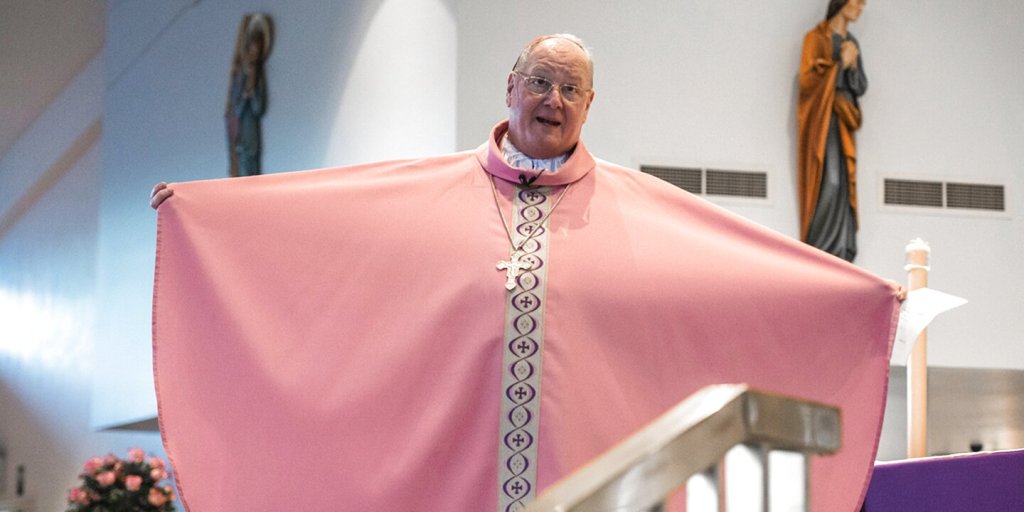
There is a more exuberant emotion, too, the third theme of Advent. There is joy! It is so important, many churches use a pink- or rose-colored candle to mark the third Sunday of Advent. In some traditions the clergy even wear matching vestments, like these:

Just in case you’re wondering, I don’t want to wear that.

I do, however, want to celebrate joy! And when we talk about biblical joy, we mean an emotion that resides in us in all circumstances, even when we are experiencing what otherwise might be thought of as “bad times.”

“Rejoice in the Lord always; again, I will say, rejoice,” Paul told the church at Philippi. (Philippians 4:4.)

Why? Think what we have been given:

Eternal life!

The promise that all that has gone wrong, is going wrong and will go wrong will be made right.

The experience of God in this life, now.

Therein lies our joy. We are able to look at any negative situation and say, “You know what? That has already been defeated.”

Lord, may our experience of joy be as emotional as it is intellectual. And again, may others see in us what you are offering them. Amen.

The God Who Speaks

By Chuck Griffin
LifeTalk Editor

Hebrews 1:1-2 (New Living Translation)

Long ago God spoke many times and in many ways to our ancestors through the prophets. And now in these final days, he has spoken to us through his Son. God promised everything to the Son as an inheritance, and through the Son he created the universe.


These words and what follows in the opening of Hebrews remind us of the astonishing change God wrought in the history of the universe through Jesus Christ.

Even in their sin-soaked brokenness, people had always received at least some indirect word from God. In particular, prophets would arise who would speak on God’s behalf, usually issuing a call to repent, an exhortation to live as God would have them live.

In those prophecies, there also were promises. God said he would provide a way out of sin, an opportunity for otherwise hardened hearts to be softened, beating once again to God’s rhythms rather than the world’s.

In this season of Advent, we move toward celebrating the incarnation, the strange fact that God actually took on flesh and lived among us. Not only that, God came among us not as a king but as a vulnerable, very poor baby, fully experiencing what it means to be human.

How does the Son speak to you? Are you in Matthew, Mark, Luke and John, letting his words challenge and shape you?

Advent is a good season to reconnect with the one who is always available. God continues to speak a new, life-changing truth to all of us.

Over the next few days, try something. Read the first two chapters of each of the gospels. It’s my prayer that starting these stories will renew a desire to hear what the Son has to say.

Lord, thank you for the ongoing blessing of your holy word. We particularly thank you for the penetrating, life-changing words of the Messiah. Amen.

Give Thanks! Exercise 4

Psalm 100

First, meditate for a bit on the Contemporary English Version translation of Psalm 100, linked above.

With Thanksgiving Day tomorrow, let’s circle back to the one whom we thank, and let’s remember again what God has done for us.

John 3:16: “For God so loved the world that He gave His only begotten Son, that whoever believes in Him should not perish but have everlasting life.” (NKJV)

However you may be in contact with others on Thanksgiving Day, it is my prayer that Christ is at the center of your celebration, remembered constantly as the source of your joy!

Life Talk devotionals will resume Monday, Nov. 30, God willing.

Bread Offered Every Day

By Chuck Griffin
LifeTalk Editor

John 6:25-35 (NLT)

They found him on the other side of the lake and asked, “Rabbi, when did you get here?”

Jesus replied, “I tell you the truth, you want to be with me because I fed you, not because you understood the miraculous signs. But don’t be so concerned about perishable things like food. Spend your energy seeking the eternal life that the Son of Man can give you. For God the Father has given me the seal of his approval.”

They replied, “We want to perform God’s works, too. What should we do?”

Jesus told them, “This is the only work God wants from you: Believe in the one he has sent.”

They answered, “Show us a miraculous sign if you want us to believe in you. What can you do? After all, our ancestors ate manna while they journeyed through the wilderness! The Scriptures say, ‘Moses gave them bread from heaven to eat.’”

Jesus said, “I tell you the truth, Moses didn’t give you bread from heaven. My Father did. And now he offers you the true bread from heaven. The true bread of God is the one who comes down from heaven and gives life to the world.”

“Sir,” they said, “give us that bread every day.”

Jesus replied, “I am the bread of life. Whoever comes to me will never be hungry again. Whoever believes in me will never be thirsty.”


You can live for the moment, or you can seek forever in the moment.

The crowds followed Jesus in part because he had demonstrated an ability to provide for their immediate needs. They hoped for ongoing provisions, along the lines of what the Israelites received in the desert for 40 years.

Now, let’s be clear—when people have immediate, pressing needs, it is hard for them to focus on much else. “How will I feed my children?” can be an overwhelming question.

That’s why James wrote, “Suppose you see a brother or sister who has no food or clothing, and you say, ‘Good-bye and have a good day; stay warm and eat well’—but then you don’t give that person any food or clothing. What good does that do?” (James 2:15-16)

For the simple sake of goodness, we are called as Christians to get people beyond worrying about their basic needs. Such relief also directly supports the mission of the church. Where basic needs are met, people can then more easily think about broader concepts, like a relationship with God and salvation.

A lot of this sounds like Maslow’s Hierarchy of Needs. The Bible basically came up with the idea first. Jesus’ Matthean concept of the judgment amounts to a call to lift people out of their day-to-day worries.

Once we’ve acknowledged the basic relief we should provide, we then must stay very conscious of that all-important next step, understanding who we are in relation to God. Having our daily bread, it’s important to move on to a contemplation of the Bread of Life, God’s gift to us.

Through Jesus Christ, we are offered a daily experience of God and his eternally life-altering plan, and once we’re on the way to grasping what this means, we need to invite others to explore and accept salvation, too.

It’s all so exciting, so mind-boggling, that we might even find ourselves forgetting to eat.

Lord, where we see earthly needs, may we respond quickly, and where we see openings to offer your eternal grace, may we move with utmost speed. Amen.

Stairway to Heaven

By Chuck Griffin
LifeTalk Editor

Genesis 28:10-17 (New Living Translation)

Let’s take a few minutes to consider Jacob, Jesus, Led Zeppelin and the chance to have an eternal connection to God.

I would bet that upon reading this devotional’s title, most of you first thought of Led Zeppelin. I’ll go ahead and correct a critical theological error in the group’s most famous song. No matter how much money a lady has, she won’t be buying the stairway to heaven.

If you are wondering what the stairway might look like, Israelite patriarch Jacob got a glimpse of it in a dream, while sleeping against a rock in a place eventually known as Bethel. Angels went up and down the stairway, marking the place as a connection between heaven and earth. At the top of the stairway stood the Lord, who restated promises made decades earlier to Jacob’s father, Isaac, and his grandfather Abraham.

Some of you raised on older English Bible translations may be protesting a bit right now, saying, “No, it was a ladder to heaven.” Many of us also were raised singing, “We are climbing … Jacob’s ladder.”

Either “ladder” or “stairway” works as a translation of the Hebrew word used in the story, which appears just once in Scripture. I like “stairway” better—as I imagine angels simultaneously going up and down, with God standing at the top, a stairway is more like what I see. As a child, I tried to visualize angels going up and down a ladder, and I couldn’t help but wonder if they felt crowded as they passed each other.

But back to Jacob’s dream. My New Living Translation Study Bible has a footnote attached to the story: “The point of the vision was that God and his angels were with Jacob on his journey.”

Jesus must have had that point in mind as he connected his very reason for existing to Jacob’s dream. In John 1:51, we hear Jesus say, “I tell you the truth, you will all see heaven open and the angels of God going up and down on the Son of Man.”

In other words, God wants to be with us on our journeys, just as he was with Jacob. Jesus, God in flesh, is the stairway—because of his work as intermediary we have access to heaven.

God even comes down to us now, in this life! Belief in the effectiveness of Jesus’ death on the cross reconnects us to God, overcoming our sins, and God’s Spirit rushes to accompany us.

It really is incredible that all of this is free for us. Christ paid the price. We simply have to accept the stairway to heaven as our own.

Lord, thank you for the connection you offer us every day of our lives. Help us to use it well, drawing eternity into the lives we live now. Amen.

Stop Shoving

By Chuck Griffin
LifeTalk Editor

Ezekiel 34:17-23 (NLT)

“And as for you, my flock, this is what the Sovereign Lord says to his people: I will judge between one animal of the flock and another, separating the sheep from the goats. Isn’t it enough for you to keep the best of the pastures for yourselves? Must you also trample down the rest? Isn’t it enough for you to drink clear water for yourselves? Must you also muddy the rest with your feet? Why must my flock eat what you have trampled down and drink water you have fouled?

“Therefore, this is what the Sovereign Lord says: I will surely judge between the fat sheep and the scrawny sheep. For you fat sheep pushed and butted and crowded my sick and hungry flock until you scattered them to distant lands. So I will rescue my flock, and they will no longer be abused. I will judge between one animal of the flock and another. And I will set over them one shepherd, my servant David. He will feed them and be a shepherd to them.”


I am guessing that when most of us think of judgment, sheep and goats, we think of Jesus’ words in Matthew 25:31-46. Jesus, however, was expanding on words spoken by a prophet 600 years earlier.

At this point in Ezekiel’s prophecy, God already had condemned the callous “shepherds,” the Israelite kings who failed to care for their people. He then went on with the metaphor, issuing an internal warning to the flock regarding how its members treated one another.

In short, they were shoving and grasping, the strong taking from the weak. There was no care being taken to ensure those most in need had their share of the basics.

All that shuffling and stomping during the hoarding of resources did a lot of damage, too. Where there is hoarding, there often is spoilage, and what could have benefitted others is wasted.

The message is pretty straightforward: Stop shoving and grasping, thinking only of yourself. Look around. To draw from a story in John 5: Who needs help reaching the pool of Bethesda?

In both the Ezekiel prophecy and in Jesus’ teaching, the concern is for the people on the margins of society, the “least of these,” the ones most damaged by the brokenness of the world. And remember, these images are all presented in “last days” judgment style—in Matthew, the lesson is conveyed by the one who will do the judging!

How we treat people pushed to the margins becomes a very serious litmus test for how effectively we have absorbed the idea that Jesus Christ is Lord and Savior. In response to this idea, people have devised a lot of schemes through the centuries regarding what governments should do. Some of those might even be worthwhile strategies.

None of that planning, however, eliminates our responsibility to look around and assess what we need to do as individual Christians. As God says through Ezekiel, “I will judge between one animal of the flock and another.”

Lord, give us eyes to see, ears to hear and a willingness to provide. Amen.

Life and Breath

By Chuck Griffin
LifeTalk Editor

The Bible has a lot to say about the not-so-simple act of breathing. In both the Old Testament and the New Testament, words for “breath,” “wind” and “spirit” overlap.

Genesis 2:7: Then the Lord God formed man from the dust of the ground, and breathed into his nostrils the breath of life; and the man became a living being.

Ezekiel 37:9: Then he said to me, “Prophesy to the breath, prophesy, mortal, and say to the breath: Thus says the Lord God: Come from the four winds, O breath, and breathe upon these slain, that they may live.”

John 20:21-23: Jesus said to them again, “Peace be with you. As the Father has sent me, so I send you.” When he had said this, he breathed on them and said to them, “Receive the Holy Spirit. If you forgive the sins of any, they are forgiven them; if you retain the sins of any, they are retained.”

Acts 2:2-4: And suddenly from heaven there came a sound like the rush of a violent wind, and it filled the entire house where they were sitting. Divided tongues, as of fire, appeared among them, and a tongue rested on each of them. All of them were filled with the Holy Spirit and began to speak in other languages, as the Spirit gave them ability.

It’s pretty obvious that in Scripture, the source of life is God’s breath, which we also might think of as the movement of the Holy Spirit. This ethereal lesson can be lived out in very practical ways, however, particularly in times of stress.

When I’ve taught people under tremendous stress how to pray in a meditative way, the “how to breathe” part of the lesson has been critical. First, you have to position your body so you can breathe. If seated, your back and neck need to be straight, your shoulders squared and hanging from your collarbones as if on coathangers.

From here, “breath prayer” begins to line up with core techniques I’ve learned from decades of martial arts practice, principles recently confirmed in books I’ve read about how soldiers and police survive and control violent, high-stress situations. Breathing is normally automatic, but it can get out of control when the world becomes overwhelming. At such times, we have to take charge of our breathing.

Inhale through your nose deeply, slowly, expanding your lower stomach. Hold at the end of the inhale for a count equal to your time spent inhaling. Exhale through your mouth at the same rate, shrinking and pushing in your lower stomach. At the bottom of the exhale, hold for the same amount of time. Some people who teach this talk about using a “four count” at each stage.

I should warn you, if your heart is racing, if your blood pressure is up, your lungs will fight you at first, particularly as you hold at the bottom of your exhale. But if you’re feeling panicked or anxious, repeating this type of breathing will calm you, center you, and allow you to turn to God.

Biblically, it makes sense. Made in the image of God and granted the Holy Spirit through our belief in Jesus Christ, we have access to the source of life.

Think of deliberate, God-focused breathing as an unspoken prayer request: “God, renew in me what you have poured into the world.”

Peace be with you. Tomorrow, I will try to help you embed this breathing in prayerful Christian meditation.

Lord, we thank you for the life you have breathed into us. May we use our lives to glorify you and to the benefit of your dawning kingdom on earth.