The Power of Stories

By Chuck Griffin
LifeTalk Editor

Psalm 78:1-4

O my people, listen to my instructions.
    Open your ears to what I am saying,
    for I will speak to you in a parable.
I will teach you hidden lessons from our past—
    stories we have heard and known,
    stories our ancestors handed down to us.
We will not hide these truths from our children;
    we will tell the next generation
about the glorious deeds of the Lord,
    about his power and his mighty wonders.

Biblical truth often is communicated in less-than-obvious ways. This piece of Psalm 78 reminds us of the power of stories and our need to wrestle with what we hear in them.

The psalmist says, “I will speak to you in parable.” Christians tend to associate “parable” with the stories Jesus told to reveal an astonishing truth. In today’s psalm, the word has a slightly different meaning, in that the psalmist is referencing historical stories passed from one generation to the next.

The underlying principle is the same, however. We should take those stories, turning them round and round and upside down. We should peer inside of them as deeply as we can. We meditate on them, we chew on them. Our goal is to discover something deeper about God and what God wants for his creation.

I get the sense that average Americans struggle with defining “truth” today. We confuse the search for truth with the acquisition of undisputed facts. As hard as it is these days to come up with an undisputed fact, it is still a much greater challenge to seek truth.

Searching for meaning in the stories of the Israelites and in the stories of Jesus is, I believe, the best way to fathom God and his mysterious love for very sinful humanity.

I can tell you God is merciful, but you’ll remember this truth better if you dwell on the story of the fall in Genesis. Focus in particular on the pause God takes while doling out punishment to show pity for the shivering, terrified, naked humans

I can tell you God loves you and longs for you to return to him, but you’re going to better grasp how deeply God loves you if you spend significant time meditating on the Parable of the Prodigal Son. Look at the story through the eyes of father, son and brother and consider what they feel and why.

I know, this involves us slowing down and truly absorbing a story, a skill we’re losing rapidly in our modern cultural rush. But if you want to deepen your ability to search for truth in Bible stories, I can recommend a couple of books to get you started.

Fairly Simple: Any of the “Parables from the Backside” books by J. Ellsworth Kalas. Dr. Kalas was one of my preaching professors, and he was the master of shifting to an unusual perspective within a familiar story so we can see truth in a new way.

A little more challenging: Henri J.M. Nouwen’s “Return of the Prodigal Son.” Nouwen offers his meditations on a Rembrandt painting depicting the moment the son returns home. This book is considered a modern Christian classic.

Whatever age you are, whatever education you may have, there’s more to be found in the Bible.

Lord, as we explore what you have revealed to us through stories in your holy word, may we find joy, excitement and a deeper sense of purpose. And give us the opportunity to pass on these truths to a new generation. Amen.


✟ To subscribe to LifeTalk devotionals, enter your email address in the box found on any page of the Methodist Life website. ✟
The Precious Present

By Chuck Griffin
LifeTalk Editor

James 4:13-16

Look here, you who say, “Today or tomorrow we are going to a certain town and will stay there a year. We will do business there and make a profit.” How do you know what your life will be like tomorrow? Your life is like the morning fog—it’s here a little while, then it’s gone. What you ought to say is, “If the Lord wants us to, we will live and do this or that.” Otherwise you are boasting about your own pretentious plans, and all such boasting is evil.


The human mind is a remarkable time traveler. Our bodies are always in the present, but our minds easily jump into the future or the past. In fact, it is very difficult to keep our minds perfectly in the present.

That’s not necessarily a problem. Our minds just work that way. Remembrances of the past and visions of the future help us make critical decisions.

If you’ve read all of James’ letter, though, you know that he has a theme regarding how our thoughts and words can reveal our failure to keep God central in our lives. Today’s Scripture reading focuses on the flippant ways we sometimes talk about the future.

Again, a little context helps. James wrote his letter at a time when the rich were very busy planning to get richer while the poor were getting poorer. 

Much like Jesus, James was not being critical of wealth per se. Both warned, however, of the incredible distraction the pursuit of wealth can become when there’s kingdom work to be done.

James took particular note of the merchants of his day, who ran from city to city planning ventures years in advance, with no acknowledgment of their own mortality or need to align with God. Along these same lines, Jesus had told a parable found in Luke 12:13-21, a story aimed more at wealthy, overly comfortable landowners.

There’s a simple, very true cliché that Jesus or James could have used: “You can’t take it with you.” And if you can’t take it with you, why would anyone who believes in God pursue wealth without considering God? As one Christian commentary notes, such a short-sighted attitude is the “sin of arrogant presumption.”

James helps us maintain the right attitude as we plan for the future by giving us a simple phrase to keep in mind: If the Lord wants, followed by whatever we need to say about the future. In the South, we might precede such statements with, “Lord willin’.”

While we naturally talk about the future, the spiritually attuned are deliberate about focusing on the precious present, the holy now. We can go to Scripture now to seek God’s truth. We can pray now, staying with God until we hear from God.

Having dwelled with God in the moment, we then are better equipped to look to the future, letting God’s greater plan shape any visions we may have.

Lord, may we walk with you moment by moment, staying on the path that leads us to eternity with you. Amen.


✟ To subscribe to LifeTalk devotionals, enter your email address in the box found on any page of the Methodist Life website. ✟

Bad to the Bone

By Chuck Griffin
LifeTalk Editor

Romans 3:9-20 (NLT)

One night in my college dorm room I was awake in bed, staring at the ceiling. For some reason my roommate also was awake. Out of the darkness, he asked me, “Chuck, do you think people are basically good or basically evil?”

Remember, I was maybe 20 at the time. My non-pastoral, non-theological answer was, “For crying out loud, Derek, I’m trying to sleep.” Derek has always been persistent, though.

“No, really,” he said. “What do you think? Are we good, or are we bad?”

I drew on the distant memory of a Sunday school lesson and said I suppose people are basically bad—that’s why we need Jesus. Derek seemed unsatisfied, though. He’s always been the kind of guy who looks for good in people.

Judging from our text today, Paul would agree with my answer. Or more accurately, I was in agreement with his, my subconscious vaguely remembering these or similar verses. Making it a satisfactory answer for genuinely curious people takes a little work, though.

“All have turned away,” Paul wrote. “All have become useless. No one does good, not a single one.”

And it’s not just Paul’s opinion. Most of what he writes is a collection of quotes from the Old Testament, the result of his years of Jewish theological training. He quotes from six different psalms and the 56th chapter of Isaiah to make his point.

Every time I hit one of Paul’s discussions of sin, I think of some of the really powerful sermons in history, the kind designed to crush listeners so they would run to the altar, weeping. There is Jonathan Edwards, of course, with that famous sermon many of us were required to read in high school or college, “Sinners in the Hands of an Angry God.” Remember this part?

The God that holds you over the pit of hell, much as one holds a spider, or some loathsome insect over the fire, abhors you, and is dreadfully provoked: his wrath towards you burns like fire; he looks upon you as worthy of nothing else, but to be cast into the fire; he is of purer eyes than to bear to have you in his sight; you are ten thousand times more abominable in his eyes, than the most hateful venomous serpent is in ours. You have offended him infinitely more than ever a stubborn rebel did his prince; and yet it is nothing but his hand that holds you from falling into the fire every moment. It is to be ascribed to nothing else, that you did not go to hell the last night; that you was suffered to awake again in this world, after you closed your eyes to sleep. And there is no other reason to be given, why you have not dropped into hell since you arose in the morning, but that God’s hand has held you up. There is no other reason to be given why you have not gone to hell, since you have sat here in the house of God, provoking his pure eyes by your sinful wicked manner of attending his solemn worship. Yea, there is nothing else that is to be given as a reason why you do not this very moment drop down into hell.

Jonathan Edwards, 1741

One man in attendance at this sermon wrote, “The hearers groaned and shrieked convulsively; and their outcries of distress once drowned the preacher’s voice, and compelled him to make a long pause.” I wonder what it would take to get such a reaction today.

Our own John Wesley, founder of the Methodist movement, was no slouch when it came to fiery sermons, either. In “Original Sin,” Wesley takes the account of the depravity of people in Noah’s day and considers whether modern people are any different. 

In 21st century language, Wesley says we’re not only bad, we are so spiritually broken from birth that we cannot sense how bad we are.

I think this somber message is much more difficult to preach than it was just a few decades ago. As a people, we are becoming more humanist in our thinking every day. By that, I mean there is this undercurrent of thought where people assume the best aspects of being human can eventually overcome the worst aspects.

I have trouble seeing how humanism is actually achieving much, though. The modern world seems able to collapse into a heap of evil rather quickly.

Humanist thinkers also become comfortable with a relative kind of morality, a line of thinking not particularly useful for people seeking a relationship with a perfectly holy God. Moral relativism makes possible thoughts like, “Well, I’m not perfect, but at least I’m better than the creeps I have known and read about.” Jesus has a parable along those lines.

Well preached, this topic should go to a very positive place, however. Relating to God through the sacrifice of Jesus Christ opens us to a healing power we could never find through human means. God intended us to be good, God still wants us to be good, and God has provided a way to goodness.

We begin with belief, and the Holy Spirit guides us from there.

Lord, it is helpful to consider our sins and brokenness. In repenting and following Christ, may we become sources of your goodness in a hurting world. Amen.

The Meaning of Manna

By Chuck Griffin
LifeTalk Editor

Exodus 16:1-8 (NLT)

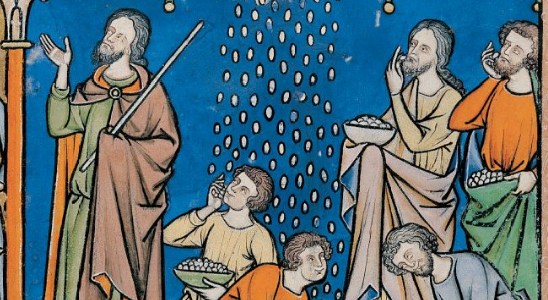
God gave the Israelites a lot of signs and miracles in Egypt and on their way out of Egypt—plagues on their captors, a pillar of cloud and fire to lead and guard their exit, the parting of the Red Sea and the drowning of the Egyptian army. We might think they would have been ready to trust God once in the desert. Trust faded as soon as they got really hungry, however.

God faithfully responded with the promise of provision. The Israelites didn’t even need to carry food with them on their journey. Instead, food rained down as quail and manna, described as a substance that makes me think of Frosted Flakes. (I like cereal, so my interpretation may be biased.)

The lesson was simple: God will provide. In fact, God wanted the Israelites to go to bed every night trusting his provision would be there for them the next day—no long-term planning needed on this journey. There was work to be done in the gathering of the food, but they always had enough. The weekly exception was when God sent them enough food for two days in anticipation of the Sabbath. God also wanted them to rest!

God still seeks the same kind of trust from us today. Pray this prayer with me: “Our father, who art in heaven, hallowed be thy name. Thy kingdom come, thy will be done, on earth as it is in heaven. Give us this day our daily bread … .” Stop right there just a second.

Do we mean it? Do we live it? What does it mean to live as if we trust our bread will come on a daily basis?

The idea certainly conflicts with our 401K/pension plan/Roth IRA mindsets. We’re taught to store provisions for use 40 years or more into the future, with all of that planning affecting when we can retire. We’re sometimes even left with the strange concern that we might live too long, running out of money in the process. Can we reconcile these two very different world views?

As I ponder this, I’m first reminded of one of Jesus’ parables. He begins telling it at Luke 12:16:

“A rich man had a fertile farm that produced fine crops. He said to himself, ‘What should I do? I don’t have room for all my crops.’ Then he said, ‘I know! I’ll tear down my barns and build bigger ones. Then I’ll have room enough to store all my wheat and other goods. And I’ll sit back and say to myself, ‘My friend, you have enough stored away for years to come. Now take it easy! Eat, drink, and be merry!’

“But God said to him, ‘You fool! You will die this very night. Then who will get everything you worked for?’

“Yes, a person is a fool to store up earthly wealth but not have a rich relationship with God.”

Then, turning to his disciples, Jesus said, “That is why I tell you not to worry about everyday life—whether you have enough food to eat or enough clothes to wear.”

Luke 12:16-22 (NLT)

As bad as his hoarding was, the rich man’s real problem was the way he deluded himself about how much control he had, in the process failing to understand his basic relationship to God.

Preparation is prudent, but we should never let go of this basic truth: We don’t control the future. Planning  and stored provisions cannot eliminate our need for God.

There also is the issue of how we use the resources we are given. Do we live as if this life is the only one that counts? Or do we live as people who believe something greater is happening? After all, we believe that God’s kingdom is truly arriving, and that the kingdom is where we store our true treasures and live out eternity.

John Wesley had a sermon, “The Danger of Riches,” that explained his idea of how to balance proper planning and trust in God. (Wesley was working from 1 Timothy 6:9.)

In the sermon, Wesley said that God provides for the roof over our heads, food, and other basic needs. We should even save to ensure the well-being of our families and businesses we may own. Beyond those provisions, everything we are given counts as riches, and they have been given to us to use “to the glory of God.” Often, this means using our riches to help those who are less blessed materially, playing a role in God’s provision for people’s basic needs.

Even for a tither, this is a concept that requires thought. It forces a reassessment of every decision we make regarding how we handle our income and possessions, simply because we learn to say, “It’s not really mine, anyway.”

When we learn to make decisions about money and other resources in the light of God’s dawning kingdom, we not only trust God daily, we begin to participate actively in the kingdom’s growth. We let God work through us so others see their daily bread arrive.

When all Christians adopt such an attitude, God’s presence will be as visible in this world as a pillar of cloud in the sky and manna on the ground.

Lord, give us this day our daily bread, and let us be content with your gracious provisions. Amen.

Psalm 119, Day 1

By Chuck Griffin
LifeTalk Editor

Let’s take a portion of a psalm familiar to many, Psalm 119:105-112, and meditate on it line-by-line for a few days. The first line is the basis of a well-known song, “Thy Word,” written by Amy Grant and Michael W. Smith. They were working from the King James Version; I think I will use one of my favorites, the New Living Translation. I pray the brief thoughts I have will trigger some thoughts of your own.

Your word is a lamp to guide my feet, and a light for my path.

I spend a lot of time emphasizing the importance of Scripture. I feel obligated to do so; too often, the incredible wealth of information about God and God’s plan to rescue humanity from sin is ignored or distorted, despite God’s word being more available now than ever.

Frankly, I’m tired of hearing this sentence, sometimes uttered by churchgoers: “Well, I don’t know what the Bible says about [fill in the blank], but I know what I think.” Christians, we should always base our thinking on what the Bible says. This Spirit-driven revelation goes back not just decades or centuries, but millennia. The most important truths found here are timeless.

I prefer to light what can be a very dark path with a lamp that has proven effective for uncountable generations. Certainly, we can receive a word from God now, through prayer and meditation, or through someone speaking prophetically, filled with the Holy Spirit. But what we hear in those instances will not conflict with what we find in the Holy Bible.

I’ve promised it once, and I’ll promise it again: I will obey your righteous regulations.

As Christians, we have to process this line a little. Obviously, we don’t follow Jewish law to the letter anymore. The bacon cheeseburger I recently had for lunch is proof enough.

We are a people who understand that Jesus Christ focused on the deeper intent of the law, encouraging us to seek a kind of holiness that penetrates our very souls rather than simply restraining our actions. When asked to summarize the law, Jesus made it fairly simple: Love the Lord with all your heart, soul, mind and strength, and love your neighbors as you would love yourself. In the Parable of the Good Samaritan, Jesus also made sure the definition of “neighbor” is quite broad.

We also have to develop the ability to discern the scriptural context of regulations. Were they meant for a specific time and community, or are they universal, tied to the very fabric of God’s creation? We focus upon the latter regulations, of course.

Tomorrow, we’ll consider what this psalm tells us about the burdensome aspects of life.

Lord, may your word guide us this day, and when we find ourselves in the dark, may we boldly explore Scripture for enlightenment. Amen.