In Christ

By John Grimm

Philippians 2:1-4 (NRSV)

If then there is any encouragement in Christ, any consolation from love, any sharing in the Spirit, any compassion and sympathy, make my joy complete: be of the same mind, having the same love, being in full accord and of one mind. Do nothing from selfish ambition or conceit, but in humility regard others as better than yourselves. Let each of you look not to your own interests, but to the interests of others.


I like to have my own personal time of devotion with God.  I need that time to confess sin, hear his forgiveness, and bask in the wonder of God.  My life, however, cannot be only about my own personal time of devotion with God.  For the same Holy Spirit of Christ that resides in me also resides in each disciple of Jesus Christ.

With Christ being in me and my being in Christ, it is reasonable to be in full accord and of one mind with other disciples of Jesus Christ.  This fact assists us in going beyond our own personal agenda, or as Paul writes, we are encouraged to do nothing from selfish ambition or conceit.

Loving others in the body of Christ therefore is not optional nor a strict mandate.  Loving others by looking to the interest of others happens because in Christ we do have consolation from love, we share the Spirit, and we do have compassion and sympathy.  It is in Christ that we do not struggle against other disciples.  It is in Christ that we can will and work for God’s good pleasure (Philippians 2:13).  Thereby, with the Holy Spirit of Christ in us, we live in humility.

Having our own personal time of devotion with God is necessary for our personal faith in Christ.  However, it is when we are with other disciples that our faith and love for Christ is lived.  How good it will be for all disciples to regard other disciples as better than ourselves!

God, thank you that all disciples of Jesus Christ share your Holy Spirit.  As we spend time with you as individuals and as the body of Christ, we look forward to having love, compassion, and sympathy for one another.  Forgive us where we have fallen short of realizing our life together is in Christ.  May we have the mind that Christ has.  In the name of Jesus, we seek to live.  Amen.

Start Right

Psalm 86:8-13 (NRSV)
There is none like you among the gods, O Lord,
    nor are there any works like yours.
All the nations you have made shall come
    and bow down before you, O Lord,
    and shall glorify your name.
For you are great and do wondrous things;
    you alone are God.
Teach me your way, O Lord,
    that I may walk in your truth;
    give me an undivided heart to revere your name.
I give thanks to you, O Lord my God, with my whole heart,
    and I will glorify your name forever.
For great is your steadfast love toward me;
    you have delivered my soul from the depths of Sheol.

When life seems complicated, it is good to lift up a simple prayer. If the news is any indicator, this week could prove to be complicated, so let’s prayerfully turn our eyes toward our wisest guide, as revealed in Psalm 86.

There is none like God. How can anything created be like the one who creates? At best, we can hope to be a reflection of God, an image pointing toward what is holy.

And what is holy will be revealed in full. Despite the turmoil, the striving, and the evil within the nations of the world, all people will one day conform to God’s will. It simply is part of God’s plan.

The greatest and most wondrous thing God has done is to give sinful beings a path home to their creator. We now understand that this reconciliation occurs through Jesus Christ, God Among Us.

In a great, mysterious act of love, Jesus died on the cross, bearing the burden of our sins so we do not have to do so. Simply through our belief in this act, we are restored, made worthy of eternal life in God’s presence.

Teach us, O Lord; help us to put aside what is not of you and live every moment of our lives for you. As we better recognize the incredible gifts you have given us, may we be a people filled with thankfulness, and may you be glorified in all we do.

Lord, carry us through this week and beyond; hear our prayer. Amen.

Giving and Receiving

Proverbs 3:9-10

Honor the Lord with your substance
    and with the first fruits of all your produce;
then your barns will be filled with plenty,
    and your vats will be bursting with wine.

As we launch into the first work week of 2021, let’s think about what we plan to dedicate to the Lord this year, supporting the work of the church.

It’s good to start a new year deliberately praying about how we will participate through our tithes and offerings in the kingdom work that will happen. If we seek guidance from God, we will find clear answers, and from there we can make commitments satisfying to our souls.

In the Old Testament, a “tithe” usually is a reference to 10 percent of what a herd or field produces. That concept, of course, can apply to monetary income, too.

Mainly, I want us to understand the value of thinking in percentages—a percentage commitment can be made before we know for sure what we will receive. Wherever I have led as a pastor, I have encouraged people to write down a percentage commitment early in the year and post it where they will see it regularly, for example, on a bathroom or dresser mirror.

Once you’ve faithfully and bravely done all that, the rest is just a matter of following through.

I have to be careful with what I next say. The above proverb also promises abundance to those who make and keep such commitments. I don’t want to sound like a prosperity gospel televangelist, saying $10 will return to you for every dollar you contribute.

But simultaneously, I will always affirm that a life lived with God, a life where we conform our resources to God’s unselfish plan, is better than a life where we simply look out for ourselves. After all, we live as reflections of the God who rained manna where needed, who turned a few loaves and fishes into great abundance, and who gives us eternal life through the cross.

As we are blessed through our close walk with God, we may even find ourselves making offerings above our basic commitments, if for no other reason than to show gratitude.

Lord, guide us in regard to how we are to use our resources in 2021. We trust we will receive our daily bread; knowing that, we seek to better understand the purpose of any abundance we see. Amen.

Joy

Yesterday, I mentioned how biblical peace describes the current relationship between God and humanity, a state made possible by Jesus’ sacrifice on the cross. Bliss is a perfectly appropriate response to that peace.

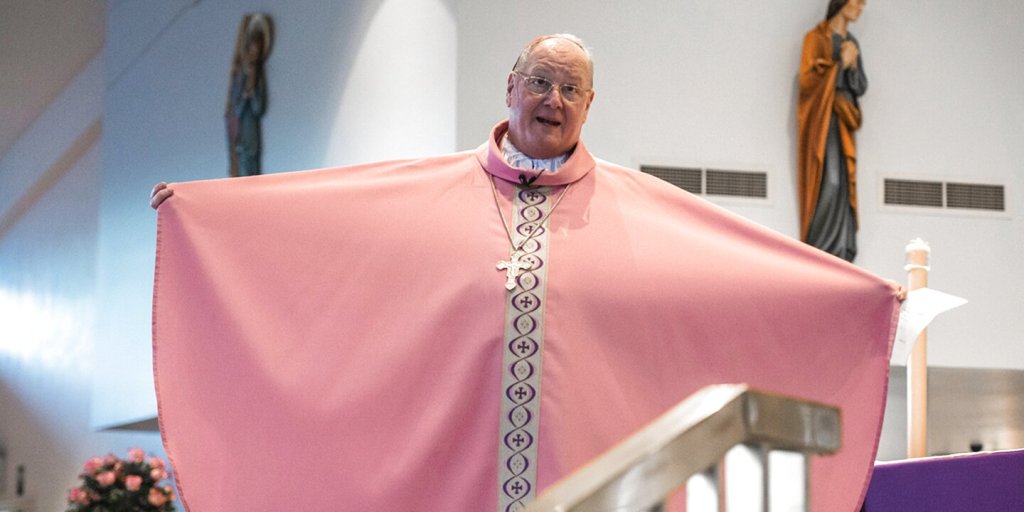
There is a more exuberant emotion, too, the third theme of Advent. There is joy! It is so important, many churches use a pink- or rose-colored candle to mark the third Sunday of Advent. In some traditions the clergy even wear matching vestments, like these:

Just in case you’re wondering, I don’t want to wear that.

I do, however, want to celebrate joy! And when we talk about biblical joy, we mean an emotion that resides in us in all circumstances, even when we are experiencing what otherwise might be thought of as “bad times.”

“Rejoice in the Lord always; again, I will say, rejoice,” Paul told the church at Philippi. (Philippians 4:4.)

Why? Think what we have been given:

Eternal life!

The promise that all that has gone wrong, is going wrong and will go wrong will be made right.

The experience of God in this life, now.

Therein lies our joy. We are able to look at any negative situation and say, “You know what? That has already been defeated.”

Lord, may our experience of joy be as emotional as it is intellectual. And again, may others see in us what you are offering them. Amen.

On to Perfection

Philippians 3:12-16

I don’t mean to say that I have already achieved these things or that I have already reached perfection. But I press on to possess that perfection for which Christ Jesus first possessed me. No, dear brothers and sisters, I have not achieved it, but I focus on this one thing: Forgetting the past and looking forward to what lies ahead, I press on to reach the end of the race and receive the heavenly prize for which God, through Christ Jesus, is calling us.

Let all who are spiritually mature agree on these things. If you disagree on some point, I believe God will make it plain to you. But we must hold on to the progress we have already made.


I was naively drawn to Methodism for very old reasons. The idea that there was a form of Christianity emphasizing continual spiritual growth toward a high standard set by God fascinated me.

I say I was naive because I somehow conflated the historic Methodism of John Wesley with the modern United Methodist Church I joined in my late twenties. Yes, because we developed a traditional understanding of Methodism, my wife and I joined the denomination when we were everything a church wants—young, seeking to be involved, and with small children.

Certainly, vestiges of the Methodism that lured us remain. But it has become obvious that with the formation of the United Methodist Church in 1968, that old, very successful form of Methodism has increasingly been forced to share a tent with people hostile to some of its basic principles. The last 20 years or so have been particularly telling.

The headline on an April 22, 1972, New York Times story about that year’s General Conference, where the fledgling United Methodist Church established its doctrines, clearly identified what would trouble the denomination for the next half-century: “Methodists Back Theological Pluralism.”

Today’s Scripture, and some important words preceding it, lay out what the UMC no longer emphasizes—a burning desire for holiness, including the pursuit of perfection.

If you just pursed your lips and wrinkled your nose, you are struggling with what these terms mean. You may be falling into the stereotype nonbelievers like to apply to church folk: “Those Christians think they are perfect.”

Hardly. Instead, we know we are broken by sin, and that we cannot find healing without God’s help. Given the great gift of salvation by Jesus Christ on the cross, we methodically go about the activities that allow the Holy Spirit to penetrate us more deeply day by day, changing us into the people God would have us be.

For most people, it’s a long process, one God likely will have to complete in us at death. But in this life, we press on, seeing Scripture as a corrective for our broken minds, learning to pray without ceasing, and living in fellowship so we can help each other through the process.

An old Nazarene preacher—the Nazarene denomination is part of the broader, very traditional Methodist movement—once described holiness as our learning to love the way Jesus loves.

Jesus was obedient unto death; Jesus offered love freely. Seems pretty straightforward to me, even if I have yet to perfect it.

Lord, help us to embrace not just salvation, but the tremendous change you are willing to make in our lives as we submit to you. Amen.

Houseful of Servants

By Chuck Griffin
LifeTalk Editor

Matthew 24:45-51
Jesus Discusses the Need To Stay Ready

“A faithful, sensible servant is one to whom the master can give the responsibility of managing his other household servants and feeding them. If the master returns and finds that the servant has done a good job, there will be a reward. I tell you the truth, the master will put that servant in charge of all he owns. But what if the servant is evil and thinks, ‘My master won’t be back for a while,’ and he begins beating the other servants, partying, and getting drunk? The master will return unannounced and unexpected, and he will cut the servant to pieces and assign him a place with the hypocrites. In that place there will be weeping and gnashing of teeth.”


Just in case you’re missing the meaning—we are the servants. In a culture where we have a tendency to exalt ourselves, we can fail to recognize this all-important starting point.

We have hit a place in the cycle of Bible readings where we’re getting daily reminders that our situation is temporary. Christians believe Jesus Christ will return one day to set the world right, restoring holiness and driving away evil. This servant metaphor is embedded in a long section of Matthew where Jesus talks in very apocalyptic tones.

Servants have responsibilities; we are to understand ourselves as being in charge of each other’s well-being. Remember Philippians 2:4? “Look not to your own interests, but to the interests of others.”

In a lot of ways, a narcissist—a psychopathically self-centered person—is the behavioral opposite of the perfect Christian. Most of us fall on a scale somewhere in between these two extremes, and we of course want to be “going on toward perfection,” to use an 18th-century Methodist term.

How will we be found? Caring for others, or obsessively taking care of our own needs and wants?

These are good questions to ask ourselves as we arise each morning. They could very well shape what we do each day!

Lord, help us to look out for those opportunities to support our fellow servants. As we care for each other, we know your household will grow stronger day by day, until the day we see you in full. Amen.

‘Loves To Be the Leader’

By Chuck Griffin
Methodist Life Editor

3 John 9-10

I wrote to the church about this, but Diotrephes, who loves to be the leader, refuses to have anything to do with us. When I come, I will report some of the things he is doing and the evil accusations he is making against us. Not only does he refuse to welcome the traveling teachers, he also tells others not to help them. And when they do help, he puts them out of the church.


Even the early church had to watch out for people who wanted leadership roles for the wrong reasons. Because of this ongoing danger, healthy churches still need to understand the concept of servant leadership.

As the author of John 3 set pen to parchment, it’s unlikely he thought, “I am now going to write what will one day be Scripture.” The letter is personal, written by an experienced Christian to a friend named Gaius. This friend obviously was struggling with developments in his church in Asia Minor, located somewhere in what is now western Turkey.

The letter isn’t long—I would encourage you to take time to read it all. It has memorialized for all time the dangerous leadership of a man named Diotrephes.

Most of us have experienced a Diotrephes at some point. Certain people simply crave power for the sake of power, perhaps to bolster a bruised ego, gain personal glory or benefit materially in some way. They do not understand that leadership, particularly Christian leadership, requires a surrendering of self.

Diotrephes went so far as to drive away people he perceived as a threat to his power, particularly traveling teachers who moved about Asia Minor in a state of poverty. They depended on Christian communities to support them as they preached core truths about Jesus and his sacrifice on the cross. Diotrephes even threw out church members who supported these itinerant Christians.

Not only was Diotrephes proving to be a self-centered leader, he also was violating a basic rule of Christian living, the mandate to show love and hospitality to others.

Diotrephes reminds modern Christians that we should always have some sort of litmus test for potential leaders. It can be difficult to fully understand another person’s motives, but we do have scriptural guidance about qualifications for leaders,* and praying to God for discernment certainly helps.

Boiled down, this discernment could involve questions like, How well does this person seem to know Jesus and the word of God? Have we seen this person bear spiritual fruit? Does this potential leader seem overly eager? Will this person submit to some sort of accountability? Is this person’s call to leadership confirmed by others, and by a willingness to surrender some worldly advantages?

If we see a knowledgeable, committed Christian giving up a lot in order to lead, we can feel more confident we have found a leader with a servant’s heart. 

Only a true calling can make a person say, “I must become less so Jesus can become more.”

Lord, we find ourselves in a crisis of leadership in churches and in so many other institutions. Raise up more humble servant leaders so your work may be done. Amen.


*Regarding the 1 Timothy text linked above: Some denominations, citing the patriarchal language here and in other texts, restrict women’s leadership roles, while other denominations do not. I see this as an example of Paul being very context-specific about a situation very different from our present day. In other writings, Paul asserts the equality of men and women and even addresses some women as leaders and vocal bearers of the Good News.

Finish with Flourish

By Chuck Griffin
LifeTalk Editor

Philippians 3:13-14:1 (NLT)

No, dear brothers and sisters, I have not achieved it, but I focus on this one thing: Forgetting the past and looking forward to what lies ahead, I press on to reach the end of the race and receive the heavenly prize for which God, through Christ Jesus, is calling us.

Let all who are spiritually mature agree on these things. If you disagree on some point, I believe God will make it plain to you. But we must hold on to the progress we have already made.

Dear brothers and sisters, pattern your lives after mine, and learn from those who follow our example. For I have told you often before, and I say it again with tears in my eyes, that there are many whose conduct shows they are really enemies of the cross of Christ. They are headed for destruction. Their god is their appetite, they brag about shameful things, and they think only about this life here on earth. But we are citizens of heaven, where the Lord Jesus Christ lives. And we are eagerly waiting for him to return as our Savior. He will take our weak mortal bodies and change them into glorious bodies like his own, using the same power with which he will bring everything under his control.

Therefore, my dear brothers and sisters, stay true to the Lord. I love you and long to see you, dear friends, for you are my joy and the crown I receive for my work.


Yesterday’s devotional focused on the big ending, the “last days,” the end of time—and those who don’t live as if it is coming. Today’s Bible passage invites us to think about our own personal finish.

Paul’s message is aimed squarely at those who already have accepted Christ and are (or should be) seeking holy “perfection,” something Paul said he had not achieved himself. Salvation through Jesus Christ is given freely, but it’s evident in Paul’s writings and in other epistles that some Holy Spirit-inspired striving is to be a continuing part of the Christian life.

I think of the effort we make as the thank-you notes to God we write with our lives. The more we live and love as Jesus did, the nicer the notes become through the years.

And certainly, we don’t want to slip backward in our beliefs or behavior. What we understood early in our faith walk is just as true now: Jesus Christ is Lord. His teachings and the teachings that continued to flow through his early followers remain true, passed to us through Scripture.

We may grow spiritually, but we never grow out of following and espousing core Christian truths. They are the stones upon which we build, not clay to be molded into new shapes.

Even in Paul’s day, people in the church sometimes believed they had become so worldly wise over the years that they could move beyond the basic idea that Jesus Christ died for our sins, and that as our savior he has certain expectations for our lives.

Sadly, they had actually fallen from their early, supernaturally inspired faith, posing a danger to newer Christians around them.

Finish well. Others are watching. And never forget, the finish line is the beginning of a greater experience.

Lord, may we always trust in the Christian truths first revealed to us, and may we never reach an age where we say, “I am done growing in Christ.” Amen.

Thankful for Each Other

By Chuck Griffin
LifeTalk Editor

Philippians 1:3-14 (NLT)

People who have not read Paul closely like to label him as severe, but I get the sense he had a warm, fuzzy feeling when he wrote today’s text.

I get what he’s saying. Short of gaining eternal life, the biggest reward of being a Christian is developing close relationships with sisters and brothers in Christ. Sometimes we want to pause, think for a minute about who has been with us along the journey, and say thanks.

Thanks to the guys my age who created space for me to be the more relaxed version of myself, and not just “Pastor Chuck.” I never want to be unholy, but it’s nice when I don’t have to be on guard.

I’ve had people tell me they think pastors shouldn’t have friends in the church. Bull-oney. Maybe if you want the pastor to die a premature death.

Thanks to those of you who walked into my office with puzzled looks on your faces and said, “I was praying, and felt I was supposed to say something to you.” I can count all of you on one hand.

My particular favorite is the fellow who had a very direct word from God, and when he finished, he loudly declared, “I have no idea what that means.”

I heard with great clarity what God was saying through each of you, even if you did not understand your words. Some of you encouraged me, some of you brought discernment, and Mr. I Have No Idea pulled me back from the precipice of a bad decision about to be made in frustration.

Unwitting prophets are in this world, and I remain astonished.

Thanks to all of you who spent so much time teaching my children about Jesus and walking with them through difficult times, times where they needed to be able to talk frankly with someone other than Mom and Pastor Dad.

Thanks to all of you who are mindful about showing kindness—gifts from the garden, precious notes, and acts of service to make life easier, for example.

To borrow from Paul, you have a special place in my heart, and I pray that the Holy Spirit fills you and sanctifies you more each day. I know that word of Jesus Christ as Lord and Savior spreads because of you.

Lord, give us eyes to see what life would be like without you and the community of Christians where we reside. Having seen, let us rejoice in what we have. Amen.


✟ To subscribe to LifeTalk devotionals, enter your email address in the box found on any page of the Methodist Life website. ✟

Means of Grace, Day 2

By Chuck Griffin
Editor, LifeTalk

Philippians 4:6 (NLT): Don’t worry about anything; instead, pray about everything. Tell God what you need, and thank him for all he has done.

Like Scripture, prayer is an extremely broad subject. Again, we are talking about a many-layered discipline, one with more depth to it than we can hope to explore in a lifetime.

Prayer takes time, and that causes us to shy away from a deep commitment to it. And yet, prayer also seems to interact with time in mysterious ways, making other moments more fruitful.

In one of his great sermons, “Degrees of Power Attending the Gospel,” C.H. Spurgeon spoke in 1865  of how important the “spirit of prayerfulness” was in his church, Metropolitan Tabernacle in London.

“Let me entreat you never to lose it,” he said. Later in the sermon, Spurgeon exhorted his congregation this way: “Let us increase our praying as we increase our doing. I like that of Martin Luther, when he says, ‘I have so much business to do today, that I shall not be able to get through it with less than three hours’ prayer.’ Now most people would say, ‘I have so much business to do today, that I must only have three minutes’ prayer—I cannot afford the time.’ But Luther thought that the more he had to do the more he must pray, or else he could not get through it. That is a blessed kind of logic—may we understand it!”

Like so many spiritual activities, the only way we can understand prayer is to actually pray. If we over-intellectualize the process, seeking to understand everything before we begin, we will never give this work of piety the time it deserves.

Prayer is very much about submitting ourselves to the will of God. Too often, we see prayer as our effort to get God to do what we want, when instead we first need to be sure we are aligned with what God wants. For me, anyway, it has been important to get to a place where I’m allowing the Spirit to enter.

I am far from being an expert on prayer. All I can do is offer what has helped me as a person who has struggled with sustained prayer through the years. I certainly make sure to praise God in prayer and lift up petitions, but I have become more comfortable with prayer as I’ve combined it with Christian meditation, a deliberate effort to set my shallow desires aside so God can shape me.

I will not go into great detail about this meditative aspect of prayer—your details may differ from mine. I will say that location, posture and breathing are important. The place of prayer must be quiet and feel connected to God. The posture needs to be reverent and submissive, but also comfortable enough to not be distracting. The breathing needs to be slow, deep and deliberate.

If you feel the need to be led through prayer, there are all sorts of guides, ancient and modern, and many of them build in time for meditation or reflection. “A Guide to Prayer for All Who Seek God,” by Norman Shawchuck and Rueben P. Job, is one of my favorites. Combining prayer with Scripture, which go together like ice cream and hot fudge, this particular guide keeps me in the flow of the lectionary, used in particular by some preachers as they work their way through the church season.

As you commit to a deeper prayer life, promise me this: Expect something big to happen. You may find yourself shaken into a bold new life—for an example, see Acts 4:23-31.

That’s the kind of prayer experience that changes not just us, but the world around us.

Lord, bless us with a deep desire to pray, and bless us continually as we pray. Amen.