The Holy City

Revelation 21:22-22:5 (NRSV)

I saw no temple in the city, for its temple is the Lord God the Almighty and the Lamb. And the city has no need of sun or moon to shine on it, for the glory of God is its light, and its lamp is the Lamb. The nations will walk by its light, and the kings of the earth will bring their glory into it. Its gates will never be shut by day—and there will be no night there. People will bring into it the glory and the honor of the nations. But nothing unclean will enter it, nor anyone who practices abomination or falsehood, but only those who are written in the Lamb’s book of life.

Then the angel showed me the river of the water of life, bright as crystal, flowing from the throne of God and of the Lamb through the middle of the street of the city. On either side of the river is the tree of life with its twelve kinds of fruit, producing its fruit each month; and the leaves of the tree are for the healing of the nations. Nothing accursed will be found there any more. But the throne of God and of the Lamb will be in it, and his servants will worship him; they will see his face, and his name will be on their foreheads. And there will be no more night; they need no light of lamp or sun, for the Lord God will be their light, and they will reign forever and ever.


By Chuck Griffin

Biblical visions of eternal life with God are highly symbolic. I do not say that to downgrade our expectations in any way—symbols point us toward an experience greater than what is described.

The images we are given in Revelation certainly lift me up, even knowing they fall short of what we will truly see. In our text today, we are granted a peek at life after a new heaven and earth have come into existence.

Our verses today focus on the vast city at the center of it all. This clearly is a place for those who have taken advantage of God’s unmerited offer of salvation, made possible by Jesus Christ’s sacrifice on the cross. 

What particularly entrances me is that the holy light of God, shining through the “Lamb,” Jesus, is all anyone needs for seeing. Just as God penetrates our hearts now, the undiluted truth of God will be continually and eternally revelatory, washing through our resurrected senses.

I also love the way the river of life flowing from the throne of God connects this vision in Revelation to the descriptions of Paradise found in Genesis. In a refashioning of what was lost to humanity because of the first sin, multiple versions of the tree of life are there, complete with death-defying fruit and leaves for healing.

I am left asking myself this question: How much of this can we experience now? Even as part of this old earth, we can make the decision to put God as revealed through Jesus Christ at the center of our lives, asking that we see everything with his holy, illuminating truth.

We are not yet invited to eat the fruit that will give eternal life, but we can be bearers of the leaves, offering healing words and actions carefully crafted to draw the lost toward salvation and holiness.

If we choose to do so, perhaps the holy city will seem vaguely familiar when we visit it for the first time.

Lord, we thank you for visions of what is to come. What we will experience will be a beautiful expansion of the gift Christ already has given us on the cross. Amen.

The Open Door

Revelation 4:1-11

By Chuck Griffin

As part of my preaching on Ascension Sunday, I referenced Christ reopening Paradise for us. Much can be seen through an open door.

When John of Patmos looked through the door, what did he see? Well, God, of course. And despite seeing, he could not find words for what he saw. The best he could do was describe exotic items of our world—jasper, carnelian, emerald, crystal—and say they somehow look like God and what surrounds God in heaven.

John’s vision reminds me of Plato’s allegory of the cave, written 380 years before Christ. Plato compared unschooled people to people who have lived all their lives shackled in a cave, their backs to the opening, seeing nothing but shadows against the wall before them. The shadows would be their reality.

If one of these prisoners were to break his shackles and escape through the cave’s mouth, he would find reality incomprehensible. There would be no way initially to connect the movement of the beings and objects outside with the shadows that had seemed so real. And if the man were to go back to his shackled friends and try to explain, they would think him mad.

John of Patmos was like Plato’s escaped prisoner. Instead of a cave opening, he looked from our shadowy world into heaven. And he found it very difficult to describe in words the glory he witnessed.

There are aspects of his vision that remain familiar, however, and we’re reminded we can get at least a glimpse through the now-open door. We have moments where we’re lifted just high enough to peek over the threshold, particularly while in worship and prayer.

In John’s view of heaven, God is the point of worship, as God should be here on earth. In heaven, beings both bizarre and familiar to us sing of God’s holiness and exist in a constant state of pure and perfect worship.

There also is evidence in John’s vision that our worship here lets us participate in worship there. As we read in chapter 5, we see the prayers of the saints—those of us here on earth—used as incense, our smoky praises and petitions floating before God.

We also see Christ in the midst of this vision, described as the “Lion of Judah” but appearing as a slain lamb. Having come to earth to be with us and die for our sins, Christ then returned to heaven at the ascension, carrying our humanity with him. He has complete power over our fates and how history is to unfold.

A view of heaven changes everything, doesn’t it? At least for as long as we can remember the view, cherish it, and revisit it through worship and prayer.

People who once looked lost to us suddenly have infinite potential. Situations that looked hopeless are actually full of promise. This shift in thinking happens because we see those people and situations against the backdrop of the open door. The light that shines through, twinkling as if it has passed through jasper and carnelian and crystal, recolors everything in this world.

A view of heaven is one powerful benefit of being among the church, the collection of people who look toward the open door.

Lord, grant us new visions of the life Jesus has unlocked for us. Amen.

The Woolly Jesus

Revelation 1:9-18 (NRSV)

By Chuck Griffin

Life seldom goes as planned. In fact, I wonder if life ever goes as planned.

A few years ago, I read an Associated Press obituary about a pilot named Denny Fitch. Back in 1989, he was riding home in an empty seat on a United Airlines DC-10 bound for Chicago.

While in the air, the tail engine on the jet exploded. Shrapnel from the engine sliced through all three of the jet’s hydraulic systems. When Denny heard the explosion, he made his way to the cockpit to see if the flight crew needed any help—after all, he also was a flight instructor for United.

Turns out they needed the help. They pretty much had lost all control of the plane, except for one option: They could make the jet go up and down, left and right by increasing and decreasing power to the remaining wing engines. Denny sat down in the only available space, the floor, and helped steer a jet carrying 300 people in this crude manner toward Sioux City airport, their best option. That’s where the jet crashed, but in a somewhat controlled manner; half the people on board survived.

In an interview for a documentary, Denny talked about the unpredictability of life: “What makes you so sure you’re going to make it home tonight? I was 46 years old the day I walked into that cockpit. I had the world ahead of me. I was a captain on a major airline. I had a beautiful healthy family, loving wife, great future. And at 4 o’clock I’m trying to stay alive.”

That’s how life goes. Bad things happen in a broken world where sin and its biggest effect, death, still have a hold. I’m not sure which is more disconcerting, the evil humans inflict on each other or the evil that just happens because some force of nature like wind or fire smacks us down. Both can make us question God’s presence. We all experience events throughout our lives that can wear us down.

It’s hard to make it to adulthood without losing to death someone you love. And then there are the other pains we experience. We love someone but are not loved back. Our careers jump the tracks, despite how hard we work. We feel like we’re careening out of control.

Whoever he was, John, the John who wrote down what we now call the book of Revelation, must have felt he was careening. We don’t know much about him, but he tells us he was persecuted. He was on the island of Patmos in exile because he had professed belief in Jesus Christ as Lord and Savior.

But then he saw the woolly haired Jesus, and everything changed. His suffering and his disappointments had context.

John’s vision of Jesus was different than our Gospel-inspired images. “I saw one like the Son of Man,” John writes, “clothed with a long robe and with a golden sash across his chest. His head and his hair were white as white wool, white as snow; his eyes were like a flame of fire, his feet were like burnished bronze, refined as in a furnace, and his voice was like the sound of many waters. In his right hand he held seven stars, and from his mouth came a sharp, two-edged sword, and his face was like the sun shining with full force.”

Don’t be too literal when reading Revelation, but don’t discount the power of symbolic speech, either. This is the glorified Jesus, the post-resurrection Jesus. This is humanity blended with deity, pure and holy. Power, strength and authority radiate from the Savior.

This vision, and other visions in John’s Revelation, remind us that the world is not out of control, even if it seems so for a time. Christ came for a reason, to set the world right. His resurrection is the first sign of the work being done today, the restoration and healing of the world.

And Christ will be seen again.

Lord Jesus, Maranatha. Come Lord, come. Amen.

Joy

Yesterday, I mentioned how biblical peace describes the current relationship between God and humanity, a state made possible by Jesus’ sacrifice on the cross. Bliss is a perfectly appropriate response to that peace.

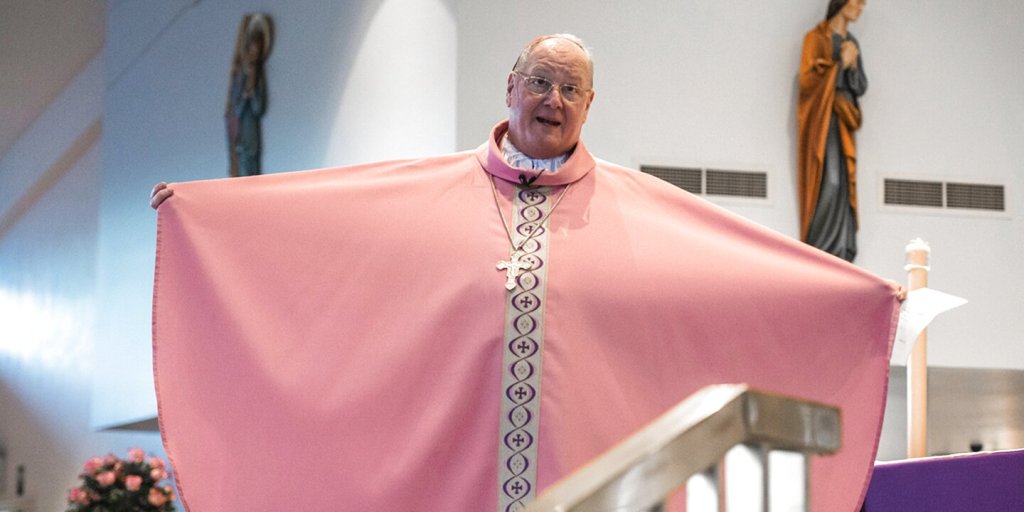
There is a more exuberant emotion, too, the third theme of Advent. There is joy! It is so important, many churches use a pink- or rose-colored candle to mark the third Sunday of Advent. In some traditions the clergy even wear matching vestments, like these:

Just in case you’re wondering, I don’t want to wear that.

I do, however, want to celebrate joy! And when we talk about biblical joy, we mean an emotion that resides in us in all circumstances, even when we are experiencing what otherwise might be thought of as “bad times.”

“Rejoice in the Lord always; again, I will say, rejoice,” Paul told the church at Philippi. (Philippians 4:4.)

Why? Think what we have been given:

Eternal life!

The promise that all that has gone wrong, is going wrong and will go wrong will be made right.

The experience of God in this life, now.

Therein lies our joy. We are able to look at any negative situation and say, “You know what? That has already been defeated.”

Lord, may our experience of joy be as emotional as it is intellectual. And again, may others see in us what you are offering them. Amen.

Psalm 23: Holy and Fearless

By Chuck Griffin
LifeTalk Editor

Our devotionals yesterday, today and tomorrow are all from the 23rd Psalm, “A Psalm of David,” considered in small meditative bites.

Verse 3b
He guides me along right paths,
    bringing honor to his name.

As his sheep, we follow his lead, behaving as the shepherd would have us behave. Sometimes the concept of Christian holiness is made to sound complicated, but it really is that simple.

We are known as his flock, and we do not want to embarrass him by wandering down paths not leading to eternity. For thousands of years, he has shown us his will through his word, recorded in the Holy Bible. This is how he tells us left or right, stop or go.

Yes, the noise of the world sometimes makes his call a little harder to discern, but if we take time to focus on Scripture in a thoughtful and prayerful way, we will know what to do.

And when we follow the right paths, people do notice. They are astonished when the harm they were expecting from us does not occur, or when they receive unexpected goodness.

And when they seek to know why we behave in such an unworldly way, we earn the right to tell them, “Because I stay in love with God—you can too!”

Verse 4
Even when I walk
    through the darkest valley,
I will not be afraid,
    for you are close beside me.
Your rod and your staff
    protect and comfort me.

Our shepherd is so loving, we can forget how strong he is. He has all the tools and weapons he needs to fend off the most terrifying threats.

The rod, a type of club worn at the belt for quick access, proves our shepherd’s willingness to go on offense when we are threatened. Evil will be crushed. The staff can be used with devastating effect in a fight, too. It also is a tool of rescue, capable of lifting lost sheep out of the most difficult circumstances.

We are reminded of the Great Shepherd, Jesus Christ. The truth he spoke acted like a bludgeon against the lies and deceptions of the world, and the day will come when Christ’s truth shreds evil like the keenest of blades. The cross became his tool for lifting us out of despair and death and into eternal life.

With a shepherd like that, why would we ever be afraid?

Lord, guard us in this life and lift us into the next, and may anxiety never keep us from heeding your call. Amen.

Peaceful Warriors

By Chuck Griffin
LifeTalk Editor

Psalm 144:1-2
A psalm of David.
Praise the Lord, who is my rock.
    He trains my hands for war
    and gives my fingers skill for battle.
He is my loving ally and my fortress,
    my tower of safety, my rescuer.
He is my shield, and I take refuge in him.
    He makes the nations submit to me.

As followers of Jesus Christ, we should have a deep aversion to violence. Our savior and teacher had a lot to say about radical forgiveness, turning the other cheek, and forgiveness for enemies.

And yet, evil remains in the world. Since the days when the church and institutional power first began to blend, Christians have struggled with how to  follow Jesus’ teachings when confronted with the potential for great violence.

There are two basic paths thoughtful Christians have promoted through the years. The first is pacifism, where Christians say violence is unacceptable under any circumstances. True Christian pacifists are relatively few in number, although that doesn’t necessarily make them wrong—I have enormous respect for the creative ways they will try to confront violence with nonviolent countermeasures.

The second involves something called Just War Theory. Essentially, war is never good, but sometimes it is necessary in a broken world. There are, however, principles that should never be violated in deciding to go to war or during its prosecution.

I pray there are no more wars in my lifetime for Americans to justify, but if one arises, we likely will hear a leader at some point describe the cause as “just.” He or she will be trying to convince the public that principles of a just war have been considered.

We should always be dubious, by the way. Just wars inherently should be rare events, far more rare than what we have experienced since the end of World War II.

By the way, some of these just war principles can be applied to the “when and how” of Christians individually defending themselves. It has been my experience that martial arts training will cause people to back into these ethical debates without realizing they’re touching on Just War Theory.

For most Christians, it is a reality that some will train their hands for war, trusting God to give their fingers skill for battle. Certainly, soldiers should train, as should our police and others willing to protect innocent lives.

We need to pray for those who train, asking that they also maintain their humanity and their connection to God. Indeed, let’s pray they feel guided by God if forced into action.

Simultaneously, we need to pray for political leaders who will not abuse how they make use of these willing warriors.

I look forward to the day when Jesus’ sword of truth has overcome all evil, and violence is part of a former world.

Lord, grant us creative solutions to ancient problems, and may we all learn to think of violent solutions as acts of last resort. Amen.


✟ To subscribe to LifeTalk devotionals, enter your email address in the box found on any page of the Methodist Life website. ✟

Like a Child

By Chuck Griffin
LifeTalk Editor

Matthew 18:1-5

About that time the disciples came to Jesus and asked, “Who is greatest in the Kingdom of Heaven?”

Jesus called a little child to him and put the child among them. Then he said, “I tell you the truth, unless you turn from your sins and become like little children, you will never get into the Kingdom of Heaven. So anyone who becomes as humble as this little child is the greatest in the Kingdom of Heaven.

“And anyone who welcomes a little child like this on my behalf is welcoming me.”


To see how we fit into the Kingdom of Heaven, it helps to look to our earliest days.

The above verses from Matthew have some important context. Just prior, Jesus and his disciples have been discussing worldly power, the temple and taxes. (A fish ends up covering what Jesus and Peter owe.)

The disciples’ question regarding who is greatest in Jesus’ promised kingdom is similar to questions they ask elsewhere in the gospels: Who will sit nearest Jesus when he is on his throne? And what kind of power will we have?

Jesus’ response forces any thoughtful reader to consider what we had as very small children, and what we have lost as we have grown.

Some words we can meditate upon: Trust. Dependence. Simplicity. Wonder. Innocence.

As we grow older, we find ourselves surrendering such notions to survive. Power structures are in place wherever we go, and they will consume us if we don’t learn to defend ourselves, gain some control, master the system’s complexity, and ideally, learn to run the part of it affecting us.

Blessed are those who don’t have to learn these hard lessons too early in life.

It’s pretty clear to me that Jesus understood the compromises we have to make in the here and now. Sin remains in the world, and it is very dangerous, leading to terrible events that consume even the most innocent of children.

Earlier in Matthew, in the 10th chapter, Jesus said, “Look, I am sending you out as sheep among wolves. So be shrewd as snakes and harmless as doves.”

This is a delicate balance for a Christian to maintain. We have to learn to navigate the world, but at the same time, we want to retain an adult version of what we had as small children.

Assuming we were blessed with good parenting, our feelings of trust and dependence flowed toward those who raised us. As adults, we can sense something similar in our relationship with God.

Knowing God should restore our sense of wonder, too. If we call him Creator, an examination of his creation should be enough to boggle any mind. And through Jesus Christ, we even can regain innocence, trusting that Christ on the cross cleanses us of our sins.

There also is much to anticipate. When the kingdom completely arrives—when we stand before God, seeing our savior, with the broken world behind us—I expect our childlike states will be fully restored.

Unlike children, we will comprehend everything, but innocence will remain, and God will call us great.

Lord, in the midst of our strategizing and surviving, may we be humble, seeking to live as much as possible in your kingdom now. May our way of living make the kingdom more real to us and those around us. Amen.

Seven Churches: Spit Out

By Chuck Griffin
LifeTalk Editor

Revelation 3:14-22

If you’ve heard a pastor stand in the pulpit and really preach one of these letters, I’m guessing it was the letter to Laodicea. This one seems particularly applicable to American churches, although I’m convinced all seven letters have important messages for today.

“You are neither hot nor cold,” Jesus said. “I wish that you were one or the other!” Make a choice, the risen Savior was saying. Make a choice, the risen Savior is saying!

Again, a city’s geography played into the message to its local church in a clever way. Nearby cities were known for their relaxing hot springs or refreshing cold springs. The water welling up in Laodicea was smelly and tepid.

Jesus was saying the Laodicean church was equally lukewarm—basically, worth a gag-induced spit—largely because its people had enough wealth that they figured they could take care of themselves.

When Christians are materially prosperous, they have to take great care to keep their priorities straight. Having plenty is a comfortable feeling, right up to the day when you realize none of it can help you any more.

And we all must face that day. Even if Elon Musk, with all his wealth, manages to transfer his brain into a computer, he will eventually find himself in a place where the universe’s resources won’t sustain him.

It’s a straightforward choice, like up or down, left or right, true or false. Godliness or worldliness—which will it be? Sure, we make mistakes, sliding into worldliness, but if we’re Christians, we’re going to rectify the problem as soon as we notice it.

We all have to decide whether we believe Jesus when he says:

Look! I stand at the door and knock. If you hear my voice and open the door, I will come in, and we will share a meal together as friends. Those who are victorious will sit with me on my throne, just as I was victorious and sat with my Father on his throne.

Revelation 3:20-21

Before we depart these letters, there are a couple of broad points about them I hope you will note. First, there is this matter of the “angels” of the churches. There are different theories on what this word means, but I tend to lean toward the supernatural one, the idea that every congregation has its guardian in heaven.

I am mindful that through the church, heaven and earth are linked. I’m thinking of Hebrews 12:1; be aware, you have to read Hebrews 11 to get the context for the great “cloud of witnesses.”

I also hope you’ll go back through the letters and note how each one ends. “Anyone with ears to hear must listen to the Spirit and understand what he is saying to the churches.”

I read that as anyone in any place or time, including here and now.

Lord, help us to search ourselves and examine our churches. If we hear what is said and find ourselves less like Smyrna or Philadelphia and more like the others, then show us the path to renewal. Amen.

Seven Churches: Death and Life

By Chuck Griffin
LifeTalk Editor

Revelation 3:1-13

As bad as it was to hear the warnings for Pergamum and Thyatira, I find Christ’s pronouncement regarding the Christians at Sardis more chilling. “You are dead” has a tone of finality to it.

The city of Sardis was commercially and militarily important, and was famous for its elaborate nearby necropolis, a “city of the dead” cemetery built on hills within view of Sardis proper. No doubt the image of the necropolis floated in the church members’ minds as they heard their letter read aloud.

As I was meditating on this letter, I thought of Jesus’ pronouncement against the Jewish leaders of his day:

What sorrow awaits you teachers of religious law and you Pharisees. Hypocrites! For you are like whitewashed tombs—beautiful on the outside but filled on the inside with dead people’s bones and all sorts of impurity. Outwardly you look like righteous people, but inwardly your hearts are filled with hypocrisy and lawlessness.

Matthew 23:27-28

What a terrible thing for a church or an individual: to have the appearance of religion—perhaps even a great history of ministry—but for it all to collapse into spiritual death. As a modern analogy, I think of beautiful buildings I have seen, stained glass and spires intact, but no Spirit-driven Christians left inside to do the work of the kingdom.

Of course, Jesus remains at the heart of these events. With Jesus, death does not have to be an end, and he indicated as much as he spoke to the church at Sardis. There was a tiny remnant clinging to the faith, and they had the potential to trigger new life in the church.

Now my mind goes to Mark 5:41. To the lifeless little girl, Jesus said, “Talitha koum.” Little girl, get up!

Church, wake up! Church, rise up!

And as we arise, as we awaken, being like the church at Philadelphia becomes our goal. Nothing could rattle their faith. Literally. The place was so earthquake prone that people after A.D. 17 preferred to live in the rural spaces around the city, away from where walls might collapse.

The Philadelphia Christians had little in the way of worldly strength, but they remained faithful, so much so that Christ promised their door to eternal life would always be open. Like the church at Smyrna, the difficult circumstances of their world translated into a rich life with Christ, a relationship destined for eternity.

Lord, renew our lives as children of God; renew our churches as places filled with your Holy Spirit. Amen.

Seven Churches: False Teachings

By Chuck Griffin
LifeTalk Editor

Revelation 2:12-29

As we continue our exploration of the seven letters to the churches in Revelation, let’s deal with the churches at Pergamum and Thyatira together.

In appearance, they were significantly different cities. Pergamum officially was the provincial capital of the Roman Empire, described in other sources as a wealthy and beautiful city. Thyatira lay about 45 miles to the east, and while not considered a great city, it was very commercial, undergirded by a network of trade guilds.

The churches within these cities had the same basic problem. False teaching had made its way inside.

Paganism surrounding the churches exacerbated their situations. Pergamum was a city known for pagan temples set aside for the worship of the Roman emperor and other supposed deities. Several of these temples offered sex with temple priestesses as part of their rituals. No wonder John the Revelator referred to Pergamum as the “city where Satan has his throne.”

In Thyatira, the trade guilds each had a particular patron deity, and their festivals also emphasized sexual revelry. In both cities, there also would have been the consumption of food sacrificed to idols, which implied participation in unholy worship.

These were tough places for Christians to try to live out their basic commitments to marriage as described by Jesus and the apostles. Most people around them would have questioned the Christians’ unwillingness to participate in premarital and extramarital sex.

I have no doubt that at some point, more than one person said to the Christians, “Hey, everybody is doing it!” In our sex-saturated culture, we should certainly understand the struggle, assuming we take our own commitments to Christ seriously.

It’s also not hard to see how dynamic, alluring liars could begin to deceive these churches, convincing their members it was okay to hang out at the temples, fully enjoy the festivities and still be in good standing with Christ. As in any era, it was a message some church members were itching to hear.

In Pergamum, the lies seem to have been carried into the church by organized heretical sects, while in Thyatira, Christ’s condemnation fell upon one false prophet in particular, a woman referred to as “Jezebel” in an Old Testament allusion.

Regardless of who led these Christians toward sin, the solution was simple, these letters said. Repent—stop doing what Jesus and his apostles taught is wrong. And then cling to doing what is right, knowing you will receive your eternal reward!

As old-fashioned as the formula may sound, it remains the best advice for today.

Lord, thank you for the well-established Scripture we now have to clearly instruct us about your will in all things. Where we have been wrong as individuals and churches, may we repent, and may we follow your teachings closely as we proceed. Amen.