For My Welfare?

Isaiah 38:10-20

By John Grimm

For my welfare?  We think we know what is best for ourselves.  We plan, we maneuver, and we make connections so that we can have the best life possible.  Then troubles come our way and we are at a loss.  Getting through the troubles strains us.

We then ask ourselves, is the trouble because of my own sins?  Are we the ones who caused our own souls to be bitter?  Or is the truth that someone else caused our misfortune and our problems?  Is it not that since we live godly lives, we can escape such bitterness?

When we know that we have caused our own bitterness, then we repent of our ways.  We confess our sin to God and he restores us.  We may even eventually see that God had been protecting us, despite our willful rebellion against him.  As soon as we recognize the good God was keeping us for, we thank him that he did not allow us to be punished for all time because of our rebellion. 

When we do not know the source of the bitterness in our life, we should keep turning to God.  It is through Jesus that we find salvation, even in the midst of bitterness.  It is during these times that we catch a glimpse of how much evil that God has kept from us.  Yes, going through the bitterness was for our welfare!

It is by living through bitterness brought on by our own sin or someone else’s sin that we can praise God!  Then we get to be in the sanctuary with other believers to sing and praise God for his work in our lives.  What a witness we have when those around us know of the bitterness of our souls and they get to hear us praise God.  Maybe it is during this pandemic that the bitterness of our souls is for our welfare.  It seems like a good time to praise God for getting us through these days.  What better way to shrug off bitterness than to be in the house of the Lord, thanking God for our deliverance?

God, we know who and what has caused bitterness in our souls.  It was not you.  We allowed that bitterness to grow.  Yet, you are using the state of our souls so that we may see how you are working to deliver us.  As we become content in your faithfulness, may we see the bitterness washing away and hear chords of praise coming from our lungs.  It is in Jesus’ name that we thank you for making a way for our welfare even when we could not grasp what was happening.  Amen.  And Amen!
Open Up!

This Sunday’s sermon at Holston View UMC in Weber City, Va., will be “Demons and Deafness.” It will be based on Mark 7:24-37. If you want to view the sermon but cannot be present, the entire worship service will be available through Holston View UMC’s web page.

Today’s preparatory text: Mark 7:32-35 (NRSV)

A deaf man with a speech impediment was brought to him, and the people begged Jesus to lay his hands on the man to heal him.

Jesus led him away from the crowd so they could be alone. He put his fingers into the man’s ears. Then, spitting on his own fingers, he touched the man’s tongue. Looking up to heaven, he sighed and said, “Ephphatha,” which means, “Be opened!” Instantly the man could hear perfectly, and his tongue was freed so he could speak plainly!


By Chuck Griffin

You’re most likely reading this on the internet in some fashion, through Facebook, email or directly on the Methodist Life site. If you’re like me, this is not always the most conducive environment for slowing down and spending time with God.

A computer or smartphone can buzz with activity. Other windows, apps or browser tabs may be open, streaming music or television. Little pop-ups may be appearing and disappearing, telling you “important email” or alerting you to an incoming text or instant message.

Try something before you read any further. What you’ll experience is really important as we look at today’s text. Find a way to sit in silence, even if just briefly—say, five minutes. It helps to take some deep breaths.

Go ahead. I’ll wait.

My premise today is a simple one. We are like the deaf man in our story in Mark. We’re just deaf for a different reason. He had a physical problem. We have an environmental problem that causes spiritual deafness.

Something had stopped up his ears. Perhaps it was a disease. Perhaps it was a head injury. He began to speak as soon as he was healed, so he apparently remembered sound and speech. But at some point in his life, the sound had no longer come in and intelligible words had stopped coming out.

The cure was not a simple one, not even for Jesus the miracle worker. This was no time for a spectacle. Jesus pulled the man aside to a private place. (It strikes me that the deaf man must have had little understanding of what was going on; he had to trust Jesus.)

Put your pandemic-induced anxieties aside for a moment and imagine what it would feel like to have Jesus stick his fingers in your ears. Imagine what it would be like to have him take his spit and put it on your tongue.

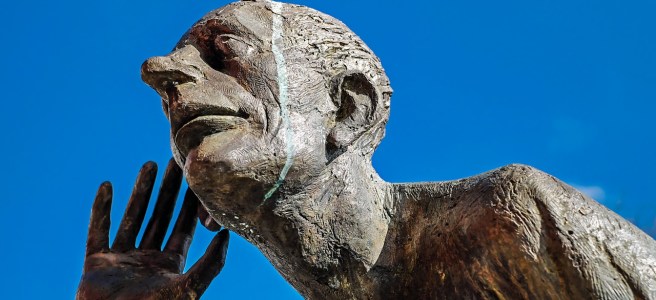
Imagine what it would be like to have Jesus pray for you in the common Aramaic his very common followers spoke, a prayer so deep that it comes out in a groaning command: Ephphatha. Open up!

When it comes to hearing Jesus, to really hearing what God has to say to us, we’re stopped up, too. The world is in our ears. We’re clogged with work, sport and school schedules, with plans, with worries, with diversions like television and video games. We’re so stopped up that we’re in danger of remaining deaf to God’s continuing call on our lives until the day we die.

This deafness also makes us spiritually mute. How can we declare what we have not recently heard?

May we go to private places with Jesus long enough that our ears be unstopped. May we hear his message well. And may we declare the message of Jesus Christ as Lord and Savior with great excitement.

Dear Lord, give us the same healing command: Ephphatha!

Judgment

Romans 2:1-11 (NRSV)

Therefore you have no excuse, whoever you are, when you judge others; for in passing judgment on another you condemn yourself, because you, the judge, are doing the very same things. You say, “We know that God’s judgment on those who do such things is in accordance with truth.” Do you imagine, whoever you are, that when you judge those who do such things and yet do them yourself, you will escape the judgment of God? Or do you despise the riches of his kindness and forbearance and patience? Do you not realize that God’s kindness is meant to lead you to repentance? But by your hard and impenitent heart you are storing up wrath for yourself on the day of wrath, when God’s righteous judgment will be revealed. For he will repay according to each one’s deeds: to those who by patiently doing good seek for glory and honor and immortality, he will give eternal life; while for those who are self-seeking and who obey not the truth but wickedness, there will be wrath and fury. There will be anguish and distress for everyone who does evil, the Jew first and also the Greek, but glory and honor and peace for everyone who does good, the Jew first and also the Greek. For God shows no partiality.


By John Grimm

It has amazed me the number of times that I have heard us humans saying to one another: “Forgive yourself.”

If we are forgiving ourselves, then when do we repent?  If we are forgiving ourselves, then how do we know when to judge ourselves by God’s standards?  It might turn out that as we attempt to forgive ourselves, that we discover we are self-seeking and that we are obeying wickedness rather than truth.  I imagine we forgive ourselves, or at least attempt to forgive ourselves, when we know that we are not doing any worse than anyone else.  Those other people might get caught, but we think we will not get caught and avoid judgement.

God is the judge. God judges each one of us.  Nothing we do, try, or believe escapes his knowledge.  Forgiving ourselves is right there in the categories of things we do, try or believe.  Attempting to forgive ourselves perpetuates evil.  What stops evil in our lives and those we attempt to judge?

Repentance.  It is the kindness and forbearance of God that allows us to turn from our evil and turn to truth.  When we seek for God’s glory, honor, and immortality, then we find God accepts our repentance and assists us to live eternal life.  And that, even now.

God shows no partiality.  We need not show ourselves any partiality.  Our pursuit is the good that God has for us.  We experience and know this good when we know Jesus Christ has died for our sins.  We experience and know this good when we receive the forgiveness that God has for us.  We experience and know this good when we give forgiveness to others, just as God has given us forgiveness.

God, we are too easy on ourselves and too hard on others.  It is your judgment which can be our concern for ourselves.  Thank you for aiding us in taking the log out of our own eyes as we repent of our evil ways.  As you forgive us, we can and do forgive others.  Thank you for the life we find in Christ Jesus and that you impartially give to us.  Amen.

What Miracles Accomplish

This Sunday’s sermon at Holston View UMC in Weber City, Va., will be “Demons and Deafness.” It will be based on Mark 7:24-37. If you want to view the sermon but cannot be present, the entire worship service will be available through Holston View UMC’s web page.

Today’s preparatory text: Luke 18:27

[Jesus] replied, “What is impossible for mortals is possible for God.”


By Chuck Griffin

Why might we seek a miracle?

We do pray for miracles, particularly when lives seem to be in jeopardy. As we move toward Sunday, however, we need to consider the purpose of miracles.

If we seek miracles strictly to bypass suffering or impending grief, we likely are missing their larger point. Certainly, when we are praying over an immediate, very personal crisis, our minds might not be processing broad theological concepts. But that is simply an argument for thinking about such matters in calmer moments, so we can better understand what it is we are seeking when times of crisis come.

An important fact to remember: As far as we know, every person Jesus healed from illness, brought out of a tomb or raised from a deathbed or funeral bier died later. If we look at these miracles simply as stories of what these people escaped, then Jesus’ work had temporary effects.

Miracles do so much more, however. First, they are evidence of God’s presence in a world where we otherwise see things as if “in a mirror, dimly,” to quote Paul. (1 Corinthians 13:12.) For just a moment, divine possibilities shine through, and the presence of the dawning Kingdom of God is easily, if briefly, seen.

Miracles were signs of God’s presence in Jesus. Miracles are signs of God’s presence in the church, by way of the indwelling Holy Spirit.

We also should understand that miracles come with responsibilities, both for their recipients and their witnesses. Someone needs to testify as to what has happened!

Belief also should naturally spread in the wake of miracles. It is a response we see throughout the Bible. God is seen, and therefore, people change their lives dramatically as they begin to believe.

Lord, we are not afraid to pray for miracles, and we pledge to testify to what we have seen as we receive them. May lives be changed! Amen.

The Wise and Foolish Builders, Pt. 2

Luke 6:46-49 (HCSB)

46 “Why do you call Me ‘Lord, Lord,’ and don’t do the things I say? 47 I will show you what someone is like who comes to Me, hears My words, and acts on them: 48 He is like a man building a house, who dug deep and laid the foundation on the rock. When the flood came, the river crashed against that house and couldn’t shake it, because it was well built. 49 But the one who hears and does not act is like a man who built a house on the ground without a foundation. The river crashed against it, and immediately it collapsed. And the destruction of that house was great!”


By ‘Debo Onabanjo

In last Tuesday’s devotional, we learned that the difference between the wise and foolish builders is not what they know, but how they act based on what they know. The wise builder builds on a solid foundation, which represents the teaching of Jesus. The foolish builder serves as a metaphor for ignoring the teaching of Jesus, building his house on sand.

In our focus text for today, we find a slight variation on this teaching of Jesus, although he once again underscores the importance of people coming to him, listening to his teaching and then following through on the instruction they receive.

I have a hard time believing someone would build a house without a foundation, but we do have many people around us who have either chosen to build their lives with no foundation or at best a sandy foundation. Some people have built their lives on their personal careers, their wealth, their position in society, their kids or their fame.  Such lives are in constant danger of collapsing.   

As John Wesley, the founder of Methodism, was prone to remind us, not all who profess to be followers of Jesus Christ are doing the will of God.

We can deceive others about our faith journey, but we cannot deceive Jesus.  Christ makes it clear that just as a tree is known by its fruit, people will be known by their actions. (Matthew 7:15-23.) Christ warns us that he will shock people when he tells them he never knew them.  People who talk about heaven or appear pious don’t necessarily belong to the Kingdom of God.  Other humans see what we display outwardly, but God sees every heart, and nothing is hidden from God’s all-seeing eyes. 

While there may not be immediate noticeable differences in our lives when we follow Christ, if we are truly building on the right foundation, the genuineness of our faith will be revealed with time.  

Help us heavenly Father to build on Jesus Christ the Solid Rock. Holy Spirit, teach us to build on Jesus the foundation of our faith with the right materials that will withstand the test of time and the challenges that will come along our journey. May we be fruitful and faithful to the end so that when our time here on earth comes to an end, we can hear you say to us, well done good and faithful servant, enter into the joy of your Master. We pray with confident assurance in the name of Jesus the Christ. Amen. 

A Shocking Assertion

This Sunday’s sermon at Holston View UMC in Weber City, Va., will be “Investing In the Future.” It will be based on Jeremiah 32:6-9. If you want to view the sermon but cannot be present, the entire worship service will be available through Holston View UMC’s web page.

Today’s preparatory text: 1 Timothy 6:9 (NRSV)

But those who want to be rich fall into temptation and are trapped by many senseless and harmful desires that plunge people into ruin and destruction.


By Chuck Griffin

A couple of times before on Methodist Life, I have referenced a John Wesley sermon, “The Danger of Riches.” As we look toward Sunday’s Jeremiah text and consider how to live boldly, I thought it would be useful to consider what the sermon has to say.

Bold behavior for the kingdom doesn’t have to involve money, of course. But let’s be realistic. Money does make the modern world go around. When we are bold for the kingdom, we likely run into one of two scenarios. We either give from our abundance or we make life decisions that reduce our opportunity for abundance.

As we make these choices, we need to fix in our minds a question, one along the lines of what I wrote for Wednesday. Do we live as if this life is the only one that counts? Or do we live as people who believe something greater is happening—that God’s kingdom is truly arriving, and that the kingdom is where we store our true treasures and live out eternity!

Once we choose the latter option, we’re ready to hear what Wesley said as he expanded on 1 Timothy 6:9.

In the sermon, Wesley asserted that God provides for the roof over our heads, food, and other basic needs, allowing us to ensure the well-being of our families and even businesses we may own. What we own beyond those basic provisions count as riches, and they have been given to us to use “to the glory of God.”

Often, this means using our riches to help those who are less blessed materially, playing a role in God’s provision for people’s basic needs.

Wesley offered us an interpretation that might even surprise a tither. I have no doubt someone accused the founder of Methodism of having “gone to meddling.”

His very correct interpretation of Scripture should force a reassessment of every decision we make regarding how we handle our income and possessions. When we learn to make such decisions in the light of God’s dawning kingdom, we not only trust God daily, we begin to participate actively in the kingdom’s growth.

In other words, we become quite bold.

Lord, the world needs people who look to you as the source of all that matters and then act accordingly. Raise up a bold generation so that your Holy Spirit may rush through them, making your Kingdom work complete. Amen.

Asking by Faith

James 1:2-8 (NIV)

Consider it pure joy, my brothers and sisters, whenever you face trials of many kinds, because you know that the testing of your faith produces perseverance. Let perseverance finish its work so that you may be mature and complete, not lacking anything. If any of you lacks wisdom, you should ask God, who gives generously to all without finding fault, and it will be given to you. But when you ask, you must believe and not doubt, because the one who doubts is like a wave of the sea, blown and tossed by the wind. That person should not expect to receive anything from the Lord. Such a person is double-minded and unstable in all they do.


By John Grimm

Trials?  What trials?  That seems to be one approach to living through this pandemic.  We know of men and women who are no longer involved in any church, of any kind, because of restrictions placed upon churches during this pandemic.  Instead of facing trials, some men and women have tried to avoid any trial during the pandemic.

Trials!  What trials!  That’s a different approach. Yes, we have placed restrictions upon churches during this pandemic.  But in the midst of all of that, consider what God has helped us learn. We can be disciples of Christ during this pandemic through active participation in church.

Before this pandemic, I had never pastored a church during a pandemic.  I am sure that before this pandemic, you did not know how to live through a pandemic.  We can expect God to give us wisdom so that we may become mature in Christ during this pandemic. 

If we are avoiding trials, then are we double-minded and unstable in all we do?  Faith in  God was possible before the pandemic.  Faith in God is possible through the pandemic.  Once we leave the pandemic behind, we should find our perseverance is closer to finishing its work in us.

God, thank you that you have been with us through this pandemic.  When we asked you for wisdom about how to face trials caused by this pandemic, you have generously given to us!  What a joy it is to be alive during a pandemic and see how you continue to give to us!  May our brothers and sisters in Christ who are not involved in church because of the pandemic find this joy that we have from placing our faith in you.  In the name of Jesus, we pray.  Amen.

The Emboldening Truth

This Sunday’s sermon at Holston View UMC in Weber City, Va., will be “Investing In the Future.” It will be based on Jeremiah 32:6-9. If you want to view the sermon but cannot be present, the entire worship service will be available through Holston View UMC’s web page.

Today’s preparatory text: 1 Corinthians 15:12-20 (NLT)

But tell me this—since we preach that Christ rose from the dead, why are some of you saying there will be no resurrection of the dead? For if there is no resurrection of the dead, then Christ has not been raised either. And if Christ has not been raised, then all our preaching is useless, and your faith is useless. And we apostles would all be lying about God—for we have said that God raised Christ from the grave. But that can’t be true if there is no resurrection of the dead. And if there is no resurrection of the dead, then Christ has not been raised. And if Christ has not been raised, then your faith is useless and you are still guilty of your sins. In that case, all who have died believing in Christ are lost! And if our hope in Christ is only for this life, we are more to be pitied than anyone in the world.

But in fact, Christ has been raised from the dead. He is the first of a great harvest of all who have died.


By Chuck Griffin

When we fully understand what it means to follow Christ, Christians should, in theory, stop thinking of our interests as existing solely within the nine decades or so we hope to live.

We look back to Jesus hanging on a cross and then exiting a tomb nearly 2,000 years ago, and we see how our lives are changed now. We understand salvation because earlier Christians made great sacrifices to ensure the message of Jesus Christ spread from one generation to the next.

We also look forward to a day when the Redeemer will restore us from death in the resurrection.

Job expressed it well centuries before Christ was born:

“But as for me, I know that my Redeemer lives, and he will stand upon the earth at last. And after my body has decayed, yet in my body I will see God! I will see him for myself. Yes, I will see him with my own eyes. I am overwhelmed at the thought!” (Job 19:25-27.)

We should stay overwhelmed at the thought. And if others are to share that thought, then we may need to chase objectives that might seem irrational to the secular world.

When we reach that thought’s fulfillment, I wonder what we will regret more as we stand before the holy Savior. Will it be the wrong things we did, or the right things we failed to do? Sometimes we are so focused on sins of commission that we’re not thinking about sins of omission.

Often, I think, sins of omission are simply failures to be bold, to live bravely as citizens of a dawning kingdom.

I don’t know what your bold move might be. It may involve your time or your money. It may involve the direction of your life.

All we can do is ask God to reveal what seemingly irrational steps he may ask us to take, and then pray for the courage to take them.

Lord, once again root our souls in the truth of Jesus Christ, and let us see what you would have us do now as people who will live forever. Amen.

Results

This Sunday’s sermon at Holston View UMC in Weber City, Va., will be “Samson!” It will be based on stories found in Judges 13-16. If you want to view the sermon but cannot be present, the entire worship service will be available through Holston View UMC’s web page.

Today’s preparatory text: Take time to read the story of Samson.


By Chuck Griffin

With his massive strength and what sounds like really great hair, Samson had the kind of advantages that a leader in any era would find helpful.

Like many such leaders, though, he fell short of what was possible. Certainly, God was with him. Certainly, he did a lot of damage to the Philistines, the enemy God intended Samson to vanquish.

When all is said and done, however, the final results are what matter. The earliest judges, the people empowered by God to lead Israel, brought their people to a time when “the land had rest,” a phrase indicating peace and prosperity. Othniel, Ehud, Deborah and Gideon seem to have had success.

There is no such indication at the end of Samson’s story, or at the end of the story of some of his predecessors. Instead, we simply receive a report of how long they led.

As I read Samson’s story, I try to spot his shortcomings as a leader. I noted Wednesday how he seems to lack humility, even though it is quite possible to be both strong and humble. He kept forgetting the source of his strength, God, and spent much of his time pursuing what Samson wanted.

Trusting in the power of his arms and legs, Samson also tried to do everything on his own. The earliest judges were able to rally the people. To one degree or another, God’s power flowed through them to strengthen the Israelites.

It seems like Samson wanted to underscore the notion that it is lonely at the top, even though that old adage can easily be overcome by a savvy leader who deliberately calls on the help of the best and the brightest available.

Samson’s story is an ancient one, yet the themes within are timeless, and certainly applicable to situations playing out right now in the world. May God guide all who lead, and may those who lead humbly follow God’s guidance, helping their troubled people find a time of rest.

Lord, once again we pray, “Thy kingdom come, thy will be done, on earth as it is in heaven.” Amen.

As Indeed You Are Doing?

1 Thessalonians 5:1-11 (NRSV)

1 Now concerning the times and the seasons, brothers and sisters, you do not need to have anything written to you. 2 For you yourselves know very well that the day of the Lord will come like a thief in the night. 3 When they say, “There is peace and security,” then sudden destruction will come upon them, as labor pains come upon a pregnant woman, and there will be no escape! 4 But you, beloved, are not in darkness, for that day to surprise you like a thief; 5 for you are all children of light and children of the day; we are not of the night or of darkness. 6 So then let us not fall asleep as others do, but let us keep awake and be sober; 7 for those who sleep sleep at night, and those who are drunk get drunk at night. 8 But since we belong to the day, let us be sober, and put on the breastplate of faith and love, and for a helmet the hope of salvation. 9 For God has destined us not for wrath but for obtaining salvation through our Lord Jesus Christ, 10 who died for us, so that whether we are awake or asleep we may live with him. 11 Therefore encourage one another and build up each other, as indeed you are doing.


By John Grimm

I cannot count how many times that I have read these verses.  Well, to be honest, I have heard only a portion of these verses being emphasized.  It appears that in my life I have heard many people only quote verse one and two.  What about verses three through eleven, do they matter to us?

Paul is emphasizing how we Christians are to live, remembering that the day of the Lord will come like a thief in the night.  Faith, love, and salvation are our themes as we live as children of light and children of the day.  It is through our Lord Jesus Christ that we live, now and later.  Salvation is ours in Christ now.  The day of the Lord is later, and salvation is ours also at that time.

You can be encouraged with this info.  You can build up other Christians with this news.  Paul says that is “as indeed you are doing.”  However, we know what we have been doing.  We stopped reading after verse two.  God help us!  As we live as children of the night or of darkness, we have not been able or willing to encourage one another or to build up each other. 

Will you take time today to recognize the salvation you have in Jesus?  Will you start encouraging and building up other Christians, even today? 

God, as I live in Christ, nothing will surprise me about the day of the Lord.  Yet, I have not grasped the salvation I have in the Lord Jesus Christ.  Forgive me for my slowness of living as a child of light and a child of the day.  In this day, may other Christians find encouragement and be built up in Christ by my words and actions.  In the Name of Jesus, I hope to be found on the day of the Lord, amen.