There It Is!

Psalm 133 (NRSV)
A Song of Ascents.

How very good and pleasant it is
    when kindred live together in unity!
It is like the precious oil on the head,
    running down upon the beard,
on the beard of Aaron,
    running down over the collar of his robes.
It is like the dew of Hermon,
    which falls on the mountains of Zion.
For there the Lord ordained his blessing,
    life forevermore.

By John Grimm

The kindred we know and appreciate in the church are all those who believe that Jesus Christ is their Lord and their Savior. This news seems self-evident. However, we know from experience that we do not treat each other as kindred. As Jesus’ people, we may even show preference to those who act, think, and smell like us! Yet, living our preferences keeps us from seeing unity.

Being who we are as children of God, even brothers and sisters in Christ, is ordained by God. We get to recognize the joy of the oil running down upon Aaron’s beard when we have unity. We get to relish the pleasantness of the dew on Mount Hermon when we have unity. The early church discovered this fact as they kept on loving each other through the growing pains of thousands being added to their number in Acts 2.

It is in unity that we discover the Lord’s blessing. Are we experiencing unity in our local church right now? Are we seeing life forevermore being lived within our congregation? We know what to do. We say those wonderful words to each other. Go ahead and say them, we will not hurt ourselves. We tell each other, “I forgive you.” Then we get to experience the Lord’s blessing in our local church.

Forgiving and blessing God, thank you for making a way for us to have unity in our local church. Your Son did not die and rise again so we could fight among ourselves. You want to give us your blessing. As you forgive us, we love each other enough to do the same. May we experience life forever more as are united in Jesus’ name and with each other in our local church. Amen.

Enduring Love

Psalm 118:1-2 (NLT)

Give thanks to the Lord, for he is good!
    His faithful love endures forever.

Let all Israel repeat:
    “His faithful love endures forever.”

By Chuck Griffin

The opening to Psalm 118 asserts a truth that some people find difficult. Perhaps that’s why it is worth repeating.

In the midst of life’s problems, we can feel God has forsaken us. Those dark times can be deeply frustrating, at least until the moment when God does break through to remind us of his grace.

The Easter season is a good time to remember just how powerfully God has broken through and will continue to break through. For no clear reason, other than the fact God is eternally loving, our savior came among us in flesh to die for our sins, making eternal life for us possible.

While dying, Jesus Christ also felt that loneliness we sometimes feel: “My God, my God, why have you forsaken me?” His cry from the cross was a quote from Psalm 22, another place in Scripture we can go when we feel forgotten.

Yes, Jesus died, but always remember, the stone was rolled back. Morning light made its way into the tomb, and the resurrected Jesus stepped forth. The resurrection proves Christ defeated the darkness that sometimes seems to surround us, including what can seem like the deep darkness of death.

Remember this, too: Until Christ is seen in full, we are to be voices in the darkness, offering hope to those who think they will never see light again.

Lord, in difficult times, give us unique signs of your presence to carry us through. Amen.

Stop

Genesis 2:1-3 (NLT)

So the creation of the heavens and the earth and everything in them was completed. On the seventh day God had finished his work of creation, so he rested from all his work. And God blessed the seventh day and declared it holy, because it was the day when he rested from all his work of creation.


By Chuck Griffin

When did you last stop?

I’m talking about a deliberate stop, a scheduled pause, a planned interruption where there is nothing going on except what transpires between you and God.

Those moments are critically important. Let me tell you one of Satan’s best tricks—making our lives busier and busier and busier, ensuring we don’t stop and engage with his mortal enemy, our creator, savior and comforter.

As we see in the creation story, stopping to rest is built into the very fabric of the universe. There is the very important idea of a weekly sabbath, of course, that day where we put aside worldly activities and rest in our love for God and each other. But there also is that need to stop at times each day, as Jesus so often did in the midst of his astonishingly busy ministry.

Taking time to be at rest and talk with God actually can cause our worldly efforts to be more effective. Martin Luther, when asked about his plans for a busy day, is said to have replied, “Work, work from early until late. In fact, I have so much to do that I shall spend the first three hours in prayer.”

If necessary, make it a new item on your to-do list. Stop!

Lord, as we stop, settle our minds and souls so we truly rest in your presence, bringing you our troubles and worries and letting your peace and love shape what happens next. Amen.

In Death, Victory

1 Corinthians 15:35-49 (NRSV)

But someone will ask, “How are the dead raised? With what kind of body do they come?” Fool! What you sow does not come to life unless it dies. And as for what you sow, you do not sow the body that is to be, but a bare seed, perhaps of wheat or of some other grain. But God gives it a body as he has chosen, and to each kind of seed its own body. Not all flesh is alike, but there is one flesh for human beings, another for animals, another for birds, and another for fish. There are both heavenly bodies and earthly bodies, but the glory of the heavenly is one thing, and that of the earthly is another. There is one glory of the sun, and another glory of the moon, and another glory of the stars; indeed, star differs from star in glory.

So it is with the resurrection of the dead. What is sown is perishable, what is raised is imperishable. It is sown in dishonor, it is raised in glory. It is sown in weakness, it is raised in power. It is sown a physical body, it is raised a spiritual body. If there is a physical body, there is also a spiritual body. Thus it is written, “The first man, Adam, became a living being”; the last Adam became a life-giving spirit. But it is not the spiritual that is first, but the physical, and then the spiritual. The first man was from the earth, a man of dust; the second man is from heaven. As was the man of dust, so are those who are of the dust; and as is the man of heaven, so are those who are of heaven. Just as we have borne the image of the man of dust, we will also bear the image of the man of heaven.


Dead as a doornail. Dead as a dodo. Not only merely dead, but really most sincerely dead.

English writers have done a good job of describing death as an irreversible end, be it in a Shakespearean play or “The Wizard of Oz.” But even before there was an English language, there was the idea that death could be undone.

Actual reversals of death were rare events, of course, but where they are recorded, it is clear they occurred to signal the presence of God.

Take 1 Kings 17:8-24, for example. In the midst of drought and famine, God sent the prophet Elijah to find a widow and her son, locating them as the woman prepared to bake the last handful of flour and oil she had into bread. She planned that she and her son would share in this tiny meal and then die.

Once the widow showed Elijah a little hospitality, however, the jar of meal and the jug of oil always had enough in them to sustain the three, even though there was no food in the land for such a poor collection of people. By the hand of God, death had been delayed.

Death still came, however. In a perplexing turn of events, the boy became ill, and “there was no breath left in him.” The mother was convinced that in the presence of a prophet, her sins had somehow become more glaring, causing the death of her boy.

Elijah took the boy upstairs, however, and through intense prayer convinced God to restore him to life. When he carried the boy down to his mother, she said, “Now I know that you are a man of God, and that the word of the Lord in your mouth is truth.”

God is revealed in life, not death.

Centuries later, Jesus performed a similar miracle for a similar widow, raising her son from his funeral bier. There was one major difference in Jesus’ approach, though. Elijah prayed fervently to God; Jesus spoke as God, saying, “Young man, I say to you, rise!”

In this and other death-reversing miracles, Jesus gave a preview of coming attractions. In dying on the cross, he atoned for our sins, that root cause of death.

And in his resurrection—his defeat of death—he made it clear that when we follow him, we have nothing to fear. Not even our own temporary, transitory deaths.

Death is not final. We all shall rise from it, look at our renewed bodies, see our risen loved ones, and see the one who makes the miracle possible. Our joy will be greater than that of a widow finding her only son restored to life.

As Paul writes in 1 Corinthians 15:55, “Where, O death, is your victory? Where, O death, is your sting?”

Lord, may the resurrection to come exist firmly in our minds, shaping how we live until such time as we experience this holy transformation. Amen.


He Is Risen!

By Chuck Griffin

Depending on which gospel you read, the resurrection story is told in slightly different ways. The core facts are the same, however: Jesus was definitely dead, crucified on a cross.

Then he was and is clearly alive, fully recognizable and yet transformed in a way that should still astound us.

We often rely on the gospel of John during Holy Week and Easter, if for no other reason than the precise detail provided there regarding both the crucifixion and the resurrection. Mary Magdalene, a woman who had been healed by Jesus and became his follower, finds the stone rolled away from Jesus’ tomb.

She goes for help, returning with Peter and a disciple described as “the one whom Jesus loved.” The men see the carefully discarded burial linens and leave the tomb. Mary stays and sees the risen Jesus, mistaking him at first for a gardener before speaking with him. When she runs back to the disciples, she announces, “I have seen the Lord.”

Just as angels indicated at Jesus’ birth that the world was changing because God had come to live among humanity, Mary was saying that nothing will ever be the same now that Jesus has defeated death.

The Greek verb we translate as “announce” was used very specifically in Jesus’ day, indicating that previously unknown news was being delivered. Mary Magdalene was the first to deliver the Good News about Jesus Christ and his world-transforming resurrection.

And indeed, nothing is the same. Before Jesus, death was a frightening uncertainty, at best a descent into a shadowy existence. After Jesus, death is meaningless for those who follow Christ.

We don’t seek death—we certainly don’t relish what might accompany the dying process—but faithful Christians intuitively know they have nothing to fear. How can we fear what Christ has crushed? How can we be anxious about facing Father God when we know the resurrected Son will stand by us and say, “I have made this one holy!”

And more than just the afterlife is changed. This life now is changed.

In making us holy through the cleansing action of the cross, God can dwell in us. He gives us his Spirit to sustain us until all creation is set right in the general resurrection, the complete remaking of heaven and earth. (If you don’t know that part of the story, take hope—it is where history is headed.)

The joy of eternity with God begins now, not in our passing. Easter is a reminder that the resurrection happened in this world, impacting living people, including us today.

The resurrection is a story worth hearing again and again. Nothing can match it; certainly nothing can embellish the story that makes eternity possible. I pray you have the opportunity to celebrate this great story in some way today.

Lord, thank you for salvation and eternal life! May the hope of Easter fill our hearts each day. Amen.

Horror and Salvation

By Chuck Griffin

In terms of a devotional, you don’t need much from me today. It is Good Friday, and you have the ultimate action story before you.

As Jesus prayed in the Garden of Gethsemane shortly before his arrest, he sought relief from the terrible work ahead. But he heard clearly from Father God: It has to be done. Today calls for a simple response from Christians. Give thanks for the work that has been done, the work recorded here:

John 19

At the cross, Christ gathers us in his arms, yanking us from death’s tight grip and delivering us to eternal life. As you pray, try to come alongside Jesus as he walks to the cross. As he hangs on the cross, some ultimately run and some stay for the burial, but remain with him for as long as you can.

And remember, good action has good consequences. That’s a story for Sunday, though.

Lord, may the truth of the crucifixion be very real for us this day. Amen.

Staying So We Can Love

John 13:31b-35 (NRSV)

When he had gone out, Jesus said, “Now the Son of Man has been glorified, and God has been glorified in him. If God has been glorified in him, God will also glorify him in himself and will glorify him at once.  Little children, I am with you only a little longer. You will look for me; and as I said to the Jews so now, I say to you, ‘Where I am going, you cannot come.’  I give you a new commandment, that you love one another. Just as I have loved you, you also should love one another.  By this everyone will know that you are my disciples, if you have love for one another.”


By John Grimm

Holy Week is that season of the year in which we re-learn a new commandment from Jesus.  The final instructions before Jesus’ arrest and crucifixion are vital to our life here on earth.  As we recognize Jesus being glorified through his willingness to love us here on earth, we come to terms with how we can live as his disciples.

What are we to do?  This new commandment is how we live the eternal life we have from Jesus.  Because of Jesus drawing us to himself, we get to live here and now.  This eternal life is evident by our consistently, faithfully and persistently loving one another.  

As Jesus’ disciples, we recognize that Jesus has been glorified by his willingness to suffer and die.  We are cognizant of Jesus’ love because God came to dwell among us, in the flesh.  This truth is how we live the eternal life we have through Jesus.  It is in our flesh that we love one another.  The Son of Man walked among the unlovable, the intolerant and those ashamed of themselves.  How else are we to live our eternal life but by walking among the unlovable, the intolerant and those ashamed of themselves, even as we love those who are disciples?

Jesus, your instructions are hard.  We face the truth that we get to love one another for our eternal life here on earth.  In our own past, we have failed to love.  Yet, you still have been glorified!  Your Spirit is with us now so that can live this new commandment. Work in us the ability and desire to love one another so we may once again be known as your disciples.  May we be found loving one another when you return to reign on earth.  Amen.

Feeling Betrayed

Our devotionals for Holy Week continue. The following ran on Luminary UMC’s website for Holy Wednesday last year, and received a lot of comments. It seems we’ve all felt betrayed at one time or another.

John 13:21-27 (NLT)

Now Jesus was deeply troubled, and he exclaimed, “I tell you the truth, one of you will betray me!”

The disciples looked at each other, wondering whom he could mean. The disciple Jesus loved was sitting next to Jesus at the table. Simon Peter motioned to him to ask, “Who’s he talking about?” So that disciple leaned over to Jesus and asked, “Lord, who is it?”

Jesus responded, “It is the one to whom I give the bread I dip in the bowl.” And when he had dipped it, he gave it to Judas, son of Simon Iscariot. When Judas had eaten the bread, Satan entered into him. Then Jesus told him, “Hurry and do what you’re going to do.”


By Chuck Griffin

If you have a strong reaction to this story, you’ve probably been betrayed. A co-worker, a friend, a relative, a spouse—someone not only let you down, the person actually turned on you, consciously violating a long-established trust.

The closer the relationship, the worse the pain caused by the betrayal. It usually is hard for the victim of betrayal to let go, to forgive.

Most cultures hold betrayers in very low esteem. In Dante’s fictional account of hell, punishments grew progressively more severe moving inward, and the heart of the inner circle was for betrayers who remained frozen in painfully contorted positions. In the very center, Satan munched on the people Dante considered to be the three greatest traitors, Judas Iscariot, Brutus and Cassius.

In contrast to our personal and cultural reactions, Jesus seemed resigned to betrayal. Of course, by this point in the story, he knew exactly where he was headed, down to the minute, I suspect.

Jesus didn’t do anything to change Judas when he gave him the morsel of bread; Judas’ heart was already turned toward sin. In the act, Jesus simply identified who among the 12 was most deeply broken. The sharing of the gravy-dipped bread makes me sad, though.

To eat with someone on such a night—in this case, to literally break bread—is an intimate moment. Earlier in the evening Jesus had washed the disciples’ feet, Judas included, compounding the intimacy. But none of those acts could turn the betrayer from his plan.

On that night, Judas truly was a wolf in sheep’s clothing. And once your mind is so firmly set in such a terrible direction, it is easy for Satan or one of his minions to enter and lead the way.

I do wonder about something, though. The Bible tells us that Judas died shortly after the betrayal. (The accounts of his death in Matthew 27 and Acts 1 are difficult to reconcile, but in each one he ends up dead.) Had he lived, how would the resurrected Jesus have treated his betrayer?

The closest analogy we have is Peter, who proved to be the worst of the deniers once Jesus had been arrested. Near the end of the Gospel of John, we see Jesus forgive and restore Peter. Again, the scene is intimate, on a beach near a charcoal fire, a breakfast of fish and bread cooked and waiting for some very ashamed men.

Had Judas lived, carrying with him the remorse and repentance he seems to bear in Matthew 27:3-4, I suspect he would have found forgiveness, too. Such radical forgiveness would be typical of the Savior we serve.

Lord, where we have been betrayed, let us find a way to forgive during this Holy Wednesday, and where we have betrayed others, may we be forgiven. Amen.

Almeida Júnior, “Remorse of Judas,” 1880

That Terrible Step to Come

We continue to walk with Jesus this Holy Week toward Good Friday and the cross.

John 12:20-36 (NRSV)

Now among those who went up to worship at the festival were some Greeks. They came to Philip, who was from Bethsaida in Galilee, and said to him, “Sir, we wish to see Jesus.” Philip went and told Andrew; then Andrew and Philip went and told Jesus. Jesus answered them, “The hour has come for the Son of Man to be glorified. Very truly, I tell you, unless a grain of wheat falls into the earth and dies, it remains just a single grain; but if it dies, it bears much fruit. Those who love their life lose it, and those who hate their life in this world will keep it for eternal life. Whoever serves me must follow me, and where I am, there will my servant be also. Whoever serves me, the Father will honor.

“Now my soul is troubled. And what should I say—‘Father, save me from this hour’? No, it is for this reason that I have come to this hour. Father, glorify your name.” Then a voice came from heaven, “I have glorified it, and I will glorify it again.” The crowd standing there heard it and said that it was thunder. Others said, “An angel has spoken to him.” Jesus answered, “This voice has come for your sake, not for mine. Now is the judgment of this world; now the ruler of this world will be driven out. And I, when I am lifted up from the earth, will draw all people to myself.” He said this to indicate the kind of death he was to die. The crowd answered him, “We have heard from the law that the Messiah remains forever. How can you say that the Son of Man must be lifted up? Who is this Son of Man?” Jesus said to them, “The light is with you for a little longer. Walk while you have the light, so that the darkness may not overtake you. If you walk in the darkness, you do not know where you are going. While you have the light, believe in the light, so that you may become children of light.”

After Jesus had said this, he departed and hid from them.


By Chuck Griffin

During the week that culminated in Jesus’ crucifixion, signs of what was about to happen were everywhere. At the time, only Jesus could see them.

Note how oddly Jesus acted when Greeks arrived seeking him. Rather than welcoming them, he began to speak of obedience, service and death. Eventually, he hid from the crowds for a while.

Jesus knew that while his earthly ministry was designed to bring salvation to the whole world, it mostly was to occur among his own Jewish people. It would be the role of the post-resurrection, Holy Spirit-empowered church to reach the world beyond Judaism. The arrival of Gentiles from a distant place made it clear crucifixion was unavoidably near. 

Jesus’ cryptic talk of being “lifted up” also triggered questions among the common people, who were expecting an invulnerable warrior king to take charge.

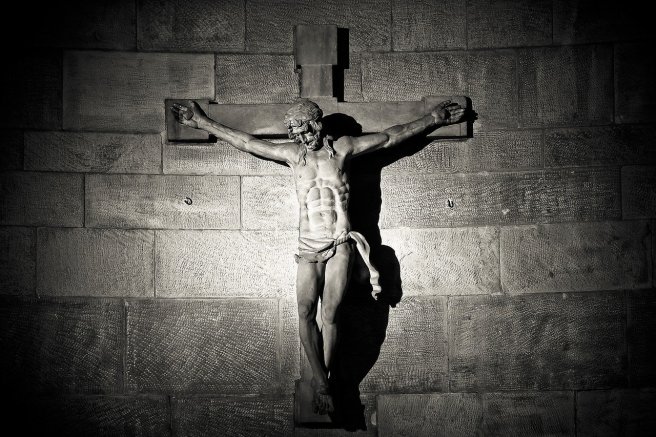
How could one anointed and glorified by God, the one we now understand to be God in flesh, die such a horrible, humiliating death? Over time, Christians have gotten used to the idea of the bloodied Jesus hanging on a cross, but we have to admit the image is strange, particularly to people not raised in the faith.

To answer the question raised by the crowd, it is necessary to explore the design of salvation, and that means we delve into a mystery too complex for us to understand in full, at least in this life. Jesus’ answer, rooted in “light” and “darkness,” gives us insight, however.

For all practical purposes, the Son of Man mounted a rescue mission. Because of our sins, we were trapped in darkness—a place that the Holy God, who is light, had every right to disregard. Out of love, however, he chose not to forget us or destroy us.

Instead, the light entered the darkness to find us, taking on flesh. The title “Son of God” reminds us of his divinity; the title “Son of Man” reminds us of his blessed humanity.

To break the grip sin and death had on us, Jesus had to bear our punishment for sin. Or we might say he had to ransom us from sin. Or we might say he carried our shame. Or we might say he became the one perfect sacrifice for sin, simultaneously priest and slain lamb. These and other descriptions of how atonement works mark the point where the mystery becomes almost unfathomable. We use metaphors to understand what can be grasped in full only by the mind of God.

What’s important is that we believe Christ’s death on the cross is effective, that the divine machinery works even if we cannot comprehend all its cogs and pulleys.

Lord, on this Holy Tuesday we reaffirm our belief that the Son of Man died on the cross, knowing our belief is enough to pull us from darkness into light.

Worshiping with Abandon

Welcome to Holy Week! We will walk with Jesus this week toward Good Friday and the cross.

John 12:1-8 (NRSV)

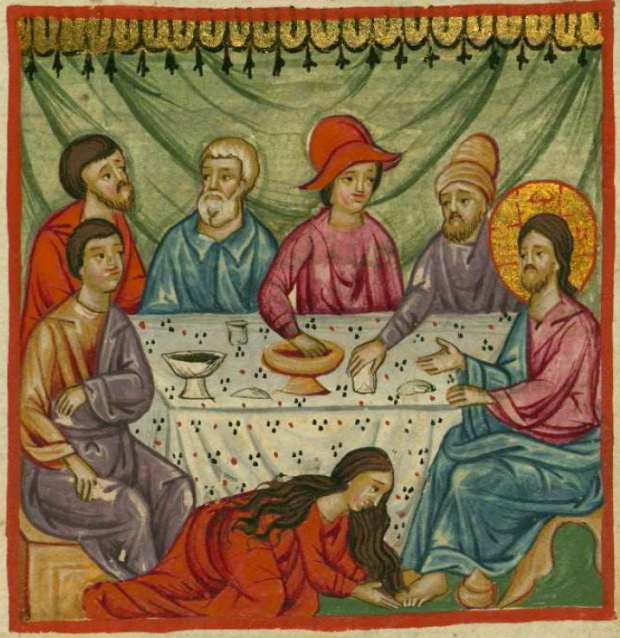
Six days before the Passover Jesus came to Bethany, the home of Lazarus, whom he had raised from the dead. There they gave a dinner for him. Martha served, and Lazarus was one of those at the table with him. Mary took a pound of costly perfume made of pure nard, anointed Jesus’ feet, and wiped them with her hair. The house was filled with the fragrance of the perfume. But Judas Iscariot, one of his disciples (the one who was about to betray him), said, “Why was this perfume not sold for three hundred denarii and the money given to the poor?” (He said this not because he cared about the poor, but because he was a thief; he kept the common purse and used to steal what was put into it.) Jesus said, “Leave her alone. She bought it so that she might keep it for the day of my burial. You always have the poor with you, but you do not always have me.”


By Chuck Griffin

It’s not difficult to discern that Mary—the sister-of-Lazarus Mary—did something strange and even shocking when she used a small fortune in perfume on Jesus’ feet.

If you see Christianity as a strait-laced, rules-oriented faith, and you would rather hold on to that view, you might want to avoid a story like this one altogether. The characters in this story had been swelling with emotion for days, and Mary finally exploded in an act of love that defied logic and propriety. The only speaker of earthly logic in this story was Judas, who was a few days from falling under Satan’s complete control.

Siblings and Friends

Bible readers will remember Mary and her siblings Martha and Lazarus. There is a story in the tenth chapter of Luke where Mary sat at Jesus’ feet as Martha worked in the kitchen. When Martha complained, Jesus said Mary had “the better part.”

John tells us all three were Jesus’ friends. It’s likely their home in Bethany, two miles from Jerusalem, was where Jesus stayed when he drew near to the heart of Judaism. They also may have been wealthy, and because the sisters are described as living with their brother, they either were young and unmarried or widowed.

The described volume of nard, probably spikenard from India, was worth about a year’s wages to a common laborer. It is unclear why Mary had it. In a world without secure bank accounts, it might have been a compact way for her to maintain some financial security. She may have intended it for her wedding night—the Song of Solomon demonstrates that nard’s warm, musky, intense smell was associated with sex. And, as is clear from the story, it could be used to prepare a loved one for burial.

For whatever reason Mary owned it, the nard represented her concern for the future.

Statements of Faith

At this dinner, Mary, Martha and Lazarus must have felt overwhelmed. Just a few days earlier, Jesus had performed his most astounding miracle, the raising of Lazarus from the dead.

As you may recall, Jesus deliberately dallied in going to his friends despite knowing Lazarus was sick, telling his disciples this event was occurring so “the Son of God may be glorified through it.”

By the time Jesus arrived in Bethany, Lazarus had been dead and in the tomb four days. In the exchange that occurred between the sisters and Jesus, we see they believed in Jesus fully. Martha went so far as to call Jesus “the Messiah, the Son of God, the one coming into the world.”

Jesus, moved by Mary and Martha’s pain, then proved he has power over life and death by calling Lazarus out of the tomb.

We need to keep those events in mind to understand Mary’s seemingly wasteful activity. She was riding an emotional epiphany—she and Martha had a deep understanding of what it means to be friends with someone who has power over life and death. Their beloved brother had been restored. They had experienced the pain and stench of death, and Jesus had replaced all of that with hope and joy.

An Act of Worship

When Mary poured out that overpowering nard and wiped Jesus’ feet with her hair, she worshiped. There really is no other word adequate to describe her actions. And in her actions, we are reminded why we worship.

I think this woman who had sat at Jesus’ feet to hear his teaching knew in some way that salvation for everyone—ever-present death transformed to everlasting life—was in the works. And knowing this, Mary dropped to her knees before our savior and worshiped, abandoning any concerns or cares she had for this world. She poured out her future on Jesus’ feet, knowing the work he would do as Messiah provided the greatest security.

As we draw nearer to Good Friday and Easter, can we learn to abandon ourselves so? Can we learn to trust so completely?

Those who do so will find true worship, and the scent of eternity will be on them and all who gather around.

Lord, on this Monday of Holy Week, we recommit ourselves to worshiping you as the one with power over life and death. Amen.