An Honest Searching

Psalm 39
For Jeduthun, the choir director: A psalm of David.
I said to myself, “I will watch what I do
    and not sin in what I say.
I will hold my tongue
    when the ungodly are around me.”
But as I stood there in silence—
    not even speaking of good things—
    the turmoil within me grew worse.
The more I thought about it,
    the hotter I got,
    igniting a fire of words:
“Lord, remind me how brief my time on earth will be.
    Remind me that my days are numbered—
    how fleeting my life is.
You have made my life no longer than the width of my hand.
    My entire lifetime is just a moment to you;
    at best, each of us is but a breath.”        Interlude

We are merely moving shadows,
    and all our busy rushing ends in nothing.
We heap up wealth,
    not knowing who will spend it.
And so, Lord, where do I put my hope?
    My only hope is in you.
Rescue me from my rebellion.
    Do not let fools mock me.
I am silent before you; I won’t say a word,
    for my punishment is from you.
But please stop striking me!
    I am exhausted by the blows from your hand.
When you discipline us for our sins,
    you consume like a moth what is precious to us.
    Each of us is but a breath.        Interlude

Hear my prayer, O Lord!
    Listen to my cries for help!
    Don’t ignore my tears.
For I am your guest—
    a traveler passing through,
    as my ancestors were before me.
Leave me alone so I can smile again
    before I am gone and exist no more.

By Chuck Griffin

This season of Lent is, again, a time for spiritual searching. Today’s psalm is a powerful example of how that search can whip one to and fro, triggering a range of emotions including stoicism, anger, despair and humility.

If you just skimmed over the psalm, please, slow down, or wait until you have time to slow down, and read it carefully. When you reach the words translated as “Interlude,” take time to breathe and to ponder what has been said thus far.

We also could say that the psalmist moves from an effort at self-control to something more valuable—willing surrender to God, to God’s majesty and undeniable power.

And remember, God does not ignore our tears. In fact, he refuses to ignore us, even if we plead with him to do so. Christ came not to ignore us, but to rescue us. There is no reason to fear that we will be gone, that we will exist no more.

Lord, this is a somber time in the Christian year, but we also feel ourselves being pulled toward hope. In our humility and despair, help us to anticipate the freedom to come. Amen.

A Sermon: “Headed Home”

Here’s a Monday Extra for Methodist Life readers. As some of you are aware, this blog began as part of outreach efforts by the Holston Wesleyan Covenant Association. The link below will take you to the manuscript of a sermon I preached last Saturday during worship, before our Holston chapter’s annual business meeting.

Headed Home”

Words to Strengthen

Revelation 2:8-11 (NLT)

“Write this letter to the angel of the church in Smyrna. This is the message from the one who is the First and the Last, who was dead but is now alive:

“I know about your suffering and your poverty—but you are rich! I know the blasphemy of those opposing you. They say they are Jews, but they are not, because their synagogue belongs to Satan. Don’t be afraid of what you are about to suffer. The devil will throw some of you into prison to test you. You will suffer for ten days. But if you remain faithful even when facing death, I will give you the crown of life.

“Anyone with ears to hear must listen to the Spirit and understand what he is saying to the churches. Whoever is victorious will not be harmed by the second death.”

By Chuck Griffin

The Book of Revelation features messages from our risen Christ to seven churches in various states of spiritual formation or decline. The church at Smyrna, located in what is now Turkey, was spiritually strong but heavily persecuted.

As I read this, my mind goes to the power of supportive words. Imagine a direct word from Jesus telling you to persevere—stick with it—hold fast to your beliefs! Even a tortured soul could weather any storm, knowing the promise of eternal life.

It’s amazing how God shows up in the small places, too. I was grumpy (again) on a recent Sunday morning. There’s no need to go into what made me grumpy, as it was silly, certainly nothing along the lines of the big threats the Christians at Smyrna were facing. But I do know this: It’s not good for a pastor to be grumpy right before preaching time.

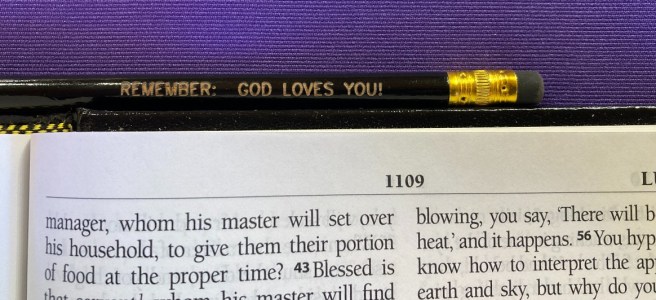
Words from God snapped me out of it. Not words from the Bible, but words on the side of a black pencil, one I had snatched up in haste from a random spot to mark my pulpit Bible. As I laid it down, these words, printed in gold, stared up at me: “REMEMBER: GOD LOVES YOU!”

I took a deep breath, and I knew things were going to be okay.

I am grateful for that little pencil, and the person who had the wisdom to order that phrase to go on it and its No. 2 box mates.

A couple of days later, I was again feeling stressed, this time over a critically important meeting. While waiting, I picked up the mail from the day before, and among the bills and advertisements was a note from two friends offering me words of encouragement.

During that meeting, the note was in my shirt pocket, a token of God’s love passed along by others.

The Bible is full of encouragement, sometimes carried into the world by angels. But don’t be surprised if a pencil or a friend steps in to deliver the message of God’s love when you need it the most.

Lord, thank you for the way grace flows into our lives in surprising ways. Keep us mindful of our role in channeling your love to those in need. Amen.

One in Twenty-Five

By Chuck Griffin

As we come out of this pandemic, the church where I serve as pastor, Holston View United Methodist in Weber City, Va., is in a time of discernment. As part of that, we are going to spend some time discussing and then, I hope, practicing evangelism.    

That’s caused me to think about basic evangelism principles I have learned through the years. If you’ve been a Christian for any significant time, I’m confident someone has shared with you the general mandate for all Christians: We are to bring others to a belief in Christ.

This act is rooted most strongly in Jesus’ words recorded at the end of the gospel of Matthew.

“Go therefore and make disciples of all nations, baptizing them in the name of the Father and of the Son and of the Holy Spirit, and teaching them to obey everything that I have commanded you,” Jesus said.

Knowing we’re supposed to evangelize and actually evangelizing are two different things, however. The idea is intriguing, but its execution can be intimidating, particularly if we begin to imagine the hostile responses we might receive.

I struggled with this until I was in seminary, when I was blessed with a very effective professor of evangelism, Dr. Robert G. Tuttle Jr. A couple of his key ideas really helped me.

The first principle helps us to remember that evangelizing is not manipulative. It is compassionate.

“I do not love in order to evangelize. I evangelize because I love,” Tuttle would say.

If we’re struggling with evangelism, we may also be struggling with our relationship with God. Growing in love for God and our neighbors by praying, worshiping, reading the Bible and being in fellowship with those in our community is essential to effective evangelism.

The second principle helps us to deal with what is basically a fear of failure. It gets us to stop expecting every encounter with a non-Christian to result in that person falling to his or her knees, calling on Christ for salvation.

Tuttle called this principle “1 in 25,” which comes from a jailhouse ministry experience he had as a young pastor. After he had witnessed to inmates one day, one of them declared his desire to follow Christ.

Tuttle said he went back the next day, obviously quite proud of himself. The inmate told him this: “Tuttle, I lay awake all last night, thinking. Suddenly it occurred to me that it takes an average of 25 different witnesses before any real encounter with God takes place. Just because you were number 25, you think you did it all, and you stink.”

When you tell someone about Christ, you may be witness number 3, or number 7, or number 22. What’s important is that you move that person forward in his or her understanding of Jesus Christ.

These two principles don’t deal with every aspect of evangelism, of course. There are entire books written on how to find common ground with people so we can talk about Christ in a natural way. Most of these books focus on the need to listen before we speak.

I pray, however, that Tuttle’s two principles will help relieve some of the fears you may experience as you share the good news about the love of Jesus Christ.

Lord, As we go about fulfilling the most basic duty you have given us, give us a sense of peace, knowing you arrived on the scene ahead of us, preparing the way. Amen.

From There

Philippians 3:17-20

By John Grimm

“I am not good enough to be in heaven.” 

Did that sound humble?  For that is the truth.  Admitting that I need a savior to come from heaven is a humbling statement.  It is to admit that I have been an enemy of Jesus, an enemy of God! When we turn from our belly (which has become our god), and escape our shame (which we used to brag about), we also turn to heaven (before, our minds were focused on what is below our feet). 

Turning to heaven is to turn where Jesus Christ is located now.  We humble ourselves because we were not focused on his glory.  Now that we have turned to heaven, we see that Jesus transforms us!  As we continue to look to Jesus, he works so that we match up to his glorious body.  Jesus does this work in us.

Jesus came the first time to die for our sins.  Jesus will come the second time on this planet so that we may be fitted to live with him for all time.  Between Jesus’ first and second arrivals on Earth, we decide.  We choose either to humble ourselves or to not humble ourselves.  The apostle Paul and numerous other Christians have given us examples to live.  What will be our decision?

Father Almighty, we are getting to the point in which we know we need a savior.  We are sinners.  As we find healthy Christians in our midst, may we see how to stop living as enemies of the cross.  Prepare us for Jesus’ second arrival on earth.  Allow Jesus to use his power so we may match up with his glorious body when he returns.  In the name of Jesus Christ, we pray.  Amen.

Alien Lives

By Chuck Griffin

Remember the Coneheads skits on Saturday Night Live? Dan Aykroyd, Jane Curtin and Laraine Newman played aliens from the planet Remulak living among us.

The funny thing about the skits was not how different the aliens appeared—great comedians don’t rely on a costume to win a laugh.

I laughed the hardest when Beldar, Prymaat and their daughter, Connie, managed to blend in with humans despite their enormous, pointy heads and mechanical speech. Usually, the explanation “We’re from Remulak, a small town in France,” was enough to carry them through an awkward moment with the neighbors.

Good comedy often rides on currents of social criticism. The Coneheads skits were funnier because we’re all conscious of how the world wants us to blend in, making  it easy for us to conform. The Bible reminds Christians, however, that we are called to live as aliens in a strange world, knowing our citizenship lies elsewhere.

In Philippians 3:17-4:1, we hear Paul tell the fledgling church at Philippi that people of the world set their minds on “earthly things,” failing to understand the bigger picture of what God is doing in the world through Jesus Christ.

“Their end is destruction; their god is the belly; and their glory is in their shame,” Paul wrote. (We don’t have a lot of details about what was going on in Philippi, although elsewhere in his letter Paul does refer to the church as being in the midst of a “crooked and perverse generation.”)

Not understanding the church, the nonbelievers even persecuted the Christians, becoming what Paul called “enemies of the cross.”

Clearly, the Philippian Christians were wavering, wanting to blend in by participating in the short-sighted living going on around them. To stiffen their resolve, Paul reminded them of their eternal citizenship in heaven and the promise that their current unglamorous position will be transformed into something glorious.

And yes, as they so often are, Paul’s words are very applicable today. Even where there is no persecution, secular society seems happiest with Christians who choose to be quiet and conform.

As long as we don’t interfere with the “consume mass quantities,” be-happy-in-the-moment forces that shape our lives, we usually are left alone, at least in the United States. We’re even allowed to make a lot of public noise about Easter, as long as we dress the story in bunnies and bonnets.

We cannot settle for blending in, however. The message of salvation through Jesus Christ is too powerful, and the eternal joy brought by the promise of resurrection is too great, even if it does make the non-Christian world uncomfortable.

We are aliens in a strange land, citizens under a coming savior king who will one day rule in both heaven and here on a restored Earth. And the news is too good to keep to ourselves.

During this season of preparation for Easter, don’t conform. Find new ways to stand out as you tell people where their true citizenship lies, in the kingdom of God.

Lord, help us to benefit your kingdom by being in the world, but not of it. Amen.

Watch!

Luke 21:34-36

By John Grimm

Every year it seems like Christmas comes before we are ready.  We are going to work.  We are doing our daily and weekly routines at the store, with our family, and with the church.  Suddenly, there it is.  It is Christmas (again)!  How did we not notice it creeping up on us?

Jesus warned the disciples and all the people (Luke 20:45) to be on guard.  We can be weighed down with the concerns of work and home.  We can be drunk on how well our college tournament brackets are going to perform.  We can even be worried about how high the gas prices will go.

Life can trap us., so much so that we may actually miss out on what God is doing around us.  Heaven forbid if we miss what God is doing in our lives!  Our social media feed will not get us caught up with what we missed from God.  What can we do?

We pray.  We are alert in prayer as we ask Jesus for strength to prepare us for the destruction Jesus foretold in Luke 21:5-33.  The power of the Holy Spirit can get us to the point where we can stand before the Son of Man.

Until Jesus Christ returns, we can be praying.  That will be the best posture for Jesus to find us in when that day happens.

Almighty God, we know not when Jesus Christ will return.  Until that day arrives, we read that Jesus wants us to be on guard.  Thank you that we can meet you in prayer.  May all the troubles of this life and the destruction to come not trap us, making us unready for when Jesus returns.  Holy Spirit, give us the strength we need to make it through that day.  We ask this request in the name of Jesus Christ.  Amen.

Real and Present Sin

I encourage the reader to take time for a slow, meditative reading of today’s Scripture. It is pertinent to our modern situation in so many ways. We will use the easier-to-process New Living Translation today.

2 Peter 2:4-21 (NLT)

For God did not spare even the angels who sinned. He threw them into hell, in gloomy pits of darkness, where they are being held until the day of judgment. And God did not spare the ancient world—except for Noah and the seven others in his family. Noah warned the world of God’s righteous judgment. So God protected Noah when he destroyed the world of ungodly people with a vast flood. Later, God condemned the cities of Sodom and Gomorrah and turned them into heaps of ashes. He made them an example of what will happen to ungodly people. But God also rescued Lot out of Sodom because he was a righteous man who was sick of the shameful immorality of the wicked people around him. Yes, Lot was a righteous man who was tormented in his soul by the wickedness he saw and heard day after day. So you see, the Lord knows how to rescue godly people from their trials, even while keeping the wicked under punishment until the day of final judgment. He is especially hard on those who follow their own twisted sexual desire, and who despise authority.

These people are proud and arrogant, daring even to scoff at supernatural beings without so much as trembling. But the angels, who are far greater in power and strength, do not dare to bring from the Lord a charge of blasphemy against those supernatural beings.

These false teachers are like unthinking animals, creatures of instinct, born to be caught and destroyed. They scoff at things they do not understand, and like animals, they will be destroyed. Their destruction is their reward for the harm they have done. They love to indulge in evil pleasures in broad daylight. They are a disgrace and a stain among you. They delight in deception even as they eat with you in your fellowship meals. They commit adultery with their eyes, and their desire for sin is never satisfied. They lure unstable people into sin, and they are well trained in greed. They live under God’s curse. They have wandered off the right road and followed the footsteps of Balaam son of Beor, who loved to earn money by doing wrong. But Balaam was stopped from his mad course when his donkey rebuked him with a human voice.

These people are as useless as dried-up springs or as mist blown away by the wind. They are doomed to blackest darkness. They brag about themselves with empty, foolish boasting. With an appeal to twisted sexual desires, they lure back into sin those who have barely escaped from a lifestyle of deception. They promise freedom, but they themselves are slaves of sin and corruption. For you are a slave to whatever controls you. And when people escape from the wickedness of the world by knowing our Lord and Savior Jesus Christ and then get tangled up and enslaved by sin again, they are worse off than before. It would be better if they had never known the way to righteousness than to know it and then reject the command they were given to live a holy life.

By Chuck Griffin

French poet and essayist Charles Baudelaire wrote, “The devil’s best trick is to persuade you that he does not exist.” Just short of that, I suppose, would be Satan’s success in convincing us that sin really doesn’t matter.

Both are notions flatly contrary to the Bible. Sin not only exists, the acts constituting sin are clearly defined, even if people want to limit themselves to post-resurrection New Testament texts. Sin at one point corrupted the realm of angels, and it most certainly continues to corrupt the abode of humanity.

Sin is in us; sin is among us. False teachers openly carry it into our most sacred places, saying, “Oh, don’t worry about that.” As they do so, they move their arguments along in stages.

Stage 1: Play a game of Theological Twister with me, and I will show you the Bible doesn’t really say what the church has claimed all these centuries.

Stage 2: If you really think about it, there are whole sections of the Bible that need to be thrown out.

Stage 3: Are we really going to trust those musty old writings over what is in our own hearts?

Our reading from 2 Peter makes it clear that sin scoffers existed among the church in the earliest days of Christianity. They have always been nearby; that same old song of the false teachers simply receives a new tune now and then. It always remains a song of destruction, though.

Yes, there is love. Praise God there is love! Only magnificent love would be so patient with such nonsense. It took far more love than we can imagine to keep the holy Christ on the cross, dying for all our sins.

The pursuit of holiness is the perfectly appropriate response to such an astonishing gift of love. Holiness is simple: It is the committed effort to cease sinning, an effort made possible by repentance and the ongoing presence of the Holy Spirit in a believer’s life.

To be flip about sin—to deliberately, consciously draw others back into it—is to disregard the cross, the source of our salvation.

Lord, as we continue through this season of Lent, search us and show us where we deviate from your will. Amen.

The Altared Life

Ruins near Bethel, where Abraham is said to have built an altar. Photo circa 1920.

By Chuck Griffin

This season of Lent is a good time to consider how we honor and worship God. Abraham, called “Abram” in Genesis until God decrees a name change, is one of those faithful people who serves as a powerful example.

In Abraham’s story, we begin to see how the relationship between God and sin-sick humanity might be restored. In Genesis 12:1-8, God tells Abraham that a faithful response to God will have its rewards. Abraham will be a great nation with a great name. And through him, a blessing will come about that makes it possible for all the families of the earth to be blessed. (Think of a particular descendant, Jesus.)

Abraham is asked to do something in response to these promises—get up and move from a prosperous, comfortable life toward a strange land, Canaan. God seems to be saying, I’ll do something new, but show me you’re the kind of person who can handle change.

I’m struck by how Abraham’s lifelong response to God’s guidance makes use of altars, stopping points along the way where Abraham can worship and honor his creator and divine friend through prayer and sacrifice.

Abraham enters Canaan and builds an altar. He moves deeper into Canaan and builds an altar. God gives him a vision of all that will be called Abraham’s—a vast territory. And Abraham builds an altar.

Altar construction must have been routine for Abraham. Even in Genesis 22, when God makes the strangest demand on Abraham, the sacrifice of the old man’s long-awaited son, Isaac, Abraham faithfully builds the altar and prepares to act. God stops the sacrifice, seeing he has found a man who can pass the ultimate test of faith.

I’m left to wonder how successful I am at faithfully building altars in the modern sense, as I move through the years. Am I constantly looking for new ways and places to give praise and thanks? Do I use worship to mark those times when God’s intervention in my life is obvious? What of my life am I willing to give up to ensure I properly honor my creator and benefactor?

The altared life is the way to live, if Abraham’s story is any indication.

Lord, remind us to respond formally to your grace, and let us find joy kneeling at the altars we construct in this world and in our hearts. Amen.

Starting Point

By Chuck Griffin

Yesterday was Ash Wednesday, the beginning of our season of Lent. If you attended a traditional Ash Wednesday service, you may have had the opportunity to recite Psalm 51, which is clearly a psalm of repentance.

Whatever you might be planning to do during Lent to draw closer to God, repentance is the place to begin. Through repentance, we open ourselves to God. Through repentance, we relieve ourselves of all sorts of burdens.

So, here is our prayer for today:

Psalm 51 (ESV)

To the choirmaster. A Psalm of David, when Nathan the prophet went to him, after he had gone in to Bathsheba.

Have mercy on me, O God,
    according to your steadfast love;
according to your abundant mercy
    blot out my transgressions.
Wash me thoroughly from my iniquity,
    and cleanse me from my sin!

For I know my transgressions,
    and my sin is ever before me.
Against you, you only, have I sinned
    and done what is evil in your sight,
so that you may be justified in your words
    and blameless in your judgment.
Behold, I was brought forth in iniquity,
    and in sin did my mother conceive me.
Behold, you delight in truth in the inward being,
    and you teach me wisdom in the secret heart.

Purge me with hyssop, and I shall be clean;
    wash me, and I shall be whiter than snow.
Let me hear joy and gladness;
    let the bones that you have broken rejoice.
Hide your face from my sins,
    and blot out all my iniquities.
Create in me a clean heart, O God,
    and renew a right spirit within me.
Cast me not away from your presence,
    and take not your Holy Spirit from me.
Restore to me the joy of your salvation,
    and uphold me with a willing spirit.

Then I will teach transgressors your ways,
    and sinners will return to you.
Deliver me from bloodguiltiness, O God,
    O God of my salvation,
    and my tongue will sing aloud of your righteousness.
O Lord, open my lips,
    and my mouth will declare your praise.
For you will not delight in sacrifice, or I would give it;
    you will not be pleased with a burnt offering.
The sacrifices of God are a broken spirit;
    a broken and contrite heart, O God, you will not despise.

Do good to Zion in your good pleasure;
    build up the walls of Jerusalem;
then will you delight in right sacrifices,
    in burnt offerings and whole burnt offerings;
    then bulls will be offered on your altar.