Alien Lives

By Chuck Griffin

Remember the Coneheads skits on Saturday Night Live? Dan Aykroyd, Jane Curtin and Laraine Newman played aliens from the planet Remulak living among us.

The funny thing about the skits was not how different the aliens appeared—great comedians don’t rely on a costume to win a laugh.

I laughed the hardest when Beldar, Prymaat and their daughter, Connie, managed to blend in with humans despite their enormous, pointy heads and mechanical speech. Usually, the explanation “We’re from Remulak, a small town in France,” was enough to carry them through an awkward moment with the neighbors.

Good comedy often rides on currents of social criticism. The Coneheads skits were funnier because we’re all conscious of how the world wants us to blend in, making  it easy for us to conform. The Bible reminds Christians, however, that we are called to live as aliens in a strange world, knowing our citizenship lies elsewhere.

In Philippians 3:17-4:1, we hear Paul tell the fledgling church at Philippi that people of the world set their minds on “earthly things,” failing to understand the bigger picture of what God is doing in the world through Jesus Christ.

“Their end is destruction; their god is the belly; and their glory is in their shame,” Paul wrote. (We don’t have a lot of details about what was going on in Philippi, although elsewhere in his letter Paul does refer to the church as being in the midst of a “crooked and perverse generation.”)

Not understanding the church, the nonbelievers even persecuted the Christians, becoming what Paul called “enemies of the cross.”

Clearly, the Philippian Christians were wavering, wanting to blend in by participating in the short-sighted living going on around them. To stiffen their resolve, Paul reminded them of their eternal citizenship in heaven and the promise that their current unglamorous position will be transformed into something glorious.

And yes, as they so often are, Paul’s words are very applicable today. Even where there is no persecution, secular society seems happiest with Christians who choose to be quiet and conform.

As long as we don’t interfere with the “consume mass quantities,” be-happy-in-the-moment forces that shape our lives, we usually are left alone, at least in the United States. We’re even allowed to make a lot of public noise about Easter, as long as we dress the story in bunnies and bonnets.

We cannot settle for blending in, however. The message of salvation through Jesus Christ is too powerful, and the eternal joy brought by the promise of resurrection is too great, even if it does make the non-Christian world uncomfortable.

We are aliens in a strange land, citizens under a coming savior king who will one day rule in both heaven and here on a restored Earth. And the news is too good to keep to ourselves.

During this season of preparation for Easter, don’t conform. Find new ways to stand out as you tell people where their true citizenship lies, in the kingdom of God.

Lord, help us to benefit your kingdom by being in the world, but not of it. Amen.
Watch!

Luke 21:34-36

By John Grimm

Every year it seems like Christmas comes before we are ready.  We are going to work.  We are doing our daily and weekly routines at the store, with our family, and with the church.  Suddenly, there it is.  It is Christmas (again)!  How did we not notice it creeping up on us?

Jesus warned the disciples and all the people (Luke 20:45) to be on guard.  We can be weighed down with the concerns of work and home.  We can be drunk on how well our college tournament brackets are going to perform.  We can even be worried about how high the gas prices will go.

Life can trap us., so much so that we may actually miss out on what God is doing around us.  Heaven forbid if we miss what God is doing in our lives!  Our social media feed will not get us caught up with what we missed from God.  What can we do?

We pray.  We are alert in prayer as we ask Jesus for strength to prepare us for the destruction Jesus foretold in Luke 21:5-33.  The power of the Holy Spirit can get us to the point where we can stand before the Son of Man.

Until Jesus Christ returns, we can be praying.  That will be the best posture for Jesus to find us in when that day happens.

Almighty God, we know not when Jesus Christ will return.  Until that day arrives, we read that Jesus wants us to be on guard.  Thank you that we can meet you in prayer.  May all the troubles of this life and the destruction to come not trap us, making us unready for when Jesus returns.  Holy Spirit, give us the strength we need to make it through that day.  We ask this request in the name of Jesus Christ.  Amen.

Real and Present Sin

I encourage the reader to take time for a slow, meditative reading of today’s Scripture. It is pertinent to our modern situation in so many ways. We will use the easier-to-process New Living Translation today.

2 Peter 2:4-21 (NLT)

For God did not spare even the angels who sinned. He threw them into hell, in gloomy pits of darkness, where they are being held until the day of judgment. And God did not spare the ancient world—except for Noah and the seven others in his family. Noah warned the world of God’s righteous judgment. So God protected Noah when he destroyed the world of ungodly people with a vast flood. Later, God condemned the cities of Sodom and Gomorrah and turned them into heaps of ashes. He made them an example of what will happen to ungodly people. But God also rescued Lot out of Sodom because he was a righteous man who was sick of the shameful immorality of the wicked people around him. Yes, Lot was a righteous man who was tormented in his soul by the wickedness he saw and heard day after day. So you see, the Lord knows how to rescue godly people from their trials, even while keeping the wicked under punishment until the day of final judgment. He is especially hard on those who follow their own twisted sexual desire, and who despise authority.

These people are proud and arrogant, daring even to scoff at supernatural beings without so much as trembling. But the angels, who are far greater in power and strength, do not dare to bring from the Lord a charge of blasphemy against those supernatural beings.

These false teachers are like unthinking animals, creatures of instinct, born to be caught and destroyed. They scoff at things they do not understand, and like animals, they will be destroyed. Their destruction is their reward for the harm they have done. They love to indulge in evil pleasures in broad daylight. They are a disgrace and a stain among you. They delight in deception even as they eat with you in your fellowship meals. They commit adultery with their eyes, and their desire for sin is never satisfied. They lure unstable people into sin, and they are well trained in greed. They live under God’s curse. They have wandered off the right road and followed the footsteps of Balaam son of Beor, who loved to earn money by doing wrong. But Balaam was stopped from his mad course when his donkey rebuked him with a human voice.

These people are as useless as dried-up springs or as mist blown away by the wind. They are doomed to blackest darkness. They brag about themselves with empty, foolish boasting. With an appeal to twisted sexual desires, they lure back into sin those who have barely escaped from a lifestyle of deception. They promise freedom, but they themselves are slaves of sin and corruption. For you are a slave to whatever controls you. And when people escape from the wickedness of the world by knowing our Lord and Savior Jesus Christ and then get tangled up and enslaved by sin again, they are worse off than before. It would be better if they had never known the way to righteousness than to know it and then reject the command they were given to live a holy life.

By Chuck Griffin

French poet and essayist Charles Baudelaire wrote, “The devil’s best trick is to persuade you that he does not exist.” Just short of that, I suppose, would be Satan’s success in convincing us that sin really doesn’t matter.

Both are notions flatly contrary to the Bible. Sin not only exists, the acts constituting sin are clearly defined, even if people want to limit themselves to post-resurrection New Testament texts. Sin at one point corrupted the realm of angels, and it most certainly continues to corrupt the abode of humanity.

Sin is in us; sin is among us. False teachers openly carry it into our most sacred places, saying, “Oh, don’t worry about that.” As they do so, they move their arguments along in stages.

Stage 1: Play a game of Theological Twister with me, and I will show you the Bible doesn’t really say what the church has claimed all these centuries.

Stage 2: If you really think about it, there are whole sections of the Bible that need to be thrown out.

Stage 3: Are we really going to trust those musty old writings over what is in our own hearts?

Our reading from 2 Peter makes it clear that sin scoffers existed among the church in the earliest days of Christianity. They have always been nearby; that same old song of the false teachers simply receives a new tune now and then. It always remains a song of destruction, though.

Yes, there is love. Praise God there is love! Only magnificent love would be so patient with such nonsense. It took far more love than we can imagine to keep the holy Christ on the cross, dying for all our sins.

The pursuit of holiness is the perfectly appropriate response to such an astonishing gift of love. Holiness is simple: It is the committed effort to cease sinning, an effort made possible by repentance and the ongoing presence of the Holy Spirit in a believer’s life.

To be flip about sin—to deliberately, consciously draw others back into it—is to disregard the cross, the source of our salvation.

Lord, as we continue through this season of Lent, search us and show us where we deviate from your will. Amen.

The Altared Life

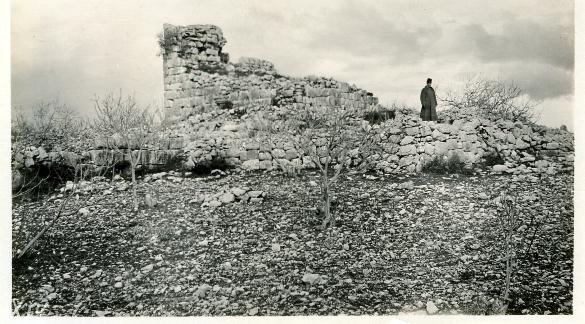
Ruins near Bethel, where Abraham is said to have built an altar. Photo circa 1920.

By Chuck Griffin

This season of Lent is a good time to consider how we honor and worship God. Abraham, called “Abram” in Genesis until God decrees a name change, is one of those faithful people who serves as a powerful example.

In Abraham’s story, we begin to see how the relationship between God and sin-sick humanity might be restored. In Genesis 12:1-8, God tells Abraham that a faithful response to God will have its rewards. Abraham will be a great nation with a great name. And through him, a blessing will come about that makes it possible for all the families of the earth to be blessed. (Think of a particular descendant, Jesus.)

Abraham is asked to do something in response to these promises—get up and move from a prosperous, comfortable life toward a strange land, Canaan. God seems to be saying, I’ll do something new, but show me you’re the kind of person who can handle change.

I’m struck by how Abraham’s lifelong response to God’s guidance makes use of altars, stopping points along the way where Abraham can worship and honor his creator and divine friend through prayer and sacrifice.

Abraham enters Canaan and builds an altar. He moves deeper into Canaan and builds an altar. God gives him a vision of all that will be called Abraham’s—a vast territory. And Abraham builds an altar.

Altar construction must have been routine for Abraham. Even in Genesis 22, when God makes the strangest demand on Abraham, the sacrifice of the old man’s long-awaited son, Isaac, Abraham faithfully builds the altar and prepares to act. God stops the sacrifice, seeing he has found a man who can pass the ultimate test of faith.

I’m left to wonder how successful I am at faithfully building altars in the modern sense, as I move through the years. Am I constantly looking for new ways and places to give praise and thanks? Do I use worship to mark those times when God’s intervention in my life is obvious? What of my life am I willing to give up to ensure I properly honor my creator and benefactor?

The altared life is the way to live, if Abraham’s story is any indication.

Lord, remind us to respond formally to your grace, and let us find joy kneeling at the altars we construct in this world and in our hearts. Amen.

Starting Point

By Chuck Griffin

Yesterday was Ash Wednesday, the beginning of our season of Lent. If you attended a traditional Ash Wednesday service, you may have had the opportunity to recite Psalm 51, which is clearly a psalm of repentance.

Whatever you might be planning to do during Lent to draw closer to God, repentance is the place to begin. Through repentance, we open ourselves to God. Through repentance, we relieve ourselves of all sorts of burdens.

So, here is our prayer for today:

Psalm 51 (ESV)

To the choirmaster. A Psalm of David, when Nathan the prophet went to him, after he had gone in to Bathsheba.

Have mercy on me, O God,
    according to your steadfast love;
according to your abundant mercy
    blot out my transgressions.
Wash me thoroughly from my iniquity,
    and cleanse me from my sin!

For I know my transgressions,
    and my sin is ever before me.
Against you, you only, have I sinned
    and done what is evil in your sight,
so that you may be justified in your words
    and blameless in your judgment.
Behold, I was brought forth in iniquity,
    and in sin did my mother conceive me.
Behold, you delight in truth in the inward being,
    and you teach me wisdom in the secret heart.

Purge me with hyssop, and I shall be clean;
    wash me, and I shall be whiter than snow.
Let me hear joy and gladness;
    let the bones that you have broken rejoice.
Hide your face from my sins,
    and blot out all my iniquities.
Create in me a clean heart, O God,
    and renew a right spirit within me.
Cast me not away from your presence,
    and take not your Holy Spirit from me.
Restore to me the joy of your salvation,
    and uphold me with a willing spirit.

Then I will teach transgressors your ways,
    and sinners will return to you.
Deliver me from bloodguiltiness, O God,
    O God of my salvation,
    and my tongue will sing aloud of your righteousness.
O Lord, open my lips,
    and my mouth will declare your praise.
For you will not delight in sacrifice, or I would give it;
    you will not be pleased with a burnt offering.
The sacrifices of God are a broken spirit;
    a broken and contrite heart, O God, you will not despise.

Do good to Zion in your good pleasure;
    build up the walls of Jerusalem;
then will you delight in right sacrifices,
    in burnt offerings and whole burnt offerings;
    then bulls will be offered on your altar.

Ash Wednesday

Isaiah 58:1-12

By John Grimm

The spiritual reasons for fasting have been lost on society.  United Methodists are surprised to learn that John Wesley fasted two days a week in his younger days. Later he fasted on Fridays. Charles Yrigoyen Jr., in “John Wesley: Holiness of Heart and Life,” writes:

Wesley was convinced that fasting, abstaining from food or drink, was a practice firmly grounded in the Bible. People in Old Testament times fasted (Ezra 8:23). So did Jesus and his followers (Matthew 4:2; Acts 13:3), and Wesley saw no reason why modern Christians should not follow the same pattern. His plan of fasting sometimes allowed for limited eating and drinking. He found that fasting advanced holiness.

Being holy, is that a reason to fast? Being holy seems to be a reason to fast. Isaiah 58 helps us get to how we should fast.

Why isn’t fasting working? We are rebelling.  These questions matter: Do we practice righteousness?  Whose interest are we serving? Are we quarreling?

God’s grace allows us to see the harsh reality of our lives. Sin is in our lives. At times, our attitudes are horrendous. It almost sounds like we, like Israel, can be spoiled brats trying to get the attention of our downtrodden parents! There must be more to drawing near to God.

What must change to have grace in our lives? We understand the kind of fast has the Lord chosen.  The fast the Lord has chosen includes justice, feeding the hungry, housing the homeless, giving clothes to the naked, and welcoming the stranger (among other tasks).  By doing these works, we work in the grace God has given us.

God’s grace can work through fasting. It is not a diet. Fasting is not an idea for young adults and youth who are worried about their body image, who are leaning toward purging. That is a sign of needing help. If you need to get closer to God, to be more holy, then fasting can be one way that you draw closer to God. That is if you are helping those who need help. Otherwise, we are just spinning our wheels.

It is in the basics of our faith that we gain the means to be closer to God, to become holy as he is. During Lent, we can give up chocolate or sweets. That would be categorized as abstaining. But to give up a meal or two and spend the time in prayer and giving those funds to the needy, that is fasting.

Will you fast this Lent? For those of us with health concerns, talk with your doctor before you fast. For those of us who need to get closer to God, to allow his grace to work in our lives, then let us fast. Just do not let anybody know when you are fasting.

That Constant Presence

 Deuteronomy 26:1-11

By Chuck Griffin

The above text will be, God willing, the heart of my sermon this Sunday. When I wrote about it here more than a year ago, I focused on our dependency on God.

I had this Jewish offering recitation on my mind yesterday, which was very different from my usual Monday. I had a midday church-related meeting in Alcoa, Tenn., and being in the area, I had dinner with a clergy friend in Knoxville that evening.

In between these events, I worked in some sermon planning, but I also had about an hour to walk around the University of Tennessee campus, something I had not been able to do in several years.. I graduated from UT’s College of Communications in 1988.

The nature of change was on my mind all day. I had spent time discussing the impending split of our denomination; later, my friend and I talked about the terrible personal change he has experienced.

The campus walk seemed surreal. I passed from the completely familiar to the astonishingly new as I moved from block to block. Buildings where I had once taken classes—buildings that had been surrounded by large swaths of green space—now sat huddled in the shadows of gleaming new structures.

I actually was excited by all I saw. The new buildings are wonderful additions, and the campus seems to have a sense of continuity that it lacked 34 years ago.

Strangest of all: There are wheeled delivery robots roaming the streets, less than knee-high and politely waiting their turns at the crosswalks. They must be very new, as the students were as intrigued by them as I was. One young man bent over to examine one, and then patted it as if it were a dog.

A day like I had yesterday, a day marked by thoughts of change and evidence of change, can startle us. Sometimes, it can even depress us. It helps to have some sort of recitation in our minds, a narrative account of how all that we experience fits into a larger story, one with some constancy to it.

When good Jews recited these words from Deuteronomy, they were anchoring themselves in the great truth that God loves them. When there was change, God was there to lead them through it all. Disease, invaders, famine, whatever, they remembered they were children of a wandering Aramean, and ultimately, the children of God.

As Christians, we use a similar strategy. The Apostles’ Creed reminds us of all those points in history where God has intervened to make us, redeem us and sustain us, and it promises God is in control into an eternal future. In our individual lives, we learn to tell the stories of how God has reached out to us, incorporating us into that larger story.

When faced with change, perhaps we could learn to recite a story beginning along these lines: “Mine was a wandering heart, brought home by an always present and loving God.”

Lord, keep us constantly mindful of your presence. Amen.

Grace Mail

By Chuck Griffin

Junk mail. I get it, you get it, we all get it. Usually, we just throw it away.

There’s a particularly annoying form of junk mail coming more and more. In recent years, marketers who use junk mail have become more deceptive as they try to get us to read what we didn’t want in our mailbox.

Instead of slick colors, the junk mail now sometimes comes in very official looking black-and-white envelopes, envelopes that practically scream, “I am important!”

I got a real humdinger. The return address was for a Florida office going by the name, “Records of Entitlement.”

The good folks there had printed “DISTRIBUTION OF FUNDS” on the envelope in thumbprint-sized letters. They also stamped “IMPORTANT DOCUMENTS” in another spot.

The sales pitch was fatally flawed in one way—it was addressed to “Resident” at my home address. It has been my experience that official funds aren’t distributed randomly to unnamed residents.

I did open the envelope just to see who could be so obnoxious. It was a local car dealership holding a sale.

But then I had an odd thought. Change “FUNDS” on that envelope to “GRACE,” stick the right information inside, and that envelope could be one of the most honest in the history of marketing.

If God were to use a mass mailing to reach people, that mailing would have to go to every resident of the world. God’s grace—by “grace,” I mean God’s loving offer to restore us and make us whole—is for everyone. The envelopes would make their way even to the people without homes and mailboxes.

Inside the envelope would be some basic information about how God came to earth as Jesus and died on the cross to keep us from suffering for our sins.

The pitch letter most certainly would quote John 3:16: “For God so loved the world that he gave his only Son, that whoever believes in him should not perish but have eternal life.”

We also would learn about the resurrection, the incredible “raised from the dead” event that happened first to Jesus. It is an event that Jesus promised will happen later to all of us. We would read how the grace channeled to us through Jesus will let us live forever with God.

The end of the pitch, of course, would tell us how to qualify for this fantastic offer.

“Just believe in what Jesus has done, and your name will be placed on file with God’s ‘Records of Entitlement’ office. Your reward—joy —will be available to you both now and eternally into the future!”

Like I said, it was just an odd thought I had while opening my mail. God doesn’t use mass mailings to make such an offer to the world. God uses us.

Dear Lord, accepting Jesus as Savior is such a simple matter. Help us to help people discover this wonderful truth. Amen.

Day of the Lord

By Chuck Griffin

Before we launch into today’s verses from Zephaniah, let’s acquire a little background on his situation.

The prophet spoke about 630 years before the birth of Jesus Christ, during a time of religious indifference, social injustice and economic greed.

This also was an important time of transition for the Kingdom of Judah, which was moving from King Amon, who had been assassinated, to King Josiah, a boy king. A little later in Josiah’s reign, the Book of the Law would be rediscovered. Essentially, the people were about to re-learn who they were, and Josiah, for a time, would restore them to religious righteousness.

Zephaniah was a contemporary of the Prophet Jeremiah. It very well may be that what Zephaniah said helped lay the groundwork for the transition back toward holiness.

Let’s hear some of what he had to say, recorded in Zephaniah 1:7-18:

Stand in silence in the presence of the Sovereign Lord,
    for the awesome day of the Lord’s judgment is near.
The Lord has prepared his people for a great slaughter
    and has chosen their executioners.
“On that day of judgment,”
    says the Lord,
“I will punish the leaders and princes of Judah
    and all those following pagan customs.
Yes, I will punish those who participate in pagan worship ceremonies,
    and those who fill their masters’ houses with violence and deceit.

“On that day,” says the Lord,
    “a cry of alarm will come from the Fish Gate
and echo throughout the New Quarter of the city.
    And a great crash will sound from the hills.
Wail in sorrow, all you who live in the market area,
    for all the merchants and traders will be destroyed.

“I will search with lanterns in Jerusalem’s darkest corners
    to punish those who sit complacent in their sins.
They think the Lord will do nothing to them,
    either good or bad.
So their property will be plundered,
    their homes will be ransacked.
They will build new homes
    but never live in them.
They will plant vineyards
    but never drink wine from them.

“That terrible day of the Lord is near.
    Swiftly it comes—
a day of bitter tears,
    a day when even strong men will cry out.
It will be a day when the Lord’s anger is poured out—
    a day of terrible distress and anguish,
a day of ruin and desolation,
    a day of darkness and gloom,
a day of clouds and blackness,
     a day of trumpet calls and battle cries.
Down go the walled cities
    and the strongest battlements!

 “Because you have sinned against the Lord,
    I will make you grope around like the blind.
Your blood will be poured into the dust,
    and your bodies will lie rotting on the ground."

Your silver and gold will not save you
    on that day of the Lord’s anger.
For the whole land will be devoured
    by the fire of his jealousy.
He will make a terrifying end
    of all the people on earth.

It’s hard to miss the sound of irrevocable finality in this concept of the “Day of the Lord.” Zephaniah may seem obscure to us, but the Day of the Lord is a common biblical theme, its images at times playing out in not-completely-final ways, giving us little preludes of what we are told is to come.

Jesus spoke in similar apocalyptic tones. Mark 13 is a good example.

Not everyone lives as if they will ever see such a day, including many who consider themselves God’s followers. In church circles, it is not unusual to hear people express a longing for the positive aspect of such a day, the visible return and rule of Jesus Christ. People ask, “Why does he take so long?”

And yet, judgment for both the living and the dead will accompany Christ’s return. I suspect many will examine their lives and cry out, “We needed more time!”

Christians live in the midst of a people much like Zephaniah’s, and we have to be careful not to fall in with them. It’s easy to think of examples of religious indifference, social injustice and economic greed all around us.

Our prayer should be that we’re moving into a similar time of transition, a rediscovery of what God has revealed to us and an awakening in our culture to how that truth impacts all of us.

Thanks be to God that he works in this world with an offer of overwhelming love and forgiveness, received through the simple belief that Christ died on the cross for our sins.

In return, all we are asked to do is to present the world with this tremendous opportunity to escape from what ultimately will be destroyed on the Day of the Lord.

Lord, show each of us what to do as part of a great turning back to you. Amen.

God in Art: A Different “Last Supper”

Today’s epistle reading in the daily lectionary is 1 Corinthians 11:17-22, 27-33. Paul gives instructions regarding communion, and how it can be taken worthily or unworthily.

When we take communion, we of course do this in remembrance of Christ’s Last Supper with his disciples. Traditionally, if we think of a painting, we tend to think of DaVinci’s famous depiction. There are other attempts to picture this moment, and I particularly like the one above, painted by Artus Wolffort around 1630. As we prepare for future opportunities to take communion worthily, perhaps meditating on this work will help.

Hope your screen is big enough, and that your week is increasingly blessed!