God in Art: Pietà

As we move toward the Christmas season, let’s not forget the larger story. Christ grew in wisdom and stature, and as a man had much to teach us regarding God’s love and expectations for us. Then he died for our sins, restoring us to God.

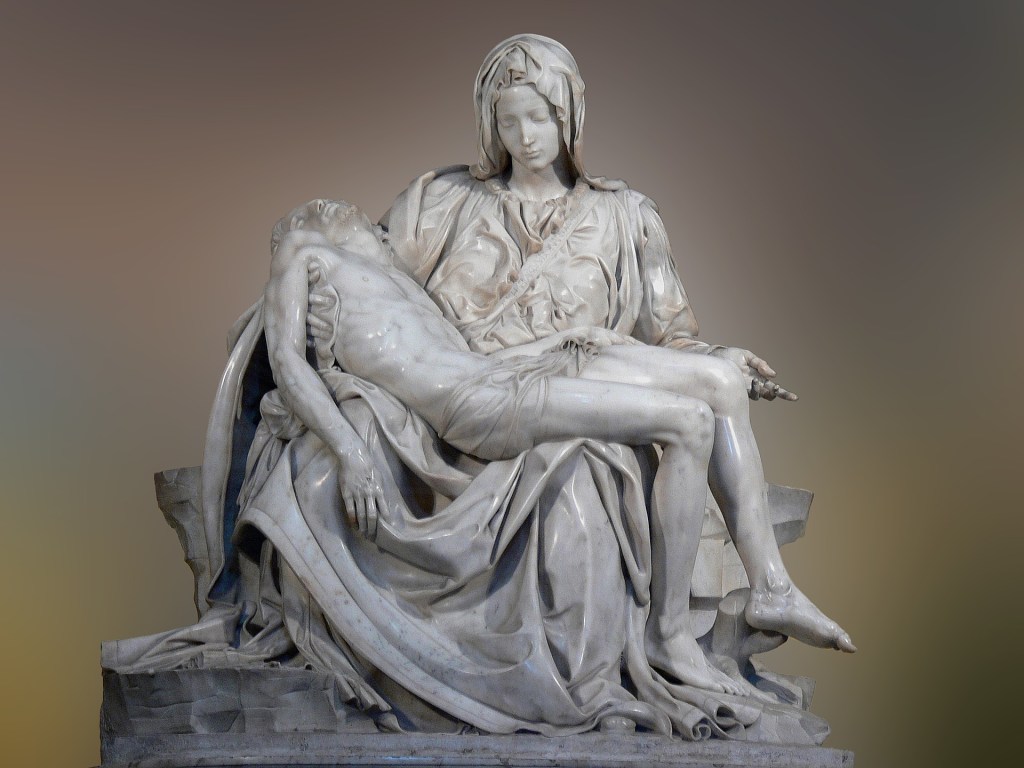
We can easily imagine Mary holding her son both at his birth and his death, when he was brought down from the crucifixion she witnessed. The Italian Renaissance artist Michelangelo beautifully captured the latter moment in a sculpture commissioned in 1497. It is called the Pietà, which in English means “Piety.” It is on display in St. Peter’s Basilica in Vatican City.

While it is a scene of death, the sculpture certainly can remind us of Christ’s birth. Mary is depicted as remarkably young, more like her age at Jesus’ birth than at his death more than three decades later. Michelangelo also altered the scale of the characters—if the two characters in the sculpture were to stand, Mary would tower over Jesus. And yet, the scene appears astonishingly natural, a mother cradling her son. The image seems to bridge the moments of birth and death.

Dear Lord, in this approaching Christmas season, may we carry in our hearts the full meaning of Christ’s presence among us. Amen.

Scripturally Gentle

Hebrews 10:10-18 (NRSV)

By Chuck Griffin

As Christians, we’re always trying to fully absorb the idea that God came among us in flesh to save us from the deadly power of sin.

With the Christmas season drawing near, I also couldn’t help but think of the humble birth of our Savior, cradled and softly placed in a feeding trough as his first bed. There is so much tenderness in that scene, a moment of beauty in the midst of what too often is a horror story, the ongoing story of people disconnected from God.

As traditional Christians, we so want to focus on the beauty of salvation, but we simultaneously want to be vigilant against the damage sin has wrought and continues to cause. The world has trouble understanding the nuanced message we offer; even followers of Christ sometimes struggle with how to offer that message.

At the extreme edges of our faith, some want to ignore the danger of sin, while others legalistically limit the possibilities of grace. Both edges can at times exhibit a surprising amount of anger.

To be successful in our basic mission, traditionalists need to carry with them an attitude rooted in how God is at work in the world. A phrase popped into my head recently: Scripturally gentle. Like Jesus, we need to be scripturally gentle, openly discussing the terrible danger of sin while preaching the power of grace.

It is not judgmental to share with others the warnings God has given us about certain behaviors. Those biblical revelations from God about what counts as sin need to be declared for all to hear. These should be gentle declarations, however, tempered constantly with the Good News that God offers redemption from sin through Jesus Christ.

Jesus gives us great examples of how to live as scripturally gentle people. One of my favorites is in John 8:3-11, the story of the woman caught in adultery and brought before Jesus. In short, there is sin present in the community, and the legalists want to use the situation as a harsh test. Jesus reminds those present that they all are in need of grace, and the woman’s would-be executioners drift away. Jesus then says to the rescued sinner, “Go your own way, and from now on do not sin again,” pointing her toward a process Methodists call sanctification.

The traditional Methodism I discovered and fell in love with as a young adult has long been filled with scripturally gentle people, setting it apart as a movement within the Kingdom of God. This middle way will continue, even if it has to happen under a new denominational name.

We offer the world an attractive, biblical way to live in faith, and God will bless this approach until the day we see Christ in full.

Lord, thank you for guidance and grace. May the two work hand-in-hand in our lives so we can become holy responses to your great gift of eternal life. Amen.

A Lesson in Changing Hearts

Acts 28:23-31 (NRSV): After [the leaders of the Jews in Rome] had set a day to meet with [Paul], they came to him at his lodgings in great numbers. From morning until evening he explained the matter to them, testifying to the kingdom of God and trying to convince them about Jesus both from the law of Moses and from the prophets. Some were convinced by what he had said, while others refused to believe.

By Chuck Griffin

I’m going to use what some think is an ugly word, even a scary word: evangelism. Before ascending into heaven, Christ called us to evangelize, but we sometimes avoid the topic because it carries some negative connotations.

All that negativity stems not from use but from abuse of the basic mission Jesus gave us. Evangelism isn’t about ambushing people with difficult questions so we feel we have discharged our duties. It is about preparing ourselves spiritually and intellectually, and then helping people find the answers to questions they naturally have.

The end of Paul’s story as he arrived to house arrest in Rome serves as a good example. Through letters and representatives, he already had built a relationship with a small group of Christians there, and his reputation allowed him to draw leaders of the Jews to his guarded home. There they heard the message that Jesus Christ is Savior, a deeply controversial idea.

Here’s what Paul did:

  1. He met his audience as the people they were. In this case, they were Jews, and he used the two godly sources they most respected, the law of Moses and the words of the prophets, to make his case. Being an educated Jew who had studied Judaism on a deep level equipped him well, of course. In short, we have to know our audience and the details of our own faith.
  2. He found a way to hold their interest and keep them in an extended conversation. It’s hard to imagine keeping people in an all-day conversation today, but we need to have a similar willingness to spend extended time with those who care enough to keep talking. Instead of a whole day, we might need to be willing to commit regular chunks of time to those who keep wanting more.
  3. He persevered despite the fact that some opposed him. Paul did all he could to make a convincing argument that Jesus Christ is Lord, and he kept trying to win the hearts of all who would listen. Acts ends this way: “He lived there two whole years at his own expense and welcomed all who came to him, proclaiming the kingdom of God and teaching about the Lord Jesus Christ with all boldness and without hindrance.”

Our churches’ situations can seem very different than what Paul faced, but these basic principles of evangelism remain. What creative efforts can we make to be Paul-like to our unbelieving neighbors?

Lord, grace us with a deeper understanding of evangelism so more may enter your kingdom each day. Amen.

Surely, Surely

Isaiah 12:2 (NRSV)
Surely God is my salvation;
    I will trust, and will not be afraid,
for the Lord God is my strength and my might;
    he has become my salvation.

By Chuck Griffin

I often default toward using longer texts in these devotions, especially if I can chase meaning in a well-developed Bible story. But sometimes a single verse offers us so much, drawing us into a more meditative place.

The first word is enough to dwell on for a while. “Surely.” Other translations go with “behold,” as if the certainty of the salvation being declared is visibly before the prophet, or another positive affirmation like “indeed.” Did Isaiah have a full vision of Jesus Christ?

How powerfully can I affirm that salvation is mine? Does my conviction rise and fall with my circumstances? Do I stand like an oak or bend like a reed?

How often does fear creep in?

Our faith is strongest, of course, when a being untainted by sin places it in us. The power to do anything, even believe, flows first from God. Faith should never involve a struggle; instead, it is an ongoing surrender.

Take time today to settle into this one verse, and see what it says to you.

Lord, wash over us so our faith never fails. Amen.

Preparing for Joy

Psalm 126. A Song of Ascents.

When the Lord restored the fortunes of Zion,
    we were like those who dream.
Then our mouth was filled with laughter,
    and our tongue with shouts of joy;
then it was said among the nations,
    “The Lord has done great things for them.”
The Lord has done great things for us,
    and we rejoiced.

Restore our fortunes, O Lord,
    like the watercourses in the Negeb.
May those who sow in tears
    reap with shouts of joy.
Those who go out weeping,
    bearing the seed for sowing,
shall come home with shouts of joy,
    carrying their sheaves.

By John Grimm

Grief takes time to work through.

Tears will arrive when they are least expected.

Misfortune can zap our dreams.

Yet the Lord has his means of restoring us.  If we have not given up, if we have not succumbed to the weeping, and if we have not been swallowed up in tragedy, then we can know how the Lord can restore us.  Some of us are cynical.  Some of us have cut ourselves off from any good because we have experienced much tragedy in our lives.  Some of us have stopped dreaming.

It is good to dream.  How can we have our fortunes restored?  How will God give us joy for which we can shout? Throughout the generations, people have paid attention to the Lord. When people pay attention to the Lord, then we see God restoring us.  That brings us joy!

We need not only have joy during Advent and Christmas.  There are more weeks to the year than the weeks of Advent.  Joy can be our shout every week of the year!  For we can notice the great things God has done for us, even if times are bad. 

Lord, we know people who have stopped dreaming.  We know that you can restore joy to each person and each nation.  May we know joy in our lives as we see you restoring us and our fortunes that are found in you alone.  Fill our lungs so we may give shouts of joy, even today!  In the name of Jesus Christ, we pray.  Amen.

A Growing List

2 Peter 1:2-11 (NLT)

May God give you more and more grace and peace as you grow in your knowledge of God and Jesus our Lord.

By his divine power, God has given us everything we need for living a godly life. We have received all of this by coming to know him, the one who called us to himself by means of his marvelous glory and excellence. And because of his glory and excellence, he has given us great and precious promises. These are the promises that enable you to share his divine nature and escape the world’s corruption caused by human desires.

In view of all this, make every effort to respond to God’s promises. Supplement your faith with a generous provision of moral excellence, and moral excellence with knowledge, and knowledge with self-control, and self-control with patient endurance, and patient endurance with godliness, and godliness with brotherly affection, and brotherly affection with love for everyone.

The more you grow like this, the more productive and useful you will be in your knowledge of our Lord Jesus Christ. But those who fail to develop in this way are shortsighted or blind, forgetting that they have been cleansed from their old sins.

So, dear brothers and sisters, work hard to prove that you really are among those God has called and chosen. Do these things, and you will never fall away. Then God will give you a grand entrance into the eternal Kingdom of our Lord and Savior Jesus Christ.

By Chuck Griffin

At the core of the above passage is a spiritual to-do list, a way to grow as a Christian. Each item is strengthened by something else on the list, with the ultimate goal of experiencing a strong, unshakable faith.

Moral excellence, or goodness, undergirds great faith and has to do with whether we choose what God would choose in the same circumstances. But how do we know how to choose?

Well, knowledge helps to prop up moral excellence. The Lord has revealed much to us in the Holy Bible, even if it does sometimes take a little effort and the guidance of the Holy Spirit to tease the information out. What a gift: thousands of years of holy revelation at our fingertips!

Why do we fail to dig out what we need? We have trouble staying focused. We lack self-control. The painful distractions and immediate pleasures of this world draw us away from the rich rewards available to us in the Bible and through direct contact with God in prayer.

Patient endurance marks the beginning of self-control. We see the fiery darts of the enemy coming at us, but regardless of whether and where they stick, we know we can keep moving forward as Christians because God is with us. And if we find ourselves passing through Vanity Fair, we don’t slow down, for we know our real destination.

If that previous paragraph was confusing, I just went all “Pilgrim’s Progress” on you. If you haven’t read it, you really should try it.

Godliness supports endurance, of course. This is a little different from the “goodness” or “moral excellence” that develops down the road in this spiritual journey. At this stage, there is a simple desire to please God, springing from the warmth that is felt when in fellowship with other Christians.

And the beginning of all of this is love. We understand true love when we first comprehend what God has done for us. “For God so loved the world … .” We didn’t deserve God’s love; maybe those around us should receive love regardless of what they deserve, too.

And don’t miss the promise Peter made: “Do these things, and you will never fall away. Then God will give you a grand entrance into the eternal Kingdom of our Lord and Savior Jesus Christ.”

Seems to me like we have a to-do list worth doing.

Lord, thank you for the guidance Peter and other conduits of your holy word offer us. May we grow as we live the lives of disciples. Amen.

God in Art: Zechariah

Domenico Ghirlandaio, “Zechariah Writes Down the Name of His Son,” 1490

No, that baby in the fresco, found in the Tornabuoni Chapel in Florence, Italy, isn’t Jesus. He is John the Baptist, cousin to Jesus and the one who would announce the coming of the Messiah. Today is a good day to consider the story of his father, Zechariah. In particular, you might want to take time to hear his “song,” the prophetic declaration he makes when his tongue is unleashed.

Confusing to Satan

Philippians 1:12-19 (NRSV)

I want you to know, beloved, that what has happened to me has actually helped to spread the gospel, so that it has become known throughout the whole imperial guard and to everyone else that my imprisonment is for Christ; and most of the brothers and sisters, having been made confident in the Lord by my imprisonment, dare to speak the word with greater boldness and without fear.

Some proclaim Christ from envy and rivalry, but others from goodwill. These proclaim Christ out of love, knowing that I have been put here for the defense of the gospel; the others proclaim Christ out of selfish ambition, not sincerely but intending to increase my suffering in my imprisonment. What does it matter? Just this, that Christ is proclaimed in every way, whether out of false motives or true; and in that I rejoice.

Yes, and I will continue to rejoice, for I know that through your prayers and the help of the Spirit of Jesus Christ this will turn out for my deliverance.

By Chuck Griffin

The words of Paul we find in Romans 8:28, “All things work together for good for those who love God,” were more than just an idea to the apostle. He saw them come true in his own tribulations.

Paul suffered mightily during his service to the Lord, and by the time he was writing to the church at Philippi, he was in prison. And yet, he was able to observe the effect his faithfulness continued to have on those around him, even those charged with keeping him imprisoned.

It’s a story repeated throughout the history of the church. Some who are against Christ attack those who stand for Christ, and the faith exhibited by those brave, Spirit-filled Christians makes strong disciples out of weak ones and believers out of skeptics. Somewhere in their minds, these witnesses to the suffering look at those under attack and think to themselves, “I want what they have.”

These moments surely send Satan into a frenzy. Just when he thinks he has those Christians where he wants them—just when they should be in despair—the Holy Spirit works through them, and he loses more of his minions to the dawning Kingdom of Heaven.

Even those who preach Christ with wrongheaded motives can end up doing good. The growing presence of the kingdom is inexorable. It will not be stopped, and it continues to creep into the world in the oddest ways.

Well, Jesus did tell us the kingdom would be like yeast, eventually permeating the whole loaf.

Lord and Savior, work your way more deeply into our lives so we may withstand any time of trial and draw others to you. Amen.

A Dwelling Place for Life

Psalm 90

By John Grimm

We see much of God in this psalm.  He is our dwelling place; is everlasting; can have anger; has wrath; has compassion; has steadfast love. He has glorious power and has favor.  We see how we start with him, then we aggravate him, and then we plead for his blessing upon us.  What an ebb and flow we go through!

We find ourselves away from God in this life because of our sin and iniquity.  We find ourselves near God in this life because of his compassion.  Maybe in our lives, we will stay closer to the Lord our God.  It is better to know the favor of the Lord our God than it is to know his wrath.

One line of thought through this psalm is trouble.  We have toil and trouble, and we have seen evil.  Yes, living our lives brings more than enough concern about toil, trouble and evil.  When we are not the cause of toil, trouble and evil, staying close to the Lord can be easier for us to do.  However, when we are the cause of our own toil, trouble and evil, we realize we are the ones who have separated ourselves from God.  It sure would be nice to live our 70 or 80 years close to God.  This choice is ours.  As the Lord turns to us, then we learn to turn to God. 

This Advent of 2021 sounds like a suitable time to turn to the Lord.  Will we accept the favor of God, or we will continue to feel his wrath?  It looks like that if the Lord is our dwelling place, toil, trouble and evil do not keep us from knowing the favor of the Lord our God.

God, we have turned from you.  Your wrath is justified against us.  We need you to get through this life.  As we live in you, let us know your steadfast love.  In the name of Jesus, we pray.  Amen.