The Long Road to Leadership

By Chuck Griffin
LifeTalk Editor

Exodus 2:11-15a (NLT)

Many years later, when Moses had grown up, he went out to visit his own people, the Hebrews, and he saw how hard they were forced to work. During his visit, he saw an Egyptian beating one of his fellow Hebrews. After looking in all directions to make sure no one was watching, Moses killed the Egyptian and hid the body in the sand.

The next day, when Moses went out to visit his people again, he saw two Hebrew men fighting. “Why are you beating up your friend?” Moses said to the one who had started the fight.

The man replied, “Who appointed you to be our prince and judge? Are you going to kill me as you killed that Egyptian yesterday?”

Then Moses was afraid, thinking, “Everyone knows what I did.” And sure enough, Pharaoh heard what had happened, and he tried to kill Moses. But Moses fled from Pharaoh and went to live in the land of Midian.


Meet the not-fully-formed Moses. After living the first part of his life as a sheltered member of Pharaoh’s court, Moses was discovering his ancestry and seeing the terrible injustices the Hebrews faced every day.

For Moses to become the man God wanted him to be—a liberator—he had to develop the sense of righteous indignation necessary to rescue his people from slavery. We see the seeds of that important emotion in this story.

Great leaders cannot be emotionally driven reactionaries, however. Moses clearly was impulsive at this point in his life, reacting to events rather than shaping them. He responded to a terrible crime by committing a more terrible crime, forcing him to flee the one place he could be effective.

I suppose impulsivity is a stage through which most future great leaders must pass. There is little basis for becoming a mature, thoughtful, right-minded leader if you have not felt youthful energy and excitement for big ideas like justice. A budding leader can make a lot of mistakes during that early phase, though.

Moses, who lived to be a supernaturally vigorous 120, needed four decades in the desert and an encounter with a burning bush to prepare. Today’s developing leaders probably cannot train for so long. But they do need time to seek guidance from God, time to watch and work under other leaders, and time to learn the importance of planning.

As leadership expert John Maxwell wrote, “God prepares leaders in a crockpot, not a microwave. More important than the awaited goal is the work God does in us while we wait. Waiting deepens and matures us, levels our perspective, and broadens our understanding.”

In our own culture, there remains much in the way of injustice needing to be cured and problems needing to be solved. My concern is whether enough people are taking the time to hear from God before trying to lead others. Impulsively burying a body or two in the sand won’t make a long-term difference.

The good news is the right leader, properly prepared, can do wonders. When a fully formed, God-inspired Moses returned to Egypt, the Hebrews left their chains behind and crossed the Red Sea in a remarkably rapid way. Moses went in with God on his side, and it didn’t hurt that plagues fell upon the Egyptians rat-a-tat-tat.

As we consider leaders around us in all our institutions, large and small, let’s look for sober judgment, sound reasoning, and a clearly expressed desire to follow God’s will both personally and professionally. With such servant leaders in place, our world might improve faster than we expect.

Lord, raise up for us new leaders where they are needed. We pray fervently that many have been preparing themselves through the years and are ready to step forward. Amen.

A Greater Sense of Majesty

By Chuck Griffin
Life Talk Editor

Psalm 8 (NLT)

In the 1987 movie “Roxanne,” Chris, the newly arrived fireman, has yet to meet the department chief, C.D. Bales. He has been warned, however, that the chief’s nose is, well, unusual, and that C.D. is a little sensitive about the subject.

And then they meet. Chris is mesmerized; all he can do is stare in shocked fascination, following every movement of this huge proboscis. “It’s hypnotic, isn’t it?” the chief finally asks.

“It’s huge! It’s enormous! It’s gigantic!” Chris responds. “I mean, they said it was big, but I didn’t expect it to be big!”

Although C.D. does joke at one point about his nose influencing the tides, noses and celestial bodies are very different things. But when I consider Psalm 8, I have a reaction a little like Chris’ as I consider the night sky and its moon and stars.

In the day the psalm was written, those who peered into the dark using only their naked eyes were astounded by what they saw—dazzling, inexplicable pin pricks of light, some coursing across the center of the sky like a river of milk, with a bright, shape-shifting orb as the dominant feature. And as they paused to imagine God making it all, they felt overwhelmed.

They did have one slight advantage over us. They had clear desert night skies with no artificial lights, a rare experience for most of us looking toward the stars now. But as we consider the sky, we have a huge advantage over them, rockets and telescopes of all kinds, some floating in space. Human feet have even trodden the moon.

What we see is in many ways far better understood than ever. Science has explained much. But simultaneously, as we better sense creation’s vastness, we also realize the scale of space and time is simply beyond full human comprehension.


Called the eXtreme Deep Field, or XDF, this photo was assembled by combining 10 years of NASA Hubble Space Telescope photographs taken of a tiny patch of sky inside the constellation Fornax. You could easily cover this patch of sky with the tip of your pinky finger held at arm’s length. The lights are galaxies, each made up of billions of stars. The image at full resolution contains about 5,500 galaxies.

When they said it was big, we didn’t expect it to be big!

Faced with all this, some people give up on the idea of God. I simply become more intrigued. The precision, power and beauty of the universe combine so as to trigger every possible human emotion, even when the tale is dumbed down to an article suitable for a non-scientist like me.

We seem to have been created in part to appreciate God’s handiwork, and whenever we think we’re starting to get used to its intricacy, we see a little deeper, or we find something else needing explaining.

I am glad we are made in God’s image, tiny, poor reflections that we might be. We at least are able to scratch the surface of what God knows, appreciating our creator’s magnificence more with each discovery.

As the psalm says in its own ancient way, the universe is vast, but at the same time, we also believe its maker has taken a direct, loving interest in us. Perhaps God has done so repeatedly with other beings scattered across his vast life machine—the idea intrigues me. But what’s immediately important is we know he is in relationship with us now.

We’re on quite a ride, with enough scenery in heaven and earth to keep us mesmerized for eternity. Thanks be to Jesus Christ, who makes eternal life, understanding and awe possible!

Lord, thank you for science, technology and curiosity; may they always provide new ways to view your majesty and dominion over all things. Amen.

Small Groups Save Lives

By Chuck Griffin
LifeTalk Editor

The above headline makes a bold assertion. In the past few weeks, I’ve talked about how small groups restore people to God, keep people in a tight-knit community and help their members grow as disciples.

And yes, when times are tough, when much is at stake, small groups save lives.

One example is how small groups save the lives of leaders. While the idea of modern small groups is of course not fully formed in an ancient text, we see the basic concept at work in Exodus 18:13-27. Here, we are deep in the story of Moses and how he leads the Israelites out of Egypt.

At this point, Moses has been reunited with his wife and children, who have been staying with Moses’ father-in-law, Jethro, a Midianite priest. Jethro is astonished by the miracles God has performed while liberating the Israelites from Egypt, but he is also concerned about how Moses is trying to handle every problem on his own.

“This is not good!” Jethro says. “You’re going to wear yourself out—and the people, too.”

Jethro’s advice is pretty simple: Find men you trust, men with high moral standards, and group the people under them to help. Moses takes the advice, at least initially.

Sadly, Moses eventually burns out anyway, the stress of leadership proving to be too much. A fit of anger while leading the recalcitrant people ultimately costs him entry into the Promised Land. No matter how smart we may think we are, we all need wise companions as we make our way through this broken world toward God’s kingdom, particularly if we are called to lead.

Small groups save lives in more direct ways, too. Churches structured around small groups have been able to do great kingdom work in the midst of terrible evil.

For example, if you don’t know the story of Le Chambon-sur-Lignon, you should take time to learn more about it. This little French village, working mostly out of its small Protestant church, was able to save thousands of Jews from deportation and extermination during World War II. What fascinates me is how the people of Le Chambon said they never needed a planning meeting or a vote to figure out what to do.

Well before the war, the pastor had put in place a biblical system for teaching and communication. He taught a small group of leaders, each of whom then taught their own groups.

When genocide began to happen around them, the people knew biblically what God called them to do and they simply did it, using their established small-group system. They passed Jews back and forth, keeping them safe without ever having to discuss out loud what they were doing.

I once saw an interview with a church member from that era. She said that a knock might come in the middle of the night, and a church member, child in hand, would say, “Please take care of this one.”

Trust of the church, and a common biblical understanding of the need to love others in risky ways, had been established via the small groups long before the war broke out. The church members very naturally said yes to such requests, without hesitation.

Through their small-group system, they knew when to hide their charges in the woods. They knew how to call them back into the houses by singing a song. Forged papers quietly made their way from house to house, allowing many of the Jews to flee to the safety of Switzerland.

Le Chambon reminds us of the powerful, life-saving response we can make to evil when we follow common-sense biblical strategies.

Lord, grow us in our understanding of how to structure our churches along biblical lines, so we may be ready when people around us are suffering and in need. Amen.


I also have an invitation for you today. I am organizing a weekly online small group. If you want to participate, let me know. You do not have to be a member of Holston View UMC, where I am pastor, to join. It would be helpful if you are comfortable using Google Meet, or if you think you can become comfortable after a little guidance. Contact me at chuck@methodist.life.

Once I’ve worked out who is interested, we will decide together when to meet, and we will establish a particular focus for the group. We of course will be spending time in the Bible.

Troubled Church

By Chuck Griffin
LifeTalk Editor

1 Corinthians 6:1-11 serves as an excellent reminder of how far churches can drift from their reason for existing.

It is a very old problem, reminding us of the lament in Ecclesiastes 1:9-11. “History merely repeats itself. It has all been done before. Nothing under the sun is truly new. Sometimes people say, ‘Here is something new!’ But actually it is old, nothing is ever truly new.”

The young church in Corinth was troubled, although probably no more troubled than large portions of the American church are today, constantly struggling with the secular pressures around them. Gordon Fee, in his 1987 commentary “The First Epistle to the Corinthians,” wrote that the Corinth of Paul’s day “was at once the New York, Los Angeles and Las Vegas of the ancient world.”

Paul was blunt about how the Christians in Corinth kept jumping with both feet back into the world, rather than living as people bound together in Christian discipleship. They sued each other when they had disputes—Paul said it would be better for them to accept injustice than to provide such a poor witness about the church to nonbelievers.

Paul also left a list of sins, many of them sexual in nature, that were creeping into the church from the world.

Paul was making a straightforward point. The church should be different. We should be distinguishable from what is going on around us. Once we blend into the part of our culture that does not acknowledge Jesus Christ as Lord and Savior, our ability to act as witnesses to Christ’s redeeming, life-change work in the world vanishes.

We should not cut ourselves off from the world—Jesus’ mandate for the church at the end of Matthew makes that clear. But the holy nature of the church, which is dependent on the holy nature of the individuals within, has to be maintained.

We are the primary way the Holy Spirit is at work to move the world toward a complete relationship with God. We are to permeate the world, not vice versa.

As church members, it’s good to always be asking, “How different are we from the world? Do we stand together in holy ways, changing our own lives and then the people around us?”

Lord knows, we need more people willing to treat the church as their primary, life-altering community, studying God’s word together, worshiping together, and holding one another accountable in loving ways. Do that as a church, and others will notice.

Lord, where we are weak, give us a renewed vision of what it means to be a church. Amen.

Healing and Belief

By Chuck Griffin
LifeTalk Editor

Matthew 8:1-13

Like yesterday, I hope you’re clicking the Scripture link and taking time to absorb some powerful stories about faith and healing. Also like yesterday, our verses reference leprosy and a soldier who desires something from God.

Today we are in the New Testament, and Jesus Christ, Lord and Savior, provides the healing, a foreshadowing of the healing he later would offer all the world on the cross.

Two key points from the story of the leper who comes seeking healing:

First, the man, an outcast from society because of his disease, phrases his request with a particular nuance: “If you are willing, you can heal me and make me clean.” The leper makes clear his understanding that he is subject to the will of God, seen at work in Jesus, whom we understand to be God in flesh. The leper’s hope is that God has a loving, restorative character—that he is the kind of God who wants to overcome sickness in the world, which is part of the brokenness of creation caused by human sin.

Jesus’ response brings us to the second point. Not only is he willing to grant healing, he touches the leper in doing so. This technically should have rendered Jesus unclean. It is a powerful gesture, one reminding us of just how personally God engaged with humanity to make eternal healing possible. The cross later would bring far greater shame and humiliation than this ritual uncleanliness.

The second story, the one about the soldier who seeks healing for a beloved servant, reminds us of the immediate power of straightforward faith. In short, the officer, drawing on his military background, makes an assertion.  Just say the word, and it will happen, Jesus. Even our savior is astonished.

In other places in the gospels, Jesus talks about the power of having the tiniest bit of faith. We can, however, be gifted early in life with an unusually confident faith—or over time, we can grow into such confidence as we live our lives with God more and more.

Such faith seems to bring astonishing results. What an incentive to walk daily with God!

Lord, meet us in the faith we have, and through the presence of your Holy Spirit, grow us in our faith so we may better join in the work of your present and growing kingdom. Amen.

Too Easy

By Chuck Griffin
LifeTalk Editor

2 Kings 5:1-14 (NLT)

I hope you’ve taken a few moments to read the above story of two kings, a slave girl, a powerful leper named Naaman, and a healing so simple that Naaman almost refused to accept a life-changing gift from God.

I think of this story as the Old Testament preparing us for New Testament grace. I’ve known people who actually refused to accept Christ as Savior because they thought the path to salvation sounded too easy, like religious pablum spooned out to calm the masses.

According to the 2 Kings story, the Prophet Elisha didn’t even bother to go outside his house when Naaman the Great arrived with his entourage. Instead, Elisha sent a servant out to tell the army commander to wash seven times in the Jordan River, and he would be healed.

Easy peasy!

Naaman was suspicious, though. He was very specific in describing what he had expected to happen.

“I thought he would certainly come out to meet me!” he said. “I expected him to wave his hand over the leprosy and call on the name of the Lord his God and heal me! Aren’t the rivers of Damascus, the Abana and the Pharpar, better than any of the rivers of Israel? Why shouldn’t I wash in them and be healed?”

Arrogance, preconceived notions, and a little ethnocentrism all got in the way. He almost walked away in a huff from a healing. He was blessed to be surrounded by trusted advisers who convinced him to give the prophet’s offer a try.

I’m no Elisha, but if you’re spiritually broken, let me offer you similarly simple advice. Believe Christ died on the cross to save you. You will be healed of your brokenness, your pain and your shame.

That’s it. Believe. Trust. At that point, you will be made right with God. If you’ve not been baptized, you’ll also want to be washed in the water.

You will still have to think through your new situation. You’ll have to work through some complications. Naaman had to do all that. Humbled and grateful, he decided to focus on worshiping in the right way. He also had to learn to navigate the worldliness around him while honoring the God who had healed him.

That’s all very doable, though. Trust me.

Lord, thank you for making salvation simple. We know it was not easy for Jesus; he did the work, he had to bear the pain. Let us never forget the price he paid so we may have access to healing and eternal life. Amen.

Prayer of Ascent

By Chuck Griffin
LifeTalk Editor

I try not to dwell on Covid-19 day after day in these devotionals. The pandemic is serious and it is often on our minds, but I hope to keep the message of Jesus Christ ahead of all other messages, regardless of our circumstances.

If you follow the daily lectionary, however, you might notice that the readings for today, Tuesday and Wednesday use the same psalm reading, Psalm 130. I’m hoping we can join together and pray this psalm over three days as a cry for relief from this disease.

Covid-19 is not as devastating as many plagues and famines experienced through history, but its effects are certainly bad enough, and it is wise to root ourselves in the same prayerful attitude as our spiritual ancestors.

As you read through this psalm, along with a little commentary I’m providing, hold in your hearts a request for a miracle. We seek a powerful, global sign from God as Covid-19 is driven out of our lives globally.

A song for pilgrims ascending to Jerusalem.

The psalm’s heading places us on a spiritual journey. I know we have work, school, doctors’ appointments and such—even with our world partially shut down, we remain such busy people. But can we adopt the pilgrim mindset for just a few days? Can we make our own ascent toward a holy place, toward a shared memory of Christ on the cross?

All three days, let’s take a few extra moments to settle into a time of quiet, saying to ourselves, “Right now, even if it’s only in my imagination, I’m going up to see the one who saves the world.”

From the depths of despair, O Lord,
    I call for your help.
Hear my cry, O Lord.
    Pay attention to my prayer.

This is a fervent petition, one lifted by a broken people, a people who have seen the troubling effects of their own sins and the broad effects of sin on the world. As we pray, we should be like the Canaanite woman in Sunday’s Gospel reading, desperately persistent, trusting that the tiniest crumbs of grace will make all the difference.

Lord, if you kept a record of our sins,
    who, O Lord, could ever survive?
But you offer forgiveness,
    that we might learn to fear you.

As Christians, we have a particular understanding of how this forgiveness is granted. See that cross; see the weight of the world’s sins on Christ’s shoulders. The record of our sins is expunged, and we undeservedly are found to be holy and worthy of eternal life with God. The stone is rolled away from the tomb, the resurrection is proof! Sin and death are defeated! Finding ourselves in a renewed relationship with God, we know all kinds of restoration are possible now.

I am counting on the Lord;
    yes, I am counting on him.
    I have put my hope in his word.
I long for the Lord
    more than sentries long for the dawn,
    yes, more than sentries long for the dawn.

Knowing what has been done for us, we should experience a deep longing for the Lord. In his word, recorded in his Scripture, we are able to discern right from wrong, and we simultaneously begin to see a bare outline of what a remarkable experience it must be to live in the full light of God.

Let’s root our longing for healing from Covid-19 in that deeper longing to be in the full presence of the risen Savior. And let us trust that dawn is coming—that the long night will end.

O Israel, hope in the Lord;
    for with the Lord there is unfailing love.
    His redemption overflows.
He himself will redeem Israel
    from every kind of sin.

Lord, Covid-19 is a sign of the world’s brokenness. As you drive it away, may we also see a clear sign of your unfailing love and your desire for our redemption, and may we have the courage to declare what we see. Amen.

Candy Kingdom

By Chuck Griffin
LifeTalk Editor

lot of people hate the advertising on their web browsers, but I’ve been unusually happy with mine the last few days. Earlier in the week, a relative was trying to remember what a circus peanut looks like, so I searched for a picture of one on my phone.

The software that pokes around in my browser took note that I had an interest in candy. Now I’m getting ads for candy of all kinds. My web pages regularly come decorated with bright jelly beans, gumdrops, gummy bears, nonpareils, and of course, circus peanuts in pink, yellow, white and classic orange.

I’m so happy with this result, I make sure I click on the ads from time to time, just so they will continue popping up. Thanks, Criteo!

Last night, I was showing my wife an unusually pretty offering of brightly colored “fruit slice” jelly candies for sale. It reminded me of the sleeve of fruit slices my mother would buy me at the candy counter in Sears before we went to a movie.

“Remember how candy was a very serious, very important subject when we were kids?” I asked my wife. “As I get older, I realize just how right we were.”

I know: Waistline, risk of diabetes, tooth decay, etc. But those concerns aside, there is simple joy—bright primary colors, explosive flavors, the heady rush of sugar. They all draw you very much into the present moment.

And being a pastor, I’m reminded of Jesus’ words in Mark 10:14-15: “Let the children come to me. Don’t stop them! For the Kingdom of God belongs to those who are like these children. I tell you the truth, anyone who doesn’t receive the Kingdom of God like a child will never enter it.”

The Kingdom of God is, after all, the sweetest truth. This broken world can really hurt us, but there’s a new way dawning, an eternal life free from the havoc wrought by sin, and we can taste that new life now. When we sense the Kingdom of God breaking into this world—perhaps in a song, a story, or a relationship—that moment can be a real rush, and we naturally want more.

Christianity is exhilarating stuff, and like a child, we should take what we’re being offered very seriously.

Lord, thank you for those moments when your plan becomes so evident, all we can do is smile. Amen.

Being Immediate

By Chuck Griffin
LifeTalk Editor

Revelation 15:1-4 (NLT)

Then I saw in heaven another marvelous event of great significance. Seven angels were holding the seven last plagues, which would bring God’s wrath to completion. I saw before me what seemed to be a glass sea mixed with fire. And on it stood all the people who had been victorious over the beast and his statue and the number representing his name. They were all holding harps that God had given them. And they were singing the song of Moses, the servant of God, and the song of the Lamb:

“Great and marvelous are your works,
    O Lord God, the Almighty.
Just and true are your ways,
    O King of the nations.
Who will not fear you, Lord,
    and glorify your name?
    For you alone are holy.
All nations will come and worship before you,
    for your righteous deeds have been revealed.”

When exploring ideas about the end of time, thoughtful Christians have to piece together a lot of Scripture from various books of the Bible.

As we see in today’s text and the verses further into Revelation, we are promised there will be an end to the influence of evil, a completion of Christ’s work on the cross. Sin and death have already been defanged by Jesus’ sacrifice, but they still have to be put down completely, rabid dogs of Satan that they are.

Much of the Book of Revelation is highly symbolic, the images depicting events in the past, present and future. Complicating interpretation further, the reader’s perspective in Revelation keeps changing between heaven and earth.

As we study and process what is written there, one conclusion seems certain to me. We should sense a responsibility to let people know that heaven and earth will be remade one day, for the better, after terrible birth pangs. God is very much at work in the world.

Simultaneously, we should understand that we cannot know with any real certainty the what, where and who of Revelation, the apocalyptic sections of the Book of Daniel, or other biblical references to the last days, and we certainly cannot know the when.

“No one knows when these things will happen, not even the angels in heaven or the Son himself,” Jesus said. “Only the Father knows.” (Matthew 24:36.)

To process and live out what we are taught about the end times, I find it useful to cling to “immediacy,” the idea that God’s redemptive work in this world could end and Christ could return at any moment.

In the same section of Matthew, Jesus’ words continue:

When the Son of Man returns, it will be like it was in Noah’s day. In those days before the flood, the people were enjoying banquets and parties and weddings right up to the time Noah entered his boat. People didn’t realize what was going to happen until the flood came and swept them all away. That is the way it will be when the Son of Man comes.

Matthew 24:37-39

I think it’s dangerous when people claim certain events have to happen before Christ returns in full—even as believers, we can be lulled into apathy by such thoughts. The Apostle Peter had this in mind when he wrote, “Stay alert! Watch out for your great enemy, the devil. He prowls around like a roaring lion, looking for someone to devour.” (1 Peter 5:8.)

A proper understanding of our own mortality should also give us a sense of immediacy about conforming to the will of God. None of us truly knows whether a particular day might be our last. We tend to imagine observing the end of days with an earthly view, when there’s a significant chance we will have a very different perspective.

So, what to do? Well, today’s text has one image that should give us inspiration and joy. This side of heaven or the other, let’s be sure that first, we are praising God, who through Jesus Christ has saved us from what should have been the eternal grip of sin and death.

Let’s praise God here on earth with our voices and whatever musical instruments we may have on hand, just as we will praise him one day in a new heaven and earth. Perhaps we will even lift these praises with harps in hands, standing on something like a brilliant sea of fire-imbued glass.

Lord, let today be about you, and then let each day that follows be the same. Amen.


Website image courtesy FantasyStock at fantasystock@deviantart.com.

The Meaning of Manna

By Chuck Griffin
LifeTalk Editor

Exodus 16:1-8 (NLT)

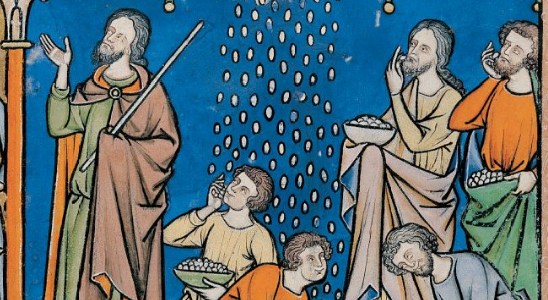
God gave the Israelites a lot of signs and miracles in Egypt and on their way out of Egypt—plagues on their captors, a pillar of cloud and fire to lead and guard their exit, the parting of the Red Sea and the drowning of the Egyptian army. We might think they would have been ready to trust God once in the desert. Trust faded as soon as they got really hungry, however.

God faithfully responded with the promise of provision. The Israelites didn’t even need to carry food with them on their journey. Instead, food rained down as quail and manna, described as a substance that makes me think of Frosted Flakes. (I like cereal, so my interpretation may be biased.)

The lesson was simple: God will provide. In fact, God wanted the Israelites to go to bed every night trusting his provision would be there for them the next day—no long-term planning needed on this journey. There was work to be done in the gathering of the food, but they always had enough. The weekly exception was when God sent them enough food for two days in anticipation of the Sabbath. God also wanted them to rest!

God still seeks the same kind of trust from us today. Pray this prayer with me: “Our father, who art in heaven, hallowed be thy name. Thy kingdom come, thy will be done, on earth as it is in heaven. Give us this day our daily bread … .” Stop right there just a second.

Do we mean it? Do we live it? What does it mean to live as if we trust our bread will come on a daily basis?

The idea certainly conflicts with our 401K/pension plan/Roth IRA mindsets. We’re taught to store provisions for use 40 years or more into the future, with all of that planning affecting when we can retire. We’re sometimes even left with the strange concern that we might live too long, running out of money in the process. Can we reconcile these two very different world views?

As I ponder this, I’m first reminded of one of Jesus’ parables. He begins telling it at Luke 12:16:

“A rich man had a fertile farm that produced fine crops. He said to himself, ‘What should I do? I don’t have room for all my crops.’ Then he said, ‘I know! I’ll tear down my barns and build bigger ones. Then I’ll have room enough to store all my wheat and other goods. And I’ll sit back and say to myself, ‘My friend, you have enough stored away for years to come. Now take it easy! Eat, drink, and be merry!’

“But God said to him, ‘You fool! You will die this very night. Then who will get everything you worked for?’

“Yes, a person is a fool to store up earthly wealth but not have a rich relationship with God.”

Then, turning to his disciples, Jesus said, “That is why I tell you not to worry about everyday life—whether you have enough food to eat or enough clothes to wear.”

Luke 12:16-22 (NLT)

As bad as his hoarding was, the rich man’s real problem was the way he deluded himself about how much control he had, in the process failing to understand his basic relationship to God.

Preparation is prudent, but we should never let go of this basic truth: We don’t control the future. Planning  and stored provisions cannot eliminate our need for God.

There also is the issue of how we use the resources we are given. Do we live as if this life is the only one that counts? Or do we live as people who believe something greater is happening? After all, we believe that God’s kingdom is truly arriving, and that the kingdom is where we store our true treasures and live out eternity.

John Wesley had a sermon, “The Danger of Riches,” that explained his idea of how to balance proper planning and trust in God. (Wesley was working from 1 Timothy 6:9.)

In the sermon, Wesley said that God provides for the roof over our heads, food, and other basic needs. We should even save to ensure the well-being of our families and businesses we may own. Beyond those provisions, everything we are given counts as riches, and they have been given to us to use “to the glory of God.” Often, this means using our riches to help those who are less blessed materially, playing a role in God’s provision for people’s basic needs.

Even for a tither, this is a concept that requires thought. It forces a reassessment of every decision we make regarding how we handle our income and possessions, simply because we learn to say, “It’s not really mine, anyway.”

When we learn to make decisions about money and other resources in the light of God’s dawning kingdom, we not only trust God daily, we begin to participate actively in the kingdom’s growth. We let God work through us so others see their daily bread arrive.

When all Christians adopt such an attitude, God’s presence will be as visible in this world as a pillar of cloud in the sky and manna on the ground.

Lord, give us this day our daily bread, and let us be content with your gracious provisions. Amen.