Welcome to Holy Week! We will walk with Jesus this week toward Good Friday and the cross.
John 12:1-8 (NRSV)
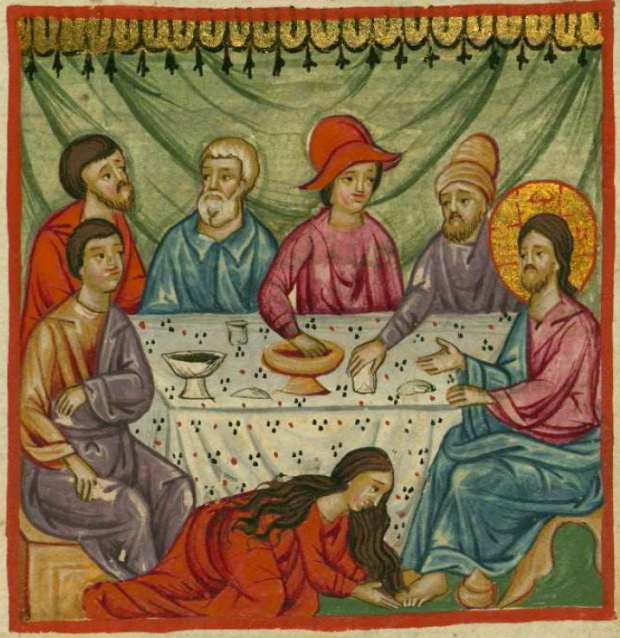
Six days before the Passover Jesus came to Bethany, the home of Lazarus, whom he had raised from the dead. There they gave a dinner for him. Martha served, and Lazarus was one of those at the table with him. Mary took a pound of costly perfume made of pure nard, anointed Jesus’ feet, and wiped them with her hair. The house was filled with the fragrance of the perfume. But Judas Iscariot, one of his disciples (the one who was about to betray him), said, “Why was this perfume not sold for three hundred denarii and the money given to the poor?” (He said this not because he cared about the poor, but because he was a thief; he kept the common purse and used to steal what was put into it.) Jesus said, “Leave her alone. She bought it so that she might keep it for the day of my burial. You always have the poor with you, but you do not always have me.”
By Chuck Griffin
It’s not difficult to discern that Mary—the sister-of-Lazarus Mary—did something strange and even shocking when she used a small fortune in perfume on Jesus’ feet.
If you see Christianity as a strait-laced, rules-oriented faith, and you would rather hold on to that view, you might want to avoid a story like this one altogether. The characters in this story had been swelling with emotion for days, and Mary finally exploded in an act of love that defied logic and propriety. The only speaker of earthly logic in this story was Judas, who was a few days from falling under Satan’s complete control.
Siblings and Friends
Bible readers will remember Mary and her siblings Martha and Lazarus. There is a story in the tenth chapter of Luke where Mary sat at Jesus’ feet as Martha worked in the kitchen. When Martha complained, Jesus said Mary had “the better part.”
John tells us all three were Jesus’ friends. It’s likely their home in Bethany, two miles from Jerusalem, was where Jesus stayed when he drew near to the heart of Judaism. They also may have been wealthy, and because the sisters are described as living with their brother, they either were young and unmarried or widowed.
The described volume of nard, probably spikenard from India, was worth about a year’s wages to a common laborer. It is unclear why Mary had it. In a world without secure bank accounts, it might have been a compact way for her to maintain some financial security. She may have intended it for her wedding night—the Song of Solomon demonstrates that nard’s warm, musky, intense smell was associated with sex. And, as is clear from the story, it could be used to prepare a loved one for burial.
For whatever reason Mary owned it, the nard represented her concern for the future.
Statements of Faith
At this dinner, Mary, Martha and Lazarus must have felt overwhelmed. Just a few days earlier, Jesus had performed his most astounding miracle, the raising of Lazarus from the dead.
As you may recall, Jesus deliberately dallied in going to his friends despite knowing Lazarus was sick, telling his disciples this event was occurring so “the Son of God may be glorified through it.”
By the time Jesus arrived in Bethany, Lazarus had been dead and in the tomb four days. In the exchange that occurred between the sisters and Jesus, we see they believed in Jesus fully. Martha went so far as to call Jesus “the Messiah, the Son of God, the one coming into the world.”
Jesus, moved by Mary and Martha’s pain, then proved he has power over life and death by calling Lazarus out of the tomb.
We need to keep those events in mind to understand Mary’s seemingly wasteful activity. She was riding an emotional epiphany—she and Martha had a deep understanding of what it means to be friends with someone who has power over life and death. Their beloved brother had been restored. They had experienced the pain and stench of death, and Jesus had replaced all of that with hope and joy.
An Act of Worship
When Mary poured out that overpowering nard and wiped Jesus’ feet with her hair, she worshiped. There really is no other word adequate to describe her actions. And in her actions, we are reminded why we worship.
I think this woman who had sat at Jesus’ feet to hear his teaching knew in some way that salvation for everyone—ever-present death transformed to everlasting life—was in the works. And knowing this, Mary dropped to her knees before our savior and worshiped, abandoning any concerns or cares she had for this world. She poured out her future on Jesus’ feet, knowing the work he would do as Messiah provided the greatest security.
As we draw nearer to Good Friday and Easter, can we learn to abandon ourselves so? Can we learn to trust so completely?
Those who do so will find true worship, and the scent of eternity will be on them and all who gather around.
Lord, on this Monday of Holy Week, we recommit ourselves to worshiping you as the one with power over life and death. Amen.



 Methodist Life