
May this Christmas season renew the seeker in you!
Living the Christian Life Together

May this Christmas season renew the seeker in you!

By Chuck Griffin
The story of the birth of Jesus is both marvelous and deeply important to the world. Even nonbelievers have been heavily impacted by it, simply because Christianity has been a key driver of human history for nearly 2,000 years.
For a complete view of Christianity, you have to understand Jesus as an adult, and in particular, you have to understand the importance of his death on the cross and his resurrection from the dead. Jesus’ birth narrative, however, is the beginning of the description of Jesus as the promised Messiah, evidence that God has chosen to be with us in the most personal of ways.
News this important needs to be told. Luke’s spare, tight account of the birth is all about the telling, with voices declaring Jesus as Messiah from both heaven and earth.
Already, angels have punctuated the story repeatedly, prepping the key players for what is to come. The actual birth happens in a straightforward manner. Mary and Joseph make their way to Bethlehem in answer to a census, and while there, Luke tells us, “The time came for her to deliver her child. And she gave birth to her firstborn son and wrapped him in bands of cloth, and laid him in a manger, because there was no place for them in the inn.”
The formal birth announcement comes from heaven, with angels appearing before lowly shepherds, declaring the arrival of “a Savior, who is the Messiah, the Lord.” The angels tell the shepherds how to find this great miracle—look for something common. “This will be a sign for you: You will find a child wrapped in bands of cloth and lying in a manger.”
I find it instructive that while angels began the announcement, the proclamation effort quickly was turned over to humans, and quite common humans at that, at least in worldly terms. God’s good news spread from the bottom up, ensuring that the people usually left out of key events were the first to know about the most important event.
The shepherds went in search of evidence of what they had heard, finding it in a primitive barn. The baby in the manger was enough for them to begin to tell others what they had seen, causing amazement.
And here we are now, still celebrating what God has done for us through this incredible birth. Word has spread not because of angels but because of faithful telling and re-telling from generation to generation.
Have you told anyone lately? Have you amazed anyone with the story of how much God loves his creation? Have you helped the joy of Christmas seep into others’ souls so their joy may be eternal?
What an opportunity the Christmas season is!
I wish you a merry Christmas, and I pray that you will carry Christmas to those in need of good news.
Micah 4:6-8 (NRSV)

In that day, says the Lord,
    I will assemble the lame
and gather those who have been driven away,
    and those whom I have afflicted.
The lame I will make the remnant,
    and those who were cast off, a strong nation;
and the Lord will reign over them in Mount Zion
    now and forevermore.

And you, O tower of the flock,
    hill of daughter Zion,
to you it shall come,
    the former dominion shall come,
    the sovereignty of daughter Jerusalem.
By Chuck Griffin
As the season of Advent ends and Christmas is upon us, let’s take one last look at where the story of the infant Christ is headed.
It moves from childhood to adulthood to his death—and astonishingly, beyond death, to his resurrection and promises that all of creation will be renewed.
We sometimes forget that we are not beyond the story, but in the middle of it. It’s important we cling tightly to the promise there is more to come, that all will be set right.
Why does God not rescue those who suffer, or the outcasts, or the ones who bear the scars brought on by their own sins or the sins of others? It’s a question often heard, and the answer is straightforward: He’s doing so right now. The process is ongoing. The world is turning upside down as people continually are offered escape from sin through belief in Jesus Christ.
We don’t ask firefighters why they aren’t rescuing the trapped when they’re breaking down the door of a burning house. We don’t ask the doctor why he isn’t healing a patient when he’s in the middle of setting a broken leg. Even if the situation appears frightening or painful, we are grateful someone is moving events in the right direction.
This Christmas season, remember to give thanks not only for what happened in Bethlehem, but what was made possible. The hope seen in the manger is our hope for the future.
Lord, the details of how your promise will be fulfilled can seem mysterious, but we know that great day to come will bring eternal life in your presence. Hallelujah! Amen.
As we move toward the Christmas season, let’s not forget the larger story. Christ grew in wisdom and stature, and as a man had much to teach us regarding God’s love and expectations for us. Then he died for our sins, restoring us to God.
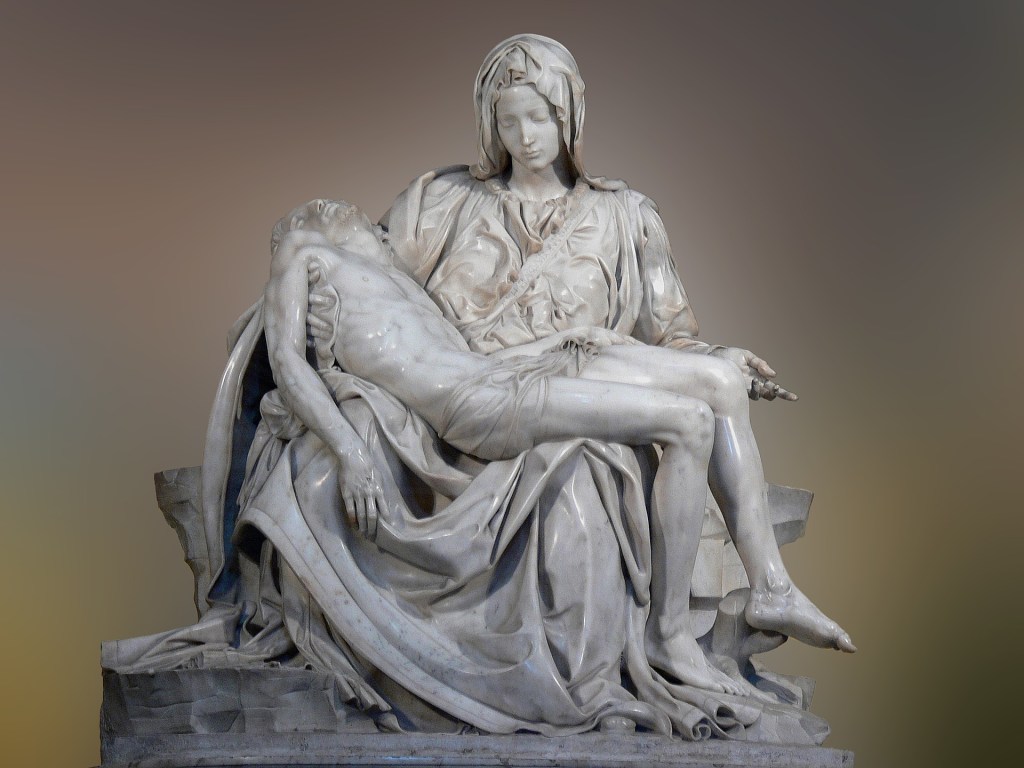
We can easily imagine Mary holding her son both at his birth and his death, when he was brought down from the crucifixion she witnessed. The Italian Renaissance artist Michelangelo beautifully captured the latter moment in a sculpture commissioned in 1497. It is called the Pietà, which in English means “Piety.” It is on display in St. Peter’s Basilica in Vatican City.
While it is a scene of death, the sculpture certainly can remind us of Christ’s birth. Mary is depicted as remarkably young, more like her age at Jesus’ birth than at his death more than three decades later. Michelangelo also altered the scale of the characters—if the two characters in the sculpture were to stand, Mary would tower over Jesus. And yet, the scene appears astonishingly natural, a mother cradling her son. The image seems to bridge the moments of birth and death.
Dear Lord, in this approaching Christmas season, may we carry in our hearts the full meaning of Christ’s presence among us. Amen.
Psalm 126. A Song of Ascents.

When the Lord restored the fortunes of Zion,
    we were like those who dream.
Then our mouth was filled with laughter,
    and our tongue with shouts of joy;
then it was said among the nations,
    “The Lord has done great things for them.”
The Lord has done great things for us,
    and we rejoiced.

Restore our fortunes, O Lord,
    like the watercourses in the Negeb.
May those who sow in tears
    reap with shouts of joy.
Those who go out weeping,
    bearing the seed for sowing,
shall come home with shouts of joy,
    carrying their sheaves.
By John Grimm
Grief takes time to work through.
Tears will arrive when they are least expected.
Misfortune can zap our dreams.
Yet the Lord has his means of restoring us. If we have not given up, if we have not succumbed to the weeping, and if we have not been swallowed up in tragedy, then we can know how the Lord can restore us. Some of us are cynical. Some of us have cut ourselves off from any good because we have experienced much tragedy in our lives. Some of us have stopped dreaming.
It is good to dream. How can we have our fortunes restored? How will God give us joy for which we can shout? Throughout the generations, people have paid attention to the Lord. When people pay attention to the Lord, then we see God restoring us. That brings us joy!
We need not only have joy during Advent and Christmas. There are more weeks to the year than the weeks of Advent. Joy can be our shout every week of the year! For we can notice the great things God has done for us, even if times are bad.
Lord, we know people who have stopped dreaming. We know that you can restore joy to each person and each nation. May we know joy in our lives as we see you restoring us and our fortunes that are found in you alone. Fill our lungs so we may give shouts of joy, even today! In the name of Jesus Christ, we pray. Amen.

Luke 2:1-20 (NRSV)
In those days a decree went out from Emperor Augustus that all the world should be registered. This was the first registration and was taken while Quirinius was governor of Syria. All went to their own towns to be registered. Joseph also went from the town of Nazareth in Galilee to Judea, to the city of David called Bethlehem, because he was descended from the house and family of David. He went to be registered with Mary, to whom he was engaged and who was expecting a child. While they were there, the time came for her to deliver her child. And she gave birth to her firstborn son and wrapped him in bands of cloth, and laid him in a manger, because there was no place for them in the inn.
In that region there were shepherds living in the fields, keeping watch over their flock by night. Then an angel of the Lord stood before them, and the glory of the Lord shone around them, and they were terrified. But the angel said to them, “Do not be afraid; for see—I am bringing you good news of great joy for all the people: to you is born this day in the city of David a Savior, who is the Messiah, the Lord. This will be a sign for you: you will find a child wrapped in bands of cloth and lying in a manger.” And suddenly there was with the angel a multitude of the heavenly host, praising God and saying,
“Glory to God in the highest heaven,
and on earth peace among those whom he favors!”
When the angels had left them and gone into heaven, the shepherds said to one another, “Let us go now to Bethlehem and see this thing that has taken place, which the Lord has made known to us.” So they went with haste and found Mary and Joseph, and the child lying in the manger. When they saw this, they made known what had been told them about this child; and all who heard it were amazed at what the shepherds told them. But Mary treasured all these words and pondered them in her heart. The shepherds returned, glorifying and praising God for all they had heard and seen, as it had been told them.

John 1:1-5
In the beginning was the Word, and the Word was with God, and the Word was God. He was in the beginning with God. All things came into being through him, and without him not one thing came into being. What has come into being in him was life, and the life was the light of all people. The light shines in the darkness, and the darkness did not overcome it.
If we are able to pause here and “get it,” we’ll have a proper understanding of the meaning of Christmas. I’ll be the first to admit, however, that these can seem like dense and lofty words.
In short, Jesus is God. Yes, we sometimes call him the “Son of God,” recognizing he is as fully human as he is divine. But he is God, and the divine aspect of Jesus has always existed—before the birth in Bethlehem and the manger, before the virgin conception, even before the universe and time existed.
If you agree with this assertion about Jesus, you are Christian in a scriptural, orthodox sense.
If you disagree, you stand outside that traditional understanding, even if you call yourself Christian. You at a minimum disregard or modify key portions of Scripture, particularly the early chapters of John.
This aspect or essence of God is called the “Word” in most English versions of John. “Word” is a translation of the Greek word “logos,” used by philosophers of the day to describe God’s wisdom. This logos was believed to hold the universe together, like stitches giving cloth its shape.
“And the Word became flesh and lived among us,” John 1:14 asserts, “and we have seen his glory, the glory as of a father’s only son, full of grace and truth.”
The power that made all things and holds all things together lived in this world as one of us, an event we call the incarnation. We call this God-man Jesus Christ, and he surprised us with much of what he said and did, like forgiving his enemies and dying among criminals on a cross.
As we move through Christmas toward Easter, we will once again watch how Jesus lived and hear what Jesus taught. We should be constantly mindful that in doing so, we are experiencing a kind of wisdom far deeper than anything that could be contrived by human minds.
If we get it, we may find Christmas and much of the rest of the Christian year to be a serious challenge to how we live.
Lord, what a remarkable truth, that you came among us to teach us, love us, call us to obedience and die for our sins. This Christmas, may we celebrate well that moment of arrival. Amen.

By Chuck Griffin
LifeTalk Editor
Ephesians 5:4: Let there be no filthiness nor foolish talk nor crude joking, which are out of place, but instead let there be thanksgiving.
Conflicts among shoppers aside, people generally are nicer to each other this time of year. That’s one of the happy side effects of drawing close to Christmas, as the lights and general tenor of the season take effect.
Let’s enjoy it while we can. Projecting niceness—politeness, thoughtfulness, sensitivity to others—is a dying art. I don’t think the pandemic was the beginning of our decline, either. It simply aggravated a growing tendency toward incivility.
Lately, I’ve noticed this tendency extends even into the way companies market their products. There’s a kind of ugliness designed into some brands and packaging. I assume professional marketers peered into peoples’ hardening hearts with their surveys and focus groups and said, “We can make money off this trend.”
For decades, we’ve had products with names and packaging that you wouldn’t want children or teens to see. They were kept away in special stores or catalogs.
What’s surprising is how these products now encroach on everyday places, like the shelves of big-box stores, bookstores and mom-and-pop businesses. I went to pay for my takeout at one of my favorite little family restaurants recently, and was surprised to see at the register a professional display of seasoning products, each item’s name a variation on a crude word for excrement.
I normally let such things go, fearing I’m somehow playing into the stereotype of the uptight or judgmental Christian. That day, I did comment to the young woman who rang up my order that I was glad I wasn’t standing there with a child or a youth group. I was imagining the conversation I would have to have later with a kid just learning to read, or a teenager confused about social boundaries.
Maybe we do need to speak up more, in a gentle way. I don’t want our culture to end up like other places in the world where I’ve seen nudity and bawdy jokes displayed on highway billboards.
More than ever, I appreciate Paul’s exhortation to avoid crude words and actions. By themselves, these social transgressions can seem relatively unimportant. But we have to consider how they slowly poison us, creating patterns of thoughtlessness that quickly devolve into meanness and sin.
Hey, when it comes to crude behavior, I’ve shown my ugly side much too often over the years, and I don’t guard my speech and behaviors enough now. But it’s time for a change, and the image of the Christ Child before us certainly should help.
Lord, in all situations, help us to bring gentleness into the world with our words and actions. Amen.
 Methodist Life