The Grace of Good Friday

Tuesday: A Deep Truth


Words to Strengthen

Revelation 2:8-11 (NLT)

“Write this letter to the angel of the church in Smyrna. This is the message from the one who is the First and the Last, who was dead but is now alive:

“I know about your suffering and your poverty—but you are rich! I know the blasphemy of those opposing you. They say they are Jews, but they are not, because their synagogue belongs to Satan. Don’t be afraid of what you are about to suffer. The devil will throw some of you into prison to test you. You will suffer for ten days. But if you remain faithful even when facing death, I will give you the crown of life.

“Anyone with ears to hear must listen to the Spirit and understand what he is saying to the churches. Whoever is victorious will not be harmed by the second death.”

By Chuck Griffin

The Book of Revelation features messages from our risen Christ to seven churches in various states of spiritual formation or decline. The church at Smyrna, located in what is now Turkey, was spiritually strong but heavily persecuted.

As I read this, my mind goes to the power of supportive words. Imagine a direct word from Jesus telling you to persevere—stick with it—hold fast to your beliefs! Even a tortured soul could weather any storm, knowing the promise of eternal life.

It’s amazing how God shows up in the small places, too. I was grumpy (again) on a recent Sunday morning. There’s no need to go into what made me grumpy, as it was silly, certainly nothing along the lines of the big threats the Christians at Smyrna were facing. But I do know this: It’s not good for a pastor to be grumpy right before preaching time.

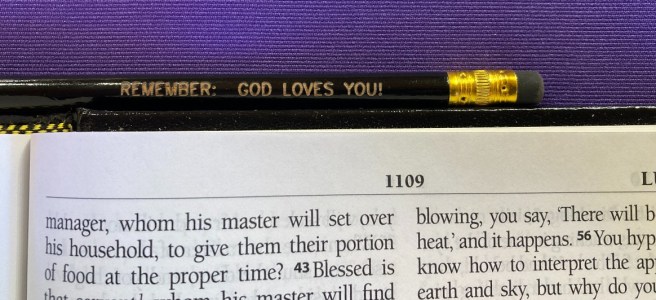
Words from God snapped me out of it. Not words from the Bible, but words on the side of a black pencil, one I had snatched up in haste from a random spot to mark my pulpit Bible. As I laid it down, these words, printed in gold, stared up at me: “REMEMBER: GOD LOVES YOU!”

I took a deep breath, and I knew things were going to be okay.

I am grateful for that little pencil, and the person who had the wisdom to order that phrase to go on it and its No. 2 box mates.

A couple of days later, I was again feeling stressed, this time over a critically important meeting. While waiting, I picked up the mail from the day before, and among the bills and advertisements was a note from two friends offering me words of encouragement.

During that meeting, the note was in my shirt pocket, a token of God’s love passed along by others.

The Bible is full of encouragement, sometimes carried into the world by angels. But don’t be surprised if a pencil or a friend steps in to deliver the message of God’s love when you need it the most.

Lord, thank you for the way grace flows into our lives in surprising ways. Keep us mindful of our role in channeling your love to those in need. Amen.

From Lament to Joy

Book of Lamentations

By Chuck Griffin

No doubt, we’ve been experiencing tough times. It’s not much consolation, but we do need to remember that times have been tougher.

In the Book of Lamentations, the Promised Land is depicted as smoking ruins, and we are told that starving mothers ate their children. Never forget that the Bible can be a grisly book.

As Lamentations notes, at least the destruction of sinful Sodom and Gomorrah was quick. Jerusalem’s punishment for disobeying God was slow and agonizing, creating scenes that even the seedier side of Hollywood might hesitate to depict.

Jewish tradition holds that this series of poems was written by the prophet Jeremiah, who warned the people of Judah that God’s punishment was coming and then watched invasion, destruction and exile unfold through his long life.

I cannot fully capture for you the somber beauty of these poems in a short article. If the imagery were not crafted with elegant conciseness, most readers would quickly turn away from the dark subject matter.

In these poems, the author twists in pain as he struggles to reconcile God’s obvious anger with God’s faithful love.

“The steadfast love of the Lord never ceases, his mercies never come to an end; they are new every morning; great is your faithfulness,” says the writer in chapter 3. He later says of God, “Although he causes grief, he will have compassion according to the abundance of his steadfast love; for he does not willingly afflict or grieve anyone.”

Yes, when God removes his protective hand from a disobedient people, terrible things happen. Existence without God is hellish. In fact, the best way to define hell is as a place separated from God.

But in the midst of all this horror, the author senses one important fact about God. His love for humanity, even for each individual human, remains, and somehow, somewhere, there must be an ultimate solution to the pain sin causes.

Once again, we find the Old Testament pointing toward the New Testament, that record of the ultimate solution found in Jesus Christ. We are reminded in the midst of suffering that God finally chose to suffer with us, in the process using the cross to solve the dilemma of human disobedience. Through simple belief, our sin is erased, and we receive the promise that the horrible effects of sin will be wiped from the world one day.

At the close of Lamentations, the author prays that his people be restored to God, “unless you have utterly rejected us, and are angry with us beyond measure.”

In Christ, we find that God loves us beyond measure. With Christ in our lives, we can walk through tough times with confidence and even joy, knowing God is eternally faithful.

Lord, whatever our circumstances, restore our joy. Amen.

To Console and Comfort

Job 2:11-13 (NRSV)

Now when Job’s three friends heard of all these troubles that had come upon him, each of them set out from his home—Eliphaz the Temanite, Bildad the Shuhite, and Zophar the Naamathite. They met together to go and console and comfort him. When they saw him from a distance, they did not recognize him, and they raised their voices and wept aloud; they tore their robes and threw dust in the air upon their heads. They sat with him on the ground seven days and seven nights, and no one spoke a word to him, for they saw that his suffering was very great.


By John Grimm

In the United States of America, when a loved one dies, we typically receive three days of bereavement time from our employers.  When a friend dies, we will make time to pay our respects to the family.  Either way, we will gather at the grieving person’s house.  We will reminiscence about the good times with the deceased loved one.  We somehow make it through those days, being able to console and comfort the grieving family.

Job’s friends came to console and comfort him.  They wept loudly; they threw dust on themselves; they tore their clothes.  Then for seven days and nights, they only sat with him.  This last mode of consoling and comforting a grieving person seems appropriate for today.  Sitting with the grieving family without saying a word is wise.

It is when we begin to accuse and blame that we have lost the practice of consoling and comforting.  The grieving person will express a range of emotions, from deep anger to praise.  They will have regrets and sweet memories.  As for Job, he could express himself, and did express himself, despite his friends’ words of accusation.

How wise would we be if we only sat with the grieving people?  How wise would we become if we refrain from accusations when we see family and friends grieving?

God of wisdom, thank you for your consolation and comfort during our grief.  Thank you for helping us to learn to grieve with those who are grieving.  Forgive us for speaking out of turn when we could be silent when we sit with those who are grieving.  May we have hearts and ears to hear the pain of grief. May we have the patience to see those who are grieving through the time of intense grief.  In the name of Jesus, we ask for wisdom when it comes time to console and comfort.  Amen.

What Miracles Accomplish

This Sunday’s sermon at Holston View UMC in Weber City, Va., will be “Demons and Deafness.” It will be based on Mark 7:24-37. If you want to view the sermon but cannot be present, the entire worship service will be available through Holston View UMC’s web page.

Today’s preparatory text: Luke 18:27

[Jesus] replied, “What is impossible for mortals is possible for God.”


By Chuck Griffin

Why might we seek a miracle?

We do pray for miracles, particularly when lives seem to be in jeopardy. As we move toward Sunday, however, we need to consider the purpose of miracles.

If we seek miracles strictly to bypass suffering or impending grief, we likely are missing their larger point. Certainly, when we are praying over an immediate, very personal crisis, our minds might not be processing broad theological concepts. But that is simply an argument for thinking about such matters in calmer moments, so we can better understand what it is we are seeking when times of crisis come.

An important fact to remember: As far as we know, every person Jesus healed from illness, brought out of a tomb or raised from a deathbed or funeral bier died later. If we look at these miracles simply as stories of what these people escaped, then Jesus’ work had temporary effects.

Miracles do so much more, however. First, they are evidence of God’s presence in a world where we otherwise see things as if “in a mirror, dimly,” to quote Paul. (1 Corinthians 13:12.) For just a moment, divine possibilities shine through, and the presence of the dawning Kingdom of God is easily, if briefly, seen.

Miracles were signs of God’s presence in Jesus. Miracles are signs of God’s presence in the church, by way of the indwelling Holy Spirit.

We also should understand that miracles come with responsibilities, both for their recipients and their witnesses. Someone needs to testify as to what has happened!

Belief also should naturally spread in the wake of miracles. It is a response we see throughout the Bible. God is seen, and therefore, people change their lives dramatically as they begin to believe.

Lord, we are not afraid to pray for miracles, and we pledge to testify to what we have seen as we receive them. May lives be changed! Amen.

The Woolly Jesus

Revelation 1:9-18 (NRSV)

By Chuck Griffin

Life seldom goes as planned. In fact, I wonder if life ever goes as planned.

A few years ago, I read an Associated Press obituary about a pilot named Denny Fitch. Back in 1989, he was riding home in an empty seat on a United Airlines DC-10 bound for Chicago.

While in the air, the tail engine on the jet exploded. Shrapnel from the engine sliced through all three of the jet’s hydraulic systems. When Denny heard the explosion, he made his way to the cockpit to see if the flight crew needed any help—after all, he also was a flight instructor for United.

Turns out they needed the help. They pretty much had lost all control of the plane, except for one option: They could make the jet go up and down, left and right by increasing and decreasing power to the remaining wing engines. Denny sat down in the only available space, the floor, and helped steer a jet carrying 300 people in this crude manner toward Sioux City airport, their best option. That’s where the jet crashed, but in a somewhat controlled manner; half the people on board survived.

In an interview for a documentary, Denny talked about the unpredictability of life: “What makes you so sure you’re going to make it home tonight? I was 46 years old the day I walked into that cockpit. I had the world ahead of me. I was a captain on a major airline. I had a beautiful healthy family, loving wife, great future. And at 4 o’clock I’m trying to stay alive.”

That’s how life goes. Bad things happen in a broken world where sin and its biggest effect, death, still have a hold. I’m not sure which is more disconcerting, the evil humans inflict on each other or the evil that just happens because some force of nature like wind or fire smacks us down. Both can make us question God’s presence. We all experience events throughout our lives that can wear us down.

It’s hard to make it to adulthood without losing to death someone you love. And then there are the other pains we experience. We love someone but are not loved back. Our careers jump the tracks, despite how hard we work. We feel like we’re careening out of control.

Whoever he was, John, the John who wrote down what we now call the book of Revelation, must have felt he was careening. We don’t know much about him, but he tells us he was persecuted. He was on the island of Patmos in exile because he had professed belief in Jesus Christ as Lord and Savior.

But then he saw the woolly haired Jesus, and everything changed. His suffering and his disappointments had context.

John’s vision of Jesus was different than our Gospel-inspired images. “I saw one like the Son of Man,” John writes, “clothed with a long robe and with a golden sash across his chest. His head and his hair were white as white wool, white as snow; his eyes were like a flame of fire, his feet were like burnished bronze, refined as in a furnace, and his voice was like the sound of many waters. In his right hand he held seven stars, and from his mouth came a sharp, two-edged sword, and his face was like the sun shining with full force.”

Don’t be too literal when reading Revelation, but don’t discount the power of symbolic speech, either. This is the glorified Jesus, the post-resurrection Jesus. This is humanity blended with deity, pure and holy. Power, strength and authority radiate from the Savior.

This vision, and other visions in John’s Revelation, remind us that the world is not out of control, even if it seems so for a time. Christ came for a reason, to set the world right. His resurrection is the first sign of the work being done today, the restoration and healing of the world.

And Christ will be seen again.

Lord Jesus, Maranatha. Come Lord, come. Amen.

What Might Be Lost

Deuteronomy 11:13-17 (NRSV)

If you will only heed his every commandment that I am commanding you today—loving the Lord your God, and serving him with all your heart and with all your soul—then he will give the rain for your land in its season, the early rain and the later rain, and you will gather in your grain, your wine, and your oil; and he will give grass in your fields for your livestock, and you will eat your fill. Take care, or you will be seduced into turning away, serving other gods and worshiping them, for then the anger of the Lord will be kindled against you and he will shut up the heavens, so that there will be no rain and the land will yield no fruit; then you will perish quickly off the good land that the Lord is giving you.


By Chuck Griffin

When I was in college, I learned an important concept in economics class: “opportunity cost.”

Essentially, when we make decisions, we need to account for more than just the gain we believe we will experience by going in a particular direction. We also need to assess what we lose by not making an alternate choice.

As Forbes magazine once wrote, “It’s a core concept for both investing and life in general.”

It’s easy to analyze opportunity costs with hindsight. For example, a lot of us may have spent $10,000 or so on a nice little car or truck in 1997. We probably enjoyed driving our little cars and trucks.

We had another option, however—we could have instead bought $10,000 worth of Amazon stock in May of that year, when it was first publicly offered. In May of 2020, according to Investopedia, that stock would have been worth $12 million.

The problem, of course, is that none of us has clear information about the future, so it’s hard to guess what our opportunity cost for a particular decision is going to be. Don’t ask me for a loan. I bought the little car.

As we see in our Deuteronomy text, God did the Israelites a real favor. He laid out what would happen if they chose to love the Lord with all their hearts and souls, and what would happen if they chose to turn away from God and sin.

One choice promised a sort of paradise on earth. The other offered a miserable existence and widespread death. The opportunity cost of each choice was made clear. But even with all that clarity, they chose poorly.

God is gracious, of course. He presents the lesson in new ways. Now he presents it to us through Jesus Christ. Choosing to reconcile with God through Jesus actually offers us peace and joy in this life, and ultimately eternal life in the presence of God!

Sin often is attractive in the short-term, offering what we think we cannot live without. To combat sin, it helps to measure the opportunity cost of straying from God’s love and guidance. Ongoing joy and eternal life are a lot to lose.

Lord, may your Holy Spirit grant us a fuller and more complete picture of where our decisions lead us. Amen.

Being Immediate

By Chuck Griffin
LifeTalk Editor

Revelation 15:1-4 (NLT)

Then I saw in heaven another marvelous event of great significance. Seven angels were holding the seven last plagues, which would bring God’s wrath to completion. I saw before me what seemed to be a glass sea mixed with fire. And on it stood all the people who had been victorious over the beast and his statue and the number representing his name. They were all holding harps that God had given them. And they were singing the song of Moses, the servant of God, and the song of the Lamb:

“Great and marvelous are your works,
    O Lord God, the Almighty.
Just and true are your ways,
    O King of the nations.
Who will not fear you, Lord,
    and glorify your name?
    For you alone are holy.
All nations will come and worship before you,
    for your righteous deeds have been revealed.”

When exploring ideas about the end of time, thoughtful Christians have to piece together a lot of Scripture from various books of the Bible.

As we see in today’s text and the verses further into Revelation, we are promised there will be an end to the influence of evil, a completion of Christ’s work on the cross. Sin and death have already been defanged by Jesus’ sacrifice, but they still have to be put down completely, rabid dogs of Satan that they are.

Much of the Book of Revelation is highly symbolic, the images depicting events in the past, present and future. Complicating interpretation further, the reader’s perspective in Revelation keeps changing between heaven and earth.

As we study and process what is written there, one conclusion seems certain to me. We should sense a responsibility to let people know that heaven and earth will be remade one day, for the better, after terrible birth pangs. God is very much at work in the world.

Simultaneously, we should understand that we cannot know with any real certainty the what, where and who of Revelation, the apocalyptic sections of the Book of Daniel, or other biblical references to the last days, and we certainly cannot know the when.

“No one knows when these things will happen, not even the angels in heaven or the Son himself,” Jesus said. “Only the Father knows.” (Matthew 24:36.)

To process and live out what we are taught about the end times, I find it useful to cling to “immediacy,” the idea that God’s redemptive work in this world could end and Christ could return at any moment.

In the same section of Matthew, Jesus’ words continue:

When the Son of Man returns, it will be like it was in Noah’s day. In those days before the flood, the people were enjoying banquets and parties and weddings right up to the time Noah entered his boat. People didn’t realize what was going to happen until the flood came and swept them all away. That is the way it will be when the Son of Man comes.

Matthew 24:37-39

I think it’s dangerous when people claim certain events have to happen before Christ returns in full—even as believers, we can be lulled into apathy by such thoughts. The Apostle Peter had this in mind when he wrote, “Stay alert! Watch out for your great enemy, the devil. He prowls around like a roaring lion, looking for someone to devour.” (1 Peter 5:8.)

A proper understanding of our own mortality should also give us a sense of immediacy about conforming to the will of God. None of us truly knows whether a particular day might be our last. We tend to imagine observing the end of days with an earthly view, when there’s a significant chance we will have a very different perspective.

So, what to do? Well, today’s text has one image that should give us inspiration and joy. This side of heaven or the other, let’s be sure that first, we are praising God, who through Jesus Christ has saved us from what should have been the eternal grip of sin and death.

Let’s praise God here on earth with our voices and whatever musical instruments we may have on hand, just as we will praise him one day in a new heaven and earth. Perhaps we will even lift these praises with harps in hands, standing on something like a brilliant sea of fire-imbued glass.

Lord, let today be about you, and then let each day that follows be the same. Amen.


Website image courtesy FantasyStock at fantasystock@deviantart.com.