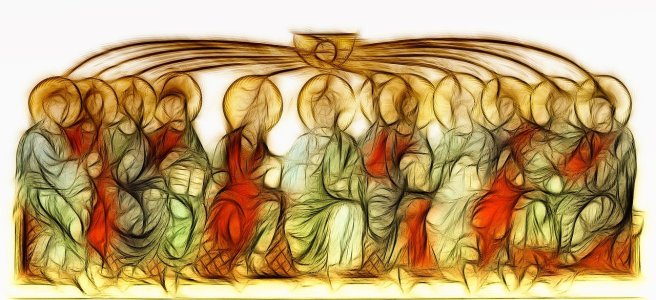
Silver Lining

Acts 8:1-8 (NLT)

Saul was one of the witnesses, and he agreed completely with the killing of Stephen.

A great wave of persecution began that day, sweeping over the church in Jerusalem; and all the believers except the apostles were scattered through the regions of Judea and Samaria. (Some devout men came and buried Stephen with great mourning.) But Saul was going everywhere to destroy the church. He went from house to house, dragging out both men and women to throw them into prison.

But the believers who were scattered preached the Good News about Jesus wherever they went. Philip, for example, went to the city of Samaria and told the people there about the Messiah. Crowds listened intently to Philip because they were eager to hear his message and see the miraculous signs he did. Many evil spirits were cast out, screaming as they left their victims. And many who had been paralyzed or lame were healed. So there was great joy in that city.


By Chuck Griffin

No one would ever look forward to persecution, but it’s amazing how resilient Christians can be in the face of such abuse. This particular outbreak of systematic oppression seems to have been led at least in part by Saul, more often called Paul after his later skull-rattling conversion to Christianity on the road to Damascus.

Let’s focus, however, on the response of these Christians in the midst of this storm of hate. They prudently scattered, but as a group they did not abandon their mission. In fact, scattering them may have been the worst mistake their enemies could make.

They scattered not like frightened rabbits, but like seeds, blooming wherever they landed. Rather than being destroyed, the church grew, spreading beyond its Jewish base further into the world beyond.

When we think of miracle-workers in Acts, we tend to think of Peter and Paul. But here we learn about Philip the Evangelist’s work. The Spirit clearly was upon him, manifested in both miraculous signs and powerful teaching and preaching.

Those of you attending Weber City, Va.’s Holston View UMC or viewing worship online this Sunday will hear more about Philip and his work, God willing. To me, Philip seems like a quiet servant of God, humble but having a great effect on the world.

I realize some of you read these devotions in places where you perhaps face hostility and danger because of your faith. We who are in the United States face nothing like real persecution—our challenges rise only to the level of extreme nuisances, and those often are inflicted on us by other members of our denomination.

If you are in one of those dangerous places, know we are praying for you. We are conscious that martyrs are being made every day.

Thank you for standing strong and sowing seeds for the kingdom.

Lord, bless all who find their freedom and their lives jeopardized for believing in you. Please continue to astonish us with the ways you work in the midst of vicious non-belief. Amen.


Grace Under Fire

Acts 4:1-4 (NLT)

While Peter and John were speaking to the people, they were confronted by the priests, the captain of the Temple guard, and some of the Sadducees. These leaders were very disturbed that Peter and John were teaching the people that through Jesus there is a resurrection of the dead. They arrested them and, since it was already evening, put them in jail until morning. But many of the people who heard their message believed it, so the number of men who believed now totaled about 5,000.


Yesterday, we considered how Peter continued to offer forgiving grace from Jesus Christ even to the people involved in the crucifixion. Thousands listened, but we also see how pointedly describing sin and the need for repentance can get a person into trouble.

The leaders who thought a crucifixion had brought an end to the Jesus movement were unhappy to hear all this talk of resurrection. Peter and John found themselves under arrest.

They seem to have approached the situation not as a problem, but as an opportunity. Read on a little, and you’ll see how they continued to declare that Jesus Christ is Lord and Savior, and that ongoing healing still was to be credited to the one who had risen from the dead.

Later, such arrests would lead to beatings for the apostles. Fearing the people who had seen the lame man healed, the Jewish leaders this day opted for authoritarian threats and intimidation, telling Peter and John to speak of Jesus no more.

The two were unimpressed.

“Do you think God wants us to obey you rather than him? We cannot stop telling about everything we have seen and heard.”

The lesson is straightforward. If they were so bold under their circumstances, we certainly should be bold in ours. Let’s always be seeking new opportunities to tell people Jesus Christ is Lord.

Lord, we know any success we have at declaring the Good News is because of your strength, not our own. May we rely on your guidance and power more each day. Amen.

Good Fish, Bad Fish

By Chuck Griffin

A lot of people, particularly younger adults, don’t like the idea of “going to church.” This is true even if they consider themselves spiritual.

That’s not just a personal observation; studies and polls are proving this fact repeatedly. Most recently, Gallup research showed that for the first time in U.S. history, less than 50 percent of American adults belong to a church. (Gallup included membership in synagogues and mosques, too, and still got to just 47 percent participation.)

Particularly instructive for us are the studies that explore why some people have strong negative reactions to the idea of being involved in a church. Yes, people sometimes complain that church is boring. Yes, people say there are now many other attractions on Sunday, and involvement in church simply cannot compete.

There is one criticism that stands out above all others, however, and it is the primary problem we “churched” people face when telling others about Jesus Christ. Churches, these church-averse people say, are full of hypocrites.

The solution is not to call these critics wrong, but to acknowledge they are right, using that humbling truth to move toward a deeper conversation about why Jesus Christ died on the cross.

Jesus told us from the start that the global church would be considerably less than pure until he returns and restores all of creation to a holy state. One place he illustrates this truth is in a parable found in Matthew 13:47-50.

The church is the primary way we now see the presence of the “kingdom of heaven” on earth. But Jesus described the kingdom of heaven as being a net full of fish, good fish and bad fish mixed together.

In the story, the good fish are put in baskets, while the bad fish are thrown out. “That is the way it will be at the end of the world,” Jesus said. “The angels will come and separate the wicked people from the righteous, throwing the wicked into the fiery furnace, where there will be weeping and gnashing of teeth.”

This parable sometimes is misinterpreted, with people assuming it’s a simple tale of God’s desire to separate the righteous and unrighteous in the world. But in this parable, the world is represented by the ocean, while the net is the initial gathering of people who say they want to follow Christ.

A similar parable is found in Matthew 13:24-30, where an “enemy” sows weeds in a field of wheat representing the kingdom of heaven. The two are allowed to grow together until the final harvest, when the weeds are separated and burned.

When we hear the “hypocrite” charge leveled at us, it’s important that we learn to say in all humility, “Yes, things are not as they should be in the church. Brokenness and sin remain among us even though we call ourselves Christians. Jesus told us this would happen.”

We can hope such simple honesty will open the door to a conversation about deeper truths. For example, Christ remains our perfect savior regardless of Christians’ imperfections. And Christ wants his followers in fellowship together, even though he knows evil will sometimes wriggle into the net.

As fishy as it sometimes smells, church remains the place to be in relationship with God.

Lord, help us to project desirable images of righteousness to a hurting world needing to know you better. Amen.

The Real Power of Healing

I have no doubt that miraculous healings from God occur today, and I have witnessed the kind of joy such healings bring. We should intently petition God to heal the sick around us, be they sick in the body, mind or spirit.

As I talk with Christians about the concept of healing, however, I do sometimes wish we could better understand the meaning of healing. For as wonderful as it is to see someone miraculously healed, it is even more wonderful to recognize why healing happens.

Jesus healed a lot of people in the Bible, and those healing stories always point us to a deeper meaning. One of the easiest places to see what I’m talking about is in the ninth chapter of John, where Jesus restores the sight of a man born blind.

It is an astounding healing. For all practical purposes, Jesus creates vision where there has been none. He mixes spit with dirt, kneading it into mud and smearing it on the man’s eyes, telling him to go wash in a pool.

When the blind man washes, he can see. People who witness him freely walking about later with his eyes open are so perplexed that they are not sure it is really the blind beggar they have always known.

In fact, most of the ninth chapter is dedicated not to the story of the healing, but the controversy that ensues. The Pharisees, great lovers of the law, ask, Who did this? And how dare he do it on a sabbath?

As the story progresses and Jesus speaks with the man he has healed, the symbolism of this healing and other healings becomes clear. The world is trapped in spiritual blindness, unable to see God for who God is. But Jesus, fully and completely God, has come to open the world’s eyes to truths hidden by sin.

As we know, Jesus goes on to do a larger work of re-creation. Ultimately, Christ sheds his blood, mixing it with the ground during the crucifixion. Because of his sacrifice, we all have the potential to see the truth that God loves us and will do whatever is necessary to bring us into a relationship with our creator. We simply need to believe to be healed spiritually.

And from time to time, some of us are healed physically or mentally, as a sign of God’s presence among us. When miraculous healings occur, we are reminded that God is in control, despite the brokenness that remains until Christ returns to seal his victory over sin and death.

In many ways, those who have been healed or have witnessed healings have a special responsibility.

We are called to testify that God’s power is present in the world. And like the healed blind man, we should boldly answer those who want to argue that God is not present.

Lord, thank you for what healings signify. As wonderful as they are for those who are healed, they are even more powerful as a sign of what is to come. Amen.

The Chosen Ones

Mark 3:13-19 (NLT)

Afterward Jesus went up on a mountain and called out the ones he wanted to go with him. And they came to him. Then he appointed twelve of them and called them his apostles. They were to accompany him, and he would send them out to preach, giving them authority to cast out demons. These are the twelve he chose:

Simon (whom he named Peter),
 James and John (the sons of Zebedee, but Jesus nicknamed them “Sons of Thunder”),
 Andrew,
 Philip,
 Bartholomew,
 Matthew,
 Thomas,
 James (son of Alphaeus),
 Thaddaeus,
 Simon (the zealot),
 Judas Iscariot (who later betrayed him).

What an odd mix.

Among them are fishermen, a tax collecting bureaucrat, a rebel who under different circumstances might try to kill the tax collector, some loud, pushy brothers, and a petty thief who would eventually prove to be a traitor. Their de facto leader, functioning like a senior student, is one of the fishermen, good old foot-in-mouth Peter.

Other than being Jews, the common denominator in the group was that they would all abandon Jesus after his arrest. I once knew a seminary professor who referred to them as the “duh-sciples.”

Out of the larger crowd of people following Jesus, these were the 12 deemed worthy to be part of the inner circle, the ones charged with spreading the Good News about Jesus, proclaiming to the world that salvation is available.

In them, I see what has been evident far too often in me: inattentiveness, dull wit, self-centeredness, impatience, insecurity, striving, and yes, the failure to perceive what is godly and right in front of me. And when I consider these flawed men, I take great comfort.

As we assess these men charged with the role of apostleship—the spread of the Good News and the growth of the church—here’s what’s incredible: They got the job done! The fact that there are more than 2 billion people calling themselves Christians nearly 2,000 years later is the proof.

Well, let me rephrase that a little. God got the job done through them, and through many who followed them. The key, it seems, is that the apostles who remained after Jesus’ resurrection were willing to let the Holy Spirit fill them and guide their work. Grace began to pour forth from these badly cracked earthenware vessels, and it just kept on pouring.

Never doubt for a moment that God can work through any of us.

Lord, thank you for the blessing of broken people who give themselves over to you. Amen.

Give It Time

Acts 5:33-42 (NRSV)

When they heard this, they were enraged and wanted to kill them. But a Pharisee in the council named Gamaliel, a teacher of the law, respected by all the people, stood up and ordered the men to be put outside for a short time. Then he said to them, “Fellow Israelites, consider carefully what you propose to do to these men. For some time ago Theudas rose up, claiming to be somebody, and a number of men, about four hundred, joined him; but he was killed, and all who followed him were dispersed and disappeared. After him Judas the Galilean rose up at the time of the census and got people to follow him; he also perished, and all who followed him were scattered. So in the present case, I tell you, keep away from these men and let them alone; because if this plan or this undertaking is of human origin, it will fail; but if it is of God, you will not be able to overthrow them—in that case you may even be found fighting against God!”

They were convinced by him, and when they had called in the apostles, they had them flogged. Then they ordered them not to speak in the name of Jesus, and let them go. As they left the council, they rejoiced that they were considered worthy to suffer dishonor for the sake of the name. And every day in the temple and at home they did not cease to teach and proclaim Jesus as the Messiah.


The “them” in the opening sentence of this passage consisted of Peter and the other apostles, who were going about in the earliest days of the church performing miracles and preaching that Jesus is the Christ.

The leaders of the temple in Jerusalem were, in the words of Acts 5:17, “filled with jealousy,” so they had the apostles arrested, only to discover these men of Christ were preaching again the next morning in the temple. An angel had freed them from prison overnight, telling them to get back to delivering the message that gives life.

So, the temple leaders had the apostles arrested again, this time intending to kill them.

As we see in our passage today, a much cooler, wiser head prevailed. Gamaliel, as we are told, was deeply respected by his fellow leaders. By the way, one of his rabbinical students was the Apostle Paul, who at this point in the story of the church had not experienced Christ on the road to Damascus.

Gamaliel correctly understood that he and the other Jewish leaders should be centered on one important task: Seeking the will of God. He also believed God would reveal whether these apostles and others who would claim to speak for God were right in what they said.

Gamaliel was spot on. Ultimately, messages and movements opposed to God will fail. All of creation is moving toward reconciliation and reunion with God, so it’s only logical that movements opposed to God will eventually collapse, even if that process sometimes takes longer than we like.

Gamaliel’s colleagues did arrange for the apostles to receive a beating none of us would want to face today. As long as evil and good continue to grow side by side, angry, jealous men will sometimes extract the vengeance they so desperately desire.

That part of the story reminds us that doing what God asks—in the apostles’ case, preaching the Good News—may require some sacrifices.

Dear Lord, your Good News has continued to be preached for nearly 2,000 years, reaching people all around the globe. May we have the courage of the apostles, trusting that the truth of Jesus Christ as Lord and Savior will always be vindicated and reign supreme at the end of time. Amen.

Here Come the Pagans

Matthew 2:1-12

The story of the “wise men from the East” has embedded itself firmly in our Christmas practices. On the church calendar, their story is the centerpiece of Jan. 6, the day we call “Epiphany,” which marks the end of the Christmas season.

On the nearest Sunday, it’s not unusual to add three crowned characters to our church nativity scenes, often accompanied by camels. We sing “We Three Kings.” We read the above story found in Matthew.

And yet, I’m not sure we always grasp the identity of these visitors, which means we may also miss the significance of their trip.

Matthew’s gospel is very sparing in details about these travelers. Writing in Greek, he simply referred to them as magi, as if he expected the audience of his day to know exactly what that meant.

Our problem arises because at some point in history, what it meant to be a magi was largely lost by western culture, resulting in English translations using words like “kings” or “wise men.” The former is largely inaccurate, despite the popular hymn; the latter is accurate but so general that we gain little in terms of understanding.

Fortunately, researchers in the last couple of centuries have developed a better understanding of these travelers’ background. One hint lies in the fact that magi did make it into the English language in words like “magic” and “magician.”

It helps if we understand the religious practices of the lands east of Israel in Jesus’ day, places we now think of as dominated by Islam—modern-day Iran and Iraq, for example. We have to remember, Islam did not exist until about 600 years after Jesus Christ’s earthly ministry. One of the dominant pre-Muslim religions in the area was Zoroastrianism.

Historically, the Zoroastrian priests were known as magi, and they practiced all sorts of activities the Jews and even the Romans would have considered the province of pagans: astrology, divination, and other activities considered to be magic. Often, the magi used these practices to advise their kings.

It is revealing that Matthew chose to incorporate the story of the magi’s astrological discovery of Jesus and their visit into the birth narrative of Jesus. In the book of Acts, the works of similar magi are presented negatively, as a force working against God.

Matthew mentioned the magi to make a larger point, however. The birth of Jesus was the fulfillment of the dreams of the world, not just the dreams of the Jewish people. Through Jesus, God was speaking to all people in a way they could understand.

Matthew also was demonstrating that the Jews should have recognized Jesus as the fulfillment of their desire for a messiah. Even far-away “pagans” were able to use what the Jews would consider forbidden practices to spot Christ’s arrival.

We live in a culture today where many people are like the magi. There is a goodness about them and a fascination with all things spiritual, to the point that interest in astrology and magic are on the upswing among generations where church attendance is in decline.

If the magi in the book of Matthew are any indication, people with general spiritual interests at least may be open to hearing the story of God among us.

They will need a shining light to guide them. Christian, you may be that light as you gently connect their desire for goodness with God’s great plan of redemption.

Lord, help us to better understand how we can lead people with differing spiritual practices to Jesus Christ. Amen.

When Push Comes to Peace

Luke 6:27-31 (NRSV)

“But I say to you that listen, Love your enemies, do good to those who hate you, bless those who curse you, pray for those who abuse you. If anyone strikes you on the cheek, offer the other also; and from anyone who takes away your coat do not withhold even your shirt. Give to everyone who begs from you; and if anyone takes away your goods, do not ask for them again. Do to others as you would have them do to you.”


I suspect a lot of good Christians wince at this radical teaching of Jesus, immediately imagining a dozen or more scenarios where these precepts seem impractical.

We are in good company. The church—by that, I mean the great, historic, traditional church stretching back to the earliest days of Christianity—has always struggled with how to live into Jesus’ teachings while contending directly with a world full of dangerous evil.

Facing imminent attack? Well, you may find Just War Theory helpful. And there are many other situations where theologians have acknowledged it can be more loving to take a naturally repulsive action than to take no action at all.

For example, turning the other cheek is a noble response, but if in doing so you endanger the lives of people dependent on you, then a different strategy may be in order. Much of what Jesus said is about witnessing to others, and allowing unnecessary harm to happen makes for a poor display of Christ’s love.

Let’s not, however, turn those rare compromises into an excuse for avoiding what Jesus would have us do. It’s particularly important we follow these teachings when a pacifist response could transform another’s soul.

Verbally assaulted? Be the one who responds with kindness.

Confronted with great need? Do something about it, even if the people in need somehow seem unworthy by worldly standards.

As we deliberately practice Jesus’ teachings in everyday situations, perhaps we will find new and creative ways to apply them to major conflicts.

Dear Lord, help us to identify opportunities to practice what you have preached, swallowing our emotional responses so we may instead demonstrate your love. Amen.

We Are Family

Matthew 12:46-50

While [Jesus] was still speaking to the crowds, his mother and his brothers were standing outside, wanting to speak to him. Someone told him, “Look, your mother and your brothers are standing outside, wanting to speak to you.” But to the one who had told him this, Jesus replied, “Who is my mother, and who are my brothers?” And pointing to his disciples, he said, “Here are my mother and my brothers! For whoever does the will of my Father in heaven is my brother and sister and mother.”


The fifth of the Ten Commandments is, “Honor your father and mother.” When we remember how important family is in Jewish culture, Jesus’ above statement becomes more startling.

Family was important to Jesus, of course. He was an obedient child; likewise, as he was dying on the cross, bearing the burden of the sins of the world, one of his concerns was who would care for his mother.

As important as family is, however, there is a greater concern. Even family cannot interfere in our relationship with God. Walking with God, understanding God and following God’s will are the most challenging and critical activities in our lives.

It can be tough when God’s will for us is out of alignment with what the family wants. I will always remember a little girl in the Czech Republic who learned in Vacation Bible School the story of Jesus’ suffering, death and resurrection. She lived in a nation with a shockingly high percentage of committed atheists, a vestige of communist rule.

Having learned how to tell the story on her own, she said, “I will tell my family. But it will make my grandmother very angry.” The interpreter and I teared up simultaneously.

Jesus knew such conflict would arise when he said, “Do you think that I have come to bring peace to the earth? No, I tell you, but rather division! From now on five in one household will be divided, three against two and two against three.” (Luke 12:51-52.)

If you and your family are aligned in the pursuit of God’s will through Jesus Christ, know what a tremendous blessing you have. And if you are not so blessed, know that your global family prays for you, and that through your witness, your biological family has hope.

Lord, give special strength and new gifts of the Spirit to those who go about the particularly difficult task of telling non-believing family members the Good News. Amen.

Fuel for the Fire

By Chuck Griffin
LifeTalk Editor

Acts 2:37-42 (NRSV)

Now when they heard this, they were cut to the heart and said to Peter and to the other apostles, “Brothers, what should we do?” Peter said to them, “Repent, and be baptized every one of you in the name of Jesus Christ so that your sins may be forgiven; and you will receive the gift of the Holy Spirit. For the promise is for you, for your children, and for all who are far away, everyone whom the Lord our God calls to him.” And he testified with many other arguments and exhorted them, saying, “Save yourselves from this corrupt generation.” So those who welcomed his message were baptized, and that day about three thousand persons were added. They devoted themselves to the apostles’ teaching and fellowship, to the breaking of bread and the prayers.


We used this text as the basis for a devotional Aug. 4, but it bears further exploration. This time around, let’s consider how we stretch a moment into a lifetime.

Filled with the Holy Spirit, Peter had preached the first fully developed Christian sermon. About 3,000 people accepted Christ as Savior and were baptized. What a day! They would carry memories of that day for the rest of their lives.

Most of us who accept the moniker “Christian” have a similar point in time where the work of Jesus Christ on the cross became very personal. We were “cut to the heart,” expressing sorrow for our sins while simultaneously understanding Jesus gave us a way to put them behind us. We knew God had lovingly committed to save us, so we committed to following God.

I also know from my own experience and the shared experiences of others that it is not unusual over time to feel a little lost again. A day comes when we crave that spiritual fire in the belly we once felt, and simply remembering the specific day we turned toward Christ isn’t enough to fan the flames.

Think of it this way: Christians are like cavemen without fire-making tools. When we find fire, we want to keep it burning through all circumstances, and the only way to do that is to feed it the fuel it needs.

Remember, these early Christians experienced works of the Spirit that astonished them. Yet even they knew what was required to continue their burning faith.

“They devoted themselves to the apostles’ teaching and fellowship, to the breaking of bread and the prayers.”

There’s the fuel for spiritual fire. We are blessed to now have the apostles’ wisdom and experiences captured in the Holy Bible.

Fellowship and the “breaking of bread” are a little more difficult for us right now, but thank God for the technology that keeps us connected, if only we make a small effort.

And of course, we can pray anywhere and anytime. The most totalitarian governments in the world have yet to figure out how to stop people who want to pray from doing so.

If you’re feeling a little cool, feed the flame God placed within you!

Lord, forgive us when we neglect the great gift you have given us, the gift of life lived now with you. Where we have gone very cold, reignite us once again—you are the sole source of spiritual fire. Amen.