
By Chuck Griffin
LifeTalk Editor
Ezekiel 34:17-23 (NLT)
“And as for you, my flock, this is what the Sovereign Lord says to his people: I will judge between one animal of the flock and another, separating the sheep from the goats. Isn’t it enough for you to keep the best of the pastures for yourselves? Must you also trample down the rest? Isn’t it enough for you to drink clear water for yourselves? Must you also muddy the rest with your feet? Why must my flock eat what you have trampled down and drink water you have fouled?
“Therefore, this is what the Sovereign Lord says: I will surely judge between the fat sheep and the scrawny sheep. For you fat sheep pushed and butted and crowded my sick and hungry flock until you scattered them to distant lands. So I will rescue my flock, and they will no longer be abused. I will judge between one animal of the flock and another. And I will set over them one shepherd, my servant David. He will feed them and be a shepherd to them.”
I am guessing that when most of us think of judgment, sheep and goats, we think of Jesus’ words in Matthew 25:31-46. Jesus, however, was expanding on words spoken by a prophet 600 years earlier.
At this point in Ezekiel’s prophecy, God already had condemned the callous “shepherds,” the Israelite kings who failed to care for their people. He then went on with the metaphor, issuing an internal warning to the flock regarding how its members treated one another.
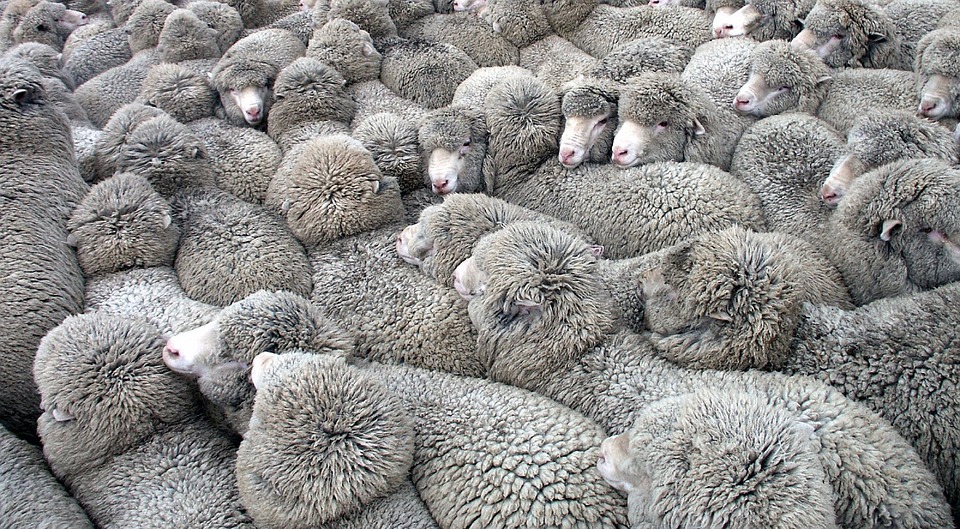
In short, they were shoving and grasping, the strong taking from the weak. There was no care being taken to ensure those most in need had their share of the basics.
All that shuffling and stomping during the hoarding of resources did a lot of damage, too. Where there is hoarding, there often is spoilage, and what could have benefitted others is wasted.
The message is pretty straightforward: Stop shoving and grasping, thinking only of yourself. Look around. To draw from a story in John 5: Who needs help reaching the pool of Bethesda?
In both the Ezekiel prophecy and in Jesus’ teaching, the concern is for the people on the margins of society, the “least of these,” the ones most damaged by the brokenness of the world. And remember, these images are all presented in “last days” judgment style—in Matthew, the lesson is conveyed by the one who will do the judging!
How we treat people pushed to the margins becomes a very serious litmus test for how effectively we have absorbed the idea that Jesus Christ is Lord and Savior. In response to this idea, people have devised a lot of schemes through the centuries regarding what governments should do. Some of those might even be worthwhile strategies.
None of that planning, however, eliminates our responsibility to look around and assess what we need to do as individual Christians. As God says through Ezekiel, “I will judge between one animal of the flock and another.”
Lord, give us eyes to see, ears to hear and a willingness to provide. Amen.
 Methodist Life