Surprisingly Simple

In this Lenten season, we’ll call this “Back to Basics Day.” Let’s begin by considering exactly what Abram (later to be called Abraham) gave up when he listened to God and moved toward an unspecified land.

This initial call in Genesis 12:1-4 is written in a rather matter-of-fact tone, but the risk must have seemed huge for an aging man. He had property and people around him, including slaves, the mark of a comfortable, wealthy man. We don’t know how long Abram had been in Haran—we only know his father Terah had moved the family from far-away Ur some time earlier—but as the family had been able to grow their wealth while there, we can assume life in Haran had been good for them.

Now Abram was to pack his family and possessions and make a journey that ultimately would prove to be more than 500 miles, about the same distance as walking from from Upper East Tennessee to Jacksonville, Fla. For them, it was a dangerous month-long one-way trip, assuming the animals in their caravan were in good shape. A return visit to Haran or the true family homeplace, Ur, might be a once-in-a-lifetime event, perhaps when someone needed a bride of proper bloodlines.

And yet, Abram went, without question, without comment. He would have questions later, but not in this initial act of faith, this huge, trusting leap toward God.

It’s easy to get caught up in what Abram did rather than focusing on the importance of what was in his heart. The Apostle Paul uses Abram in the fourth chapter of Romans to illustrate that it’s the trust we exhibit that saves us, not any work we do. When God sees we trust him, he goes ahead and calls us righteous, even though we don’t deserve it. Paul made clear he was talking about the God we know best through Jesus Christ, the one who made all things and then restored all things to holiness despite sin.

So, we’re invited to a simple act of faith. But at the same time, we’re also called to remember that it’s so simple it can be confusing, particularly for the uninitiated. When we’ve turned away from God and are caught up in sin, we feel like we’re trapped in that Harry Potter hedge maze, the one where the turns and dead-ends seem endless and the roots and branches grab at us. We have to figure the maze out, right? To survive, we have to beat back what entangles us, right?

Wrong. All we really have to do is look up and say, “Lord Jesus, I believe you can pluck me out of this.”

In the third chapter of John’s gospel, we see the Pharisee Nicodemus desperately wanting to follow Jesus, but at the same time struggling in his rigid, legalistic mind with how to do so. Accept what is from above, Jesus told him. Trust God. Trust God’s love for his creation.

“For God so loved the world that he gave his only Son, so that everyone who believes in him may not perish but may have eternal life,” Jesus said. And then came the real kicker, particularly for a legalist striving to make himself righteous: “Indeed, God did not send the Son into the world to condemn the world, but in order that the world might be saved through him.”

What, God doesn’t seek to punish us first? I don’t have to clean up my act to accept God’s gift of salvation?

We have Nicodemus types around us, perhaps even among us in church. They want to make that first step toward God much more difficult than it is, trying to resolve personal angst and the global problem of evil in one fell swoop. Often, they expect a requirement to crawl at least halfway back toward the one they’ve offended before being accepted.

As Christians, our job is to keep simple what can be misunderstood as complicated. The God of Abraham, the God who walked among us and died for our sins, loves us. He’s been reaching down to humanity for thousands of years and continues to do so today.

Sure, once we accept God’s offer, there’s more to do. It’s only natural that we want a developing, continuing relationship with the one who gives us eternal life in place of death. We pray, we study, we joyfully respond to his simple requests, the first being, “Go and tell others.”

That initial act of accepting God’s outstretched loving hand remains simple, however.
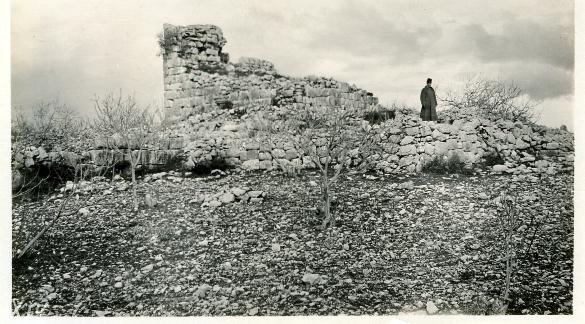
The Altared Life

Ruins near Bethel, where Abraham is said to have built an altar. Photo circa 1920.

By Chuck Griffin

This season of Lent is a good time to consider how we honor and worship God. Abraham, called “Abram” in Genesis until God decrees a name change, is one of those faithful people who serves as a powerful example.

In Abraham’s story, we begin to see how the relationship between God and sin-sick humanity might be restored. In Genesis 12:1-8, God tells Abraham that a faithful response to God will have its rewards. Abraham will be a great nation with a great name. And through him, a blessing will come about that makes it possible for all the families of the earth to be blessed. (Think of a particular descendant, Jesus.)

Abraham is asked to do something in response to these promises—get up and move from a prosperous, comfortable life toward a strange land, Canaan. God seems to be saying, I’ll do something new, but show me you’re the kind of person who can handle change.

I’m struck by how Abraham’s lifelong response to God’s guidance makes use of altars, stopping points along the way where Abraham can worship and honor his creator and divine friend through prayer and sacrifice.

Abraham enters Canaan and builds an altar. He moves deeper into Canaan and builds an altar. God gives him a vision of all that will be called Abraham’s—a vast territory. And Abraham builds an altar.

Altar construction must have been routine for Abraham. Even in Genesis 22, when God makes the strangest demand on Abraham, the sacrifice of the old man’s long-awaited son, Isaac, Abraham faithfully builds the altar and prepares to act. God stops the sacrifice, seeing he has found a man who can pass the ultimate test of faith.

I’m left to wonder how successful I am at faithfully building altars in the modern sense, as I move through the years. Am I constantly looking for new ways and places to give praise and thanks? Do I use worship to mark those times when God’s intervention in my life is obvious? What of my life am I willing to give up to ensure I properly honor my creator and benefactor?

The altared life is the way to live, if Abraham’s story is any indication.

Lord, remind us to respond formally to your grace, and let us find joy kneeling at the altars we construct in this world and in our hearts. Amen.

The Big Promise

Genesis 12:1-3 (NRSV)

Now the Lord said to Abram, “Go from your country and your kindred and your father’s house to the land that I will show you. I will make of you a great nation, and I will bless you, and make your name great, so that you will be a blessing. I will bless those who bless you, and the one who curses you I will curse; and in you all the families of the earth shall be blessed.”


I find myself repeatedly referencing these promises while I’m preaching or teaching. The last one, “in you all the families of the earth shall be blessed,” is one of those linchpins of the Bible, firmly connecting the Old and New Testaments.

Abram, of course, eventually was renamed “Abraham” by God, who worked through this man to establish a people, the Israelites, with whom God could be in relationship. Sin had broken the relationship between God and humanity, but God has from the earliest pages of the Bible wanted it restored.

What a sweeping promise: All the families of the earth shall be blessed! When we really start to think that through, it boggles the mind.

Yes, Abraham is known widely, having influenced the development of Judaism, Christianity and Islam. But being known and being the conduit of a blessing spanning millennia are two very different matters.

As Christians, we understand that God came among us in flesh through the Israelites, the promised descendants of Abraham. Jesus Christ died on the cross because “God so loved the world.” Through the work of Christ, restoration to God—the great blessing granting us forgiveness from sin and eternal life—is possible.

The promise to Abraham seems to go beyond mere possibilities, though. “All” and “shall” hint at the completeness of God’s plan, which will play out in ways that should astonish us. Salvation through Jesus Christ will be global; no family will be untouched.

The astounding quantity of God’s grace should fill us with hope, whatever our circumstances.

Lord, we seek new visions and evidence of how widespread your loving work extends, and we look forward to the day when it is complete. Show us our role in all that is to transpire. Amen.

Ultimate Covenant

By Chuck Griffin
LifeTalk Editor

Jeremiah 31:31-34

“The day is coming,” says the Lord, “when I will make a new covenant with the people of Israel and Judah. This covenant will not be like the one I made with their ancestors when I took them by the hand and brought them out of the land of Egypt. They broke that covenant, though I loved them as a husband loves his wife,” says the Lord.

“But this is the new covenant I will make with the people of Israel after those days,” says the Lord. “I will put my instructions deep within them, and I will write them on their hearts. I will be their God, and they will be my people. And they will not need to teach their neighbors, nor will they need to teach their relatives, saying, ‘You should know the Lord.’ For everyone, from the least to the greatest, will know me already,” says the Lord. “And I will forgive their wickedness, and I will never again remember their sins.”


If we are going to grasp what’s going on in the Bible from Genesis to Revelation, there are a handful of critical concepts. Two major ones are in this prophecy from Jeremiah.

First, there is the idea of “covenant.” God’s covenants with humanity evolve through time, growing ever more expansive regarding whom they reach. You can see the potential for expansion was there from the start, when God entered a covenant, a holy contract, with the man we would come to know as Abraham.

Genesis 12:1-3: “The Lord had said to Abram, ‘Leave your native country, your relatives, and your father’s family, and go to the land that I will show you. I will make you into a great nation. I will bless you and make you famous, and you will be a blessing to others. I will bless those who bless you and curse those who treat you with contempt. All the families on earth will be blessed through you.'”

Followers of Jesus Christ see his death on the cross thousands of years later as establishing a new covenant that makes salvation possible for all the families on earth. 

As covenants are established through time, we better understand a second critical concept, the idea of holiness. As God expands his relationship with humanity through Jesus Christ globally, he also begins to penetrate the hearts of his followers more deeply.

Jeremiah speaks of a time when holiness is complete, when God’s followers are so closely aligned with him that they have no need of written or spoken instruction. God will be so present within us that we simply will know God’s will for ourselves, enabling us to live in perfect harmony.

We obviously are not there yet. But as we practice faithful discipleship, it’s good to know where we are headed.

Lord, help us grow in holiness as we accept the eternal covenant offered us through Jesus Christ. Thank you for meeting us in our imperfect states, rescuing us from sin and death. Amen.