The spiritual reasons for fasting have been lost on society. United Methodists are surprised to learn that John Wesley fasted two days a week in his younger days. Later he fasted on Fridays. Charles Yrigoyen Jr., in “John Wesley: Holiness of Heart and Life,” writes:
Wesley was convinced that fasting, abstaining from food or drink, was a practice firmly grounded in the Bible. People in Old Testament times fasted (Ezra 8:23). So did Jesus and his followers (Matthew 4:2; Acts 13:3), and Wesley saw no reason why modern Christians should not follow the same pattern. His plan of fasting sometimes allowed for limited eating and drinking. He found that fasting advanced holiness.
Being holy, is that a reason to fast? Being holy seems to be a reason to fast. Isaiah 58 helps us get to how we should fast.
Why isn’t fasting working? We are rebelling. These questions matter: Do we practice righteousness? Whose interest are we serving? Are we quarreling?
God’s grace allows us to see the harsh reality of our lives. Sin is in our lives. At times, our attitudes are horrendous. It almost sounds like we, like Israel, can be spoiled brats trying to get the attention of our downtrodden parents! There must be more to drawing near to God.
What must change to have grace in our lives? We understand the kind of fast has the Lord chosen. The fast the Lord has chosen includes justice, feeding the hungry, housing the homeless, giving clothes to the naked, and welcoming the stranger (among other tasks). By doing these works, we work in the grace God has given us.
God’s grace can work through fasting. It is not a diet. Fasting is not an idea for young adults and youth who are worried about their body image, who are leaning toward purging. That is a sign of needing help. If you need to get closer to God, to be more holy, then fasting can be one way that you draw closer to God. That is if you are helping those who need help. Otherwise, we are just spinning our wheels.
It is in the basics of our faith that we gain the means to be closer to God, to become holy as he is. During Lent, we can give up chocolate or sweets. That would be categorized as abstaining. But to give up a meal or two and spend the time in prayer and giving those funds to the needy, that is fasting.
Will you fast this Lent? For those of us with health concerns, talk with your doctor before you fast. For those of us who need to get closer to God, to allow his grace to work in our lives, then let us fast. Just do not let anybody know when you are fasting.
Before we launch into today’s verses from Zephaniah, let’s acquire a little background on his situation.
The prophet spoke about 630 years before the birth of Jesus Christ, during a time of religious indifference, social injustice and economic greed.
This also was an important time of transition for the Kingdom of Judah, which was moving from King Amon, who had been assassinated, to King Josiah, a boy king. A little later in Josiah’s reign, the Book of the Law would be rediscovered. Essentially, the people were about to re-learn who they were, and Josiah, for a time, would restore them to religious righteousness.
Zephaniah was a contemporary of the Prophet Jeremiah. It very well may be that what Zephaniah said helped lay the groundwork for the transition back toward holiness.
Let’s hear some of what he had to say, recorded in Zephaniah 1:7-18:
Stand in silence in the presence of the Sovereign Lord,
    for the awesome day of the Lord’s judgment is near.
The Lord has prepared his people for a great slaughter
    and has chosen their executioners.
“On that day of judgment,”
    says the Lord,
“I will punish the leaders and princes of Judah
    and all those following pagan customs.
Yes, I will punish those who participate in pagan worship ceremonies,
    and those who fill their masters’ houses with violence and deceit.

“On that day,” says the Lord,
    “a cry of alarm will come from the Fish Gate
and echo throughout the New Quarter of the city.
    And a great crash will sound from the hills.
Wail in sorrow, all you who live in the market area,
    for all the merchants and traders will be destroyed.

“I will search with lanterns in Jerusalem’s darkest corners
    to punish those who sit complacent in their sins.
They think the Lord will do nothing to them,
    either good or bad.
So their property will be plundered,
    their homes will be ransacked.
They will build new homes
    but never live in them.
They will plant vineyards
    but never drink wine from them.

“That terrible day of the Lord is near.
    Swiftly it comes—
a day of bitter tears,
    a day when even strong men will cry out.
It will be a day when the Lord’s anger is poured out—
    a day of terrible distress and anguish,
a day of ruin and desolation,
    a day of darkness and gloom,
a day of clouds and blackness,
     a day of trumpet calls and battle cries.
Down go the walled cities
    and the strongest battlements!

 “Because you have sinned against the Lord,
    I will make you grope around like the blind.
Your blood will be poured into the dust,
    and your bodies will lie rotting on the ground."

Your silver and gold will not save you
    on that day of the Lord’s anger.
For the whole land will be devoured
    by the fire of his jealousy.
He will make a terrifying end
    of all the people on earth.
It’s hard to miss the sound of irrevocable finality in this concept of the “Day of the Lord.” Zephaniah may seem obscure to us, but the Day of the Lord is a common biblical theme, its images at times playing out in not-completely-final ways, giving us little preludes of what we are told is to come.
Not everyone lives as if they will ever see such a day, including many who consider themselves God’s followers. In church circles, it is not unusual to hear people express a longing for the positive aspect of such a day, the visible return and rule of Jesus Christ. People ask, “Why does he take so long?”
And yet, judgment for both the living and the dead will accompany Christ’s return. I suspect many will examine their lives and cry out, “We needed more time!”
Christians live in the midst of a people much like Zephaniah’s, and we have to be careful not to fall in with them. It’s easy to think of examples of religious indifference, social injustice and economic greed all around us.
Our prayer should be that we’re moving into a similar time of transition, a rediscovery of what God has revealed to us and an awakening in our culture to how that truth impacts all of us.
Thanks be to God that he works in this world with an offer of overwhelming love and forgiveness, received through the simple belief that Christ died on the cross for our sins.
In return, all we are asked to do is to present the world with this tremendous opportunity to escape from what ultimately will be destroyed on the Day of the Lord.
Lord, show each of us what to do as part of a great turning back to you. Amen.
People are called from all stations in life to follow and serve the Lord. Matthew 9:9-13, the story of the calling of a tax collector, is a great example. In many ways, Matthew was an enemy to his people, collecting taxes for hated oppressors. But Jesus saw something holy in him and called him to a new life.
“The Calling of St. Matthew,” James Tissot, circa 1890
Esther is an unusual book of the Bible. For one thing, it never mentions God.
Through the centuries, scholars have debated whether it should even be in the Bible. I’m convinced, however, that its core message is one of the most useful biblical teachings we have as we cope with the modern world.
I boil that message down this way: God often works in the world through what look like coincidences.
I’ll leave it to you to read this wonderful tale, an act that should be a pleasure. It reads like a short story, particularly if you have a modern English translation.
Suffice it to say that there are two main characters, Esther and her adoptive father Mordecai, both Jews living in exile in the capital of the Persian kingdom.
Through a series of odd events, including what amounts to a beauty pageant, Esther becomes queen, all the time keeping her Jewish heritage a secret. She has no real power, however; mostly, she exists to provide companionship to King Xerxes (Ahasuerus in some translations).
On a separate track in the story, Mordecai works as a court official, but in the process he angers the king’s top administrator, Haman. When Haman finds out Mordecai is a Jew, he plots to destroy not only Mordecai, but also every Jew in the empire.
By being in the position she is in and acting bravely, Esther saves the Jews and even arranges for the destruction of their enemies. To do this, she has to go unbidden before the king, an act that could get her killed.
The whole book turns on a series of coincidences. The enthronement of a Jew during the impending destruction of the Jews is the obvious one. The king’s sleepless night, leading to the reading of a particular court record, is another.
While God is not mentioned in the book, it is easy to assume that the original audience saw God’s hand in all that happens in the story. What makes the Esther story different is that God nudges history along through divine coincidences rather than driving it forward with pillars of fire and peals of thunder.
Of course, for God to move history in such a way, human beings have to respond to God-made opportunities when they arise. If people simply sit passively, saying, “I’m not sure I see God,” little happens.
The formula for participating in God’s divine plan is simple. First, accept that God does have a hand in day-to-day events. Second, when you think you’ve identified a moment in time where God is calling you to act, do something about it. Act courageously, with an attitude of hope in everything you do.
As Mordecai tells Esther when her moment of decision is before her: “Who knows if perhaps you were made queen for just such a time as this?” In the eyes of other people, we may have been made big or small, but I believe we are where we are for a reason.
Lord, in those moments where we sense you have gently prodded us to take risks on behalf of the kingdom, give us the kind of courage and selflessness necessary to act. Amen.
Do you ever wish God were different? It sounds like a strange question, but the prophet Jonah could have easily answered, “Yes.”
The story of Jonah opens with the prophet at home somewhere in Israel, hearing from God with the clarity most biblical prophets seem to experience. God gave Jonah a simple command: “Go at once to Nineveh, that great city, and cry out against it; for their wickedness has come up before me.”
Nineveh was to the east, in what is now the northern part of Iraq. (Its ruins are near the city of Mosul, where modern battles have been fought in recent years.) It was one of the great cities of the Assyrian empire, a wonder to those who beheld it. Jonah had no doubt which direction Nineveh lay, yet Jonah headed west by sea, rather than east by land.
The story tells us Jonah went to the coast and got on a ship bound for Tarshish, a place not easily identified today. In the novel Moby Dick, the clergyman at the New Bedford Whaleman’s Chapel, Father Mapple, preaches on Jonah and asserts that Tarshish must have been a port in Spain, the farthest point west a Jew in Jonah’s day would have known. It’s not a bad notion—we’re told Jonah is trying to go “away from the presence of the Lord,” so what seemed like the end of the earth would have been a logical destination.
Storms soon began to worry the ship on its journey to Tarshish, to the point that the pagan crew cried out to their various gods. The captain implored Jonah to pray, too. They cast lots to determine who was the cause of the problem, and something like a throw of the dice showed the cause was Jonah.
And, very early in the story, Jonah began to understand that God was present regardless of how far Jonah ran or sailed. He admitted to the crew who he was and what he had done, and despite their initial reluctance, he convinced them to throw him in the sea. The sea immediately became calm.
This brings us to the part we know best from childhood: God sent a big fish to swallow Jonah. (Yes, it could have been a whale; the Hebrew word used in the story literally means a large fish, but the Jews would have used this word to include whales.) In the belly of this large sea critter, Jonah prayed a powerful psalm, in part acknowledging that God is everywhere, even capable of hearing one of his rebellious prophets trapped beneath the waves, “at the roots of the mountains.”
In response to this prayer, God had the fish vomit Jonah out somewhere on dry land. And Jonah once again heard his marching orders: “Get up, go to Nineveh, that great city, and proclaim to it the message that I tell you.” This time, Jonah headed in the right direction, presumably after cleaning himself up.
Once in Nineveh, Jonah preached his message. “Forty days more, and Nineveh shall be overthrown!” And here’s the twist we might not expect when reading this story the first time—those pagan, supposedly godless residents of sprawling Nineveh responded!
Even the king put on sackcloth and ashes and repented. He ordered everyone to do the same, and to fast. They went so far as to cover the livestock with sackcloth and withhold the animals’ food or water. The prayers, wails, bleating and lowing set up a din that had to reach to heaven.
God heard, and God relented from the destruction he had promised. And that, we learn, was precisely what Jonah feared would happen.
“O Lord!” he prayed. “Is not this what I said while I was still in my own country? That is why I fled to Tarshish at the beginning; for I knew that you are a gracious God and merciful, slow to anger, and abounding in steadfast love, and ready to relent from punishing.”
Jonah was so bitter, he prayed that God might kill him. You see, the Israelites considered the people of Nineveh their enemy. The Jews had suffered terribly under Assyrian rule; Jonah had hoped for a scene of destruction worthy of Sodom and Gomorrah. And now, here was the God the Jews acknowledged, the God over all things, showing mercy to these people!
All Jonah could do was pout. That pretty much sums up the rest of the story of Jonah. He pouted while God explained his deep concern for the people of Nineveh, using a simple plant as an example.
God is love. God is mercy. Yes, God’s holiness demands justice. But God seems to have this unrelenting desire to let people off the hook, to forgive, to find a way to draw people back into relationships with him.
That truth is best expressed through Jesus Christ, of course. Through the great sacrifice of Christ on the cross, God found a way to extend mercy to all, no matter what evil has been done. Repercussions in this life for our bad deeds may be unavoidable, but a renewed, ongoing relationship with God is constantly available, in any moment, on any day, under any circumstances.
When we find ourselves hoping God will crush someone, we’re wishing God were different. When we think there’s no way God could love us, forgive us, or change us, we’re underestimating who God is.
Why would we want to wish for a different kind of God? The one we have freely offers eternal life. We’ll do no better than that.
Lord, thank you for your incredible, undeserved mercy, expressed most clearly by Jesus Christ on the cross, dying for our sins. Amen.
The little prophetic book of Obadiah contains a description of an emotion so nasty that God promised to destroy those who felt it.
Oddly, as powerful an emotion as it is, we don’t have a word for it in English. The Germans call it schadenfreude. The Greeks call it epichairekakia.
It is the joy we sometimes feel when someone else experiences trouble. Usually, that someone else is a rival or enemy, and we are reminded in Obadiah that we can treat people quite close to us as rivals or enemies.
Obadiah, a prophet we know little about, described in 21 tight verses why God would destroy the Edomites. The Edomites, you may recall, were the descendants of Esau, twin brother of Jacob. Jacob, of course, was a progenitor of the Israelites.
In other words, the Israelites and the Edomites were cousins. They considered themselves the killing kind rather than the kissing kind, however, keeping alive some very old grudges going back to their twin forefathers.
While we don’t know the exact time frame for Obadiah, his prophecy clearly came after the Israelites had suffered terrible defeat and destruction. The Edomites were guilty not so much of committing violence, but of reveling in what they witnessed.
“You should not have gloated over your brother on the day of his misfortune; you should not have rejoiced over the people of Judah on the day of their ruin; you should not have boasted on the day of their distress,” God said to the Edomites through Obadiah.
The desire to grin at a rival’s pain is such a common emotion that I’m surprised we don’t have a word for it in English. Perhaps we need one; it’s hard to identify and repent from a sin when you cannot name it. “Malevojoy,” a fusion of “malevolence” and “joy,” might work.
We see such perverse emotion displayed again in the New Testament, as Jesus is hanging on the cross. The chief priests, scribes and elders watch their rival bleeding and dying and mock him, no doubt with grins on their faces.
“And the people stood by watching; but the leaders scoffed at him, saying, ‘He saved others; let him save himself if he is the Messiah of God, his chosen one!'” (Luke 23:35.)
The potential result of their malevojoy seems much different in the New Testament, however. We are told in Luke how Jesus dealt with such people before they so much as spoke, knowing full well the judgment his enemies might face one day. “Father, forgive them, for they do not know what they are doing.”
Even at his death, Jesus felt only love and pity for his rivals.
Dear Lord, forgive us for the nameless sins we commit. Amen.
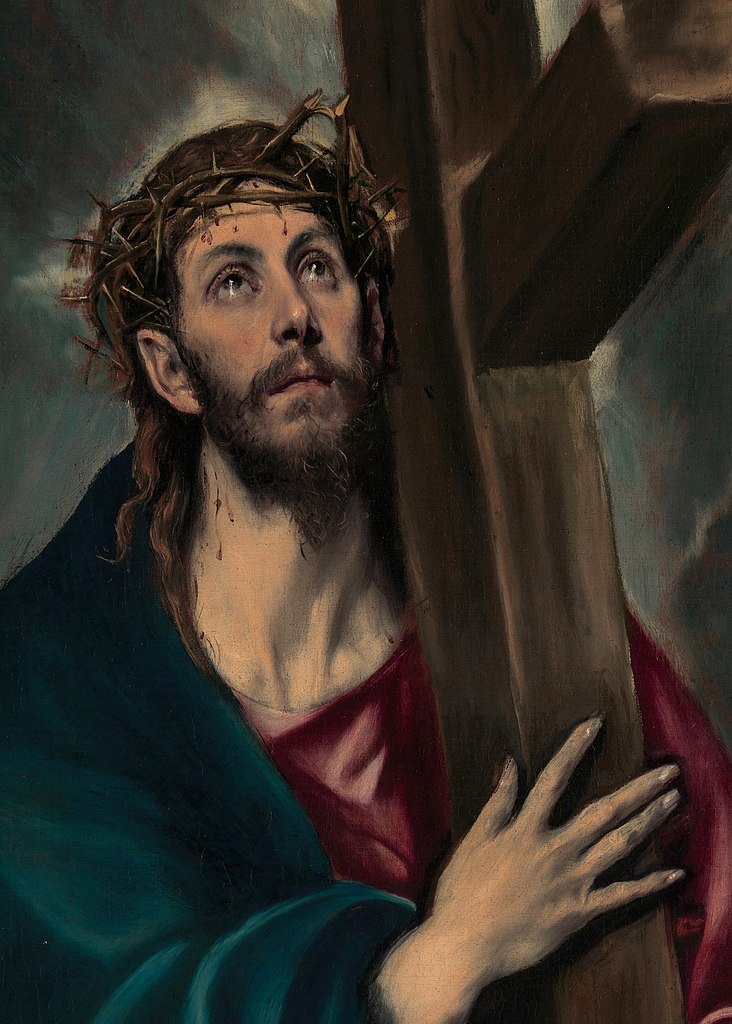
“Christ Carrying the Cross,” El Greco, circa 1580.
Having exited the Christmas season, let’s take a few moments to meditate on where the Christian story takes us as we move through winter and into spring. In between his birth and the moment depicted above, Jesus revealed much about God’s plan for humanity, including how the promise of salvation would be fulfilled.
Isaiah 53:3: “He was despised and rejected by men, a man of sorrows and acquainted with grief; and as one from whom men hide their faces he was despised, and we esteemed him not.”
Gerard David, Adoration of the Kings, National Gallery, London, circa 1515
I hope I’m not overplaying the Epiphany by spending two days on the subject. To me, it seems appropriate. Throughout much of Christian history, the celebration of the Feast of the Epiphany was a much bigger deal than celebrating Christmas.
From that alone, we should assume the story associated with it, the story of the Wise Men, is important. So what does the story tell us about God?
We receive little detail about these men chasing a “star” in search of a newborn king, a star no one else seems to have noticed. Tradition has led us to think of three wise men, but the Bible doesn’t give us an exact number.
Today, let’s simply consider some odd facts. As mentioned yesterday, an event in a tiny village was communicated via the stars and planets. We also should note that these wise men likely would not have understood God the way a Jew did, and yet God drew them into the story of his ultimate intervention in history.
It seems the big lesson God gives us in this story is how surprising he can be as he tries to shower us in grace and save us from sin. He not only will meet us where we are, he will work through our current practices to change us. (Methodists call this “prevenient grace,” the love God tries to show us even before we acknowledge who God is.)
When I think of the wise men seeing Christ’s birth registered in the sky, I also think of all the stories I’ve heard of nonbelievers discovering God in unlikely places: in bars, in prison, in dive hotels—any of those locations or moments where we might wrongly think God is not present.
The story peaks in a happy way. God led the wise men on from their visit with Herod, and there was the baby, just as promised. They gave Jesus gifts. What a joy that must have been, to give the Christ child a gift! And even better, they were able to kneel before him.
Was it worship? Translators debate how to deal with the word describing their act. We kneel in worship, but the wise men also would have been likely to kneel before a king.
We can say for certain that the moment marked a dawning awareness. These wise men would have understood God was working in the world in powerful ways, and that they had been drawn into the plan. They even would continue to hear from God in dreams, protecting the child and themselves in the process.
These wise men, these magi, were a foreshadowing of the purpose behind Jesus’ work on the cross decades later, and the church’s Holy Spirit-inspired work today. God truly calls to all people, regardless of their location or circumstances. After all, “For God so loved the world … .”
Lord, in 2022, may we with great joy worship the Christ. Thank you for the revelations about Jesus that we receive through Scripture and experience in our hearts. May we give him our gift of faithfulness, made possible by your Holy Spirit. Amen.
Psalm 63:5-9 (NRSV)

My soul is satisfied as with a rich feast,
    and my mouth praises you with joyful lips
when I think of you on my bed,
    and meditate on you in the watches of the night;
for you have been my help,
    and in the shadow of your wings I sing for joy.
My soul clings to you;
    your right hand upholds me.
By John Grimm
We are ready! We have our minds set on turkey and fixings. We are looking forward to the pie—whether it be pumpkin, pecan, apple, or mincemeat! We are glad it is time to feast.
Why are we ready to feast? God has been providing for us! We are satisfied by God in our waking—whatever time we are awake. For when we awaken in the middle of the night and can not get back to sleep, it is prime time to concentrate on the Lord. This time is when we have a rich feast, and our mouths are full of praise.
I believe the hymn title is: “Count Your Blessings.” God shelters us, and that’s a blessing we can count multiple times! We cling to God by noticing how much the Lord does for us. There is nothing like knowing God’s right hand upholds us!
Lord God, thank you satisfying our souls. Lying in bed, thinking of you and your work in our lives brings joy to us. As we know you, may our friends and family notice our contentment in you. May we have more reasons to be thankful as friends and family find satisfaction in you. In the name of Jesus Christ, we pray for joy for our friends and family this Thanksgiving. Amen.
The founder of Methodism, John Wesley, is remembered in part for his last words, “The best of all is, God is with us.” He actually said the phrase twice before dying. The second time, we are told, he raised his hand and waved it in triumph. Below is a book engraving of his passing, artist unknown. (If you can help me find a proper attribution, please pass it along.)
Lord, may we always sense that you are with us. Amen.






 Methodist Life