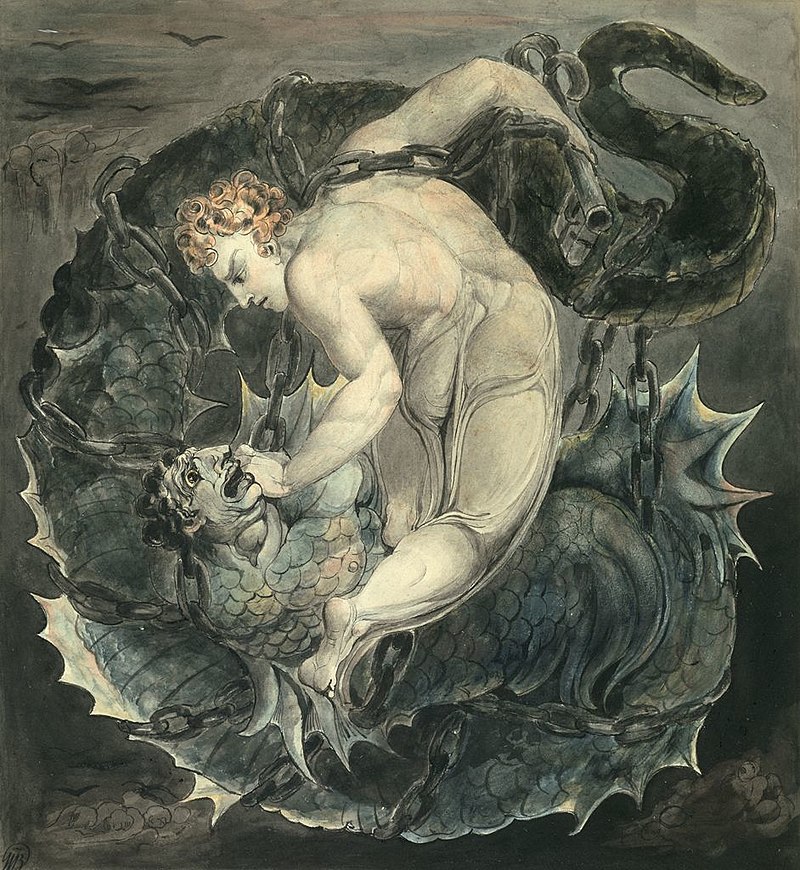
Fight My Enemies

“The Angel Michael Binding Satan,” W. Blake, circa 1805

Psalm 35:1-10

I hope you’ll take time to read these verses from Psalm 35, which can be found by clicking the above link. You can examine the psalm in different translations, if you want.

If you are someone who believes others are working against you, acting as your enemies, this psalm makes an excellent prayer to God for assistance. It creates a stirring mental picture when read; imagine the eternally powerful and wise Lord of All arming himself for battle and coming to your aid.

A word of caution, though. Praying this psalm is no magic trick, no casual incantation. Our God cannot be trapped and contained the way people believed (and still believe) pagan, little “g” gods can be controlled.

There are some serious actions that must accompany such a prayer. First and foremost, people who would lift it need to do some deep soul-searching, examining whether they have aligned themselves with the Lord. Scripture would be their best source of guidance, of course. Is what they desire precisely what God desires?

Do their tormentors, as unrighteous as they may seem, have anything resembling a valid point to make? Might they, too, be in at least partial agreement with God, and might that mean there is a place for reconciliation, for middle ground?

As Paul reminds us in Romans 3:10-12, “There is no one who is righteous, not even one; there is no one who has understanding, there is no one who seeks God. All have turned aside, together they have become worthless; there is no one who shows kindness, there is not even one.”

We are all dependent on Jesus Christ and his sacrifice on the cross for salvation. Any righteousness we have flows from our belief in the cross. Any success we might have in praying this Psalm 35 prayer would be rooted in our faith, and a willingness to also pray for our enemies, just as Jesus taught us.

Dear Lord, as we meditate on our relationship with you, may we find ways to escape hostility and be rejoined to our enemies, seeking peace. Amen.

Start Right

Psalm 86:8-13 (NRSV)
There is none like you among the gods, O Lord,
    nor are there any works like yours.
All the nations you have made shall come
    and bow down before you, O Lord,
    and shall glorify your name.
For you are great and do wondrous things;
    you alone are God.
Teach me your way, O Lord,
    that I may walk in your truth;
    give me an undivided heart to revere your name.
I give thanks to you, O Lord my God, with my whole heart,
    and I will glorify your name forever.
For great is your steadfast love toward me;
    you have delivered my soul from the depths of Sheol.

When life seems complicated, it is good to lift up a simple prayer. If the news is any indicator, this week could prove to be complicated, so let’s prayerfully turn our eyes toward our wisest guide, as revealed in Psalm 86.

There is none like God. How can anything created be like the one who creates? At best, we can hope to be a reflection of God, an image pointing toward what is holy.

And what is holy will be revealed in full. Despite the turmoil, the striving, and the evil within the nations of the world, all people will one day conform to God’s will. It simply is part of God’s plan.

The greatest and most wondrous thing God has done is to give sinful beings a path home to their creator. We now understand that this reconciliation occurs through Jesus Christ, God Among Us.

In a great, mysterious act of love, Jesus died on the cross, bearing the burden of our sins so we do not have to do so. Simply through our belief in this act, we are restored, made worthy of eternal life in God’s presence.

Teach us, O Lord; help us to put aside what is not of you and live every moment of our lives for you. As we better recognize the incredible gifts you have given us, may we be a people filled with thankfulness, and may you be glorified in all we do.

Lord, carry us through this week and beyond; hear our prayer. Amen.

What We Do Next

1 Timothy 4:11-16 (NRSV)

These are the things you must insist on and teach. Let no one despise your youth, but set the believers an example in speech and conduct, in love, in faith, in purity. Until I arrive, give attention to the public reading of scripture, to exhorting, to teaching. Do not neglect the gift that is in you, which was given to you through prophecy with the laying on of hands by the council of elders. Put these things into practice, devote yourself to them, so that all may see your progress. Pay close attention to yourself and to your teaching; continue in these things, for in doing this you will save both yourself and your hearers.


Paul wrote the above words to a young pastor. Let’s read them as instructions to mature Christians.

Yesterday, I wrote a lament and a prayer regarding events that led to mob violence in our nation’s Capitol building Wednesday. How can Christians help restore a nation’s character?

We’re discovering how dangerous it is to ignore character. For too long now, we’ve been willing to say, “Well, that person lacks character, but he promotes something I like, so let’s give him power.” Many of you will think I’m talking about just one person, but I actually could make a list.

Speech and conduct matter; they are external expressions of the character within. They should exhibit high ideals, and we as Christians believe that Jesus Christ expresses the highest ideals, given to us straight from the mind of God. Christ’s standards are so high, in fact, that they are difficult to achieve—we should always be striving toward what is higher.

Our words should reflect love for all people. We will always be broken into little factions, political, theological and otherwise, and the differences sometimes might be sharp enough that we find it difficult to live in each other’s circles. But one of the beautiful aspects of this nation is that it was designed so we can at least share a common commitment to freedom, with harm of others being the one trait we should refuse to accommodate.

As Christians, we need to use God’s word, referencing it, quoting it and letting it guide us. This means we live as true disciples, taking the Bible seriously. Using it regularly sometimes makes the secular folks around us a little uncomfortable, but only where they find themselves in conflict with God’s will.

Let’s be deliberate about living and speaking as Christians. Our baptismal vows are more than a part-time commitment. We take on Christ to be clothed in undeserved holiness. From there, we are called to project God’s purity to a hurting world.

Lord, make us bold for you. Amen.

Out of the Fire

2 Peter 3:8-13 (NRSV)

But do not ignore this one fact, beloved, that with the Lord one day is like a thousand years, and a thousand years are like one day. The Lord is not slow about his promise, as some think of slowness, but is patient with you, not wanting any to perish, but all to come to repentance. But the day of the Lord will come like a thief, and then the heavens will pass away with a loud noise, and the elements will be dissolved with fire, and the earth and everything that is done on it will be disclosed.

Since all these things are to be dissolved in this way, what sort of persons ought you to be in leading lives of holiness and godliness, waiting for and hastening the coming of the day of God, because of which the heavens will be set ablaze and dissolved, and the elements will melt with fire? But, in accordance with his promise, we wait for new heavens and a new earth, where righteousness is at home.


The Apostle Peter paints a cataclysmic picture of Christ’s return. It is an image of the universe melting away in an unimaginable heat. The earth remains, stripped bare, its people exposed before God, their inner holiness and evil undeniably on display.

Peter’s words could be just mind-boggling symbolism, of course. But as I’ve pointed out in the past, symbols are a simple way of understanding a more complex reality.

If we believe the Bible is communicating God’s truth, then we have to acknowledge the experience of judgment will be at least as overwhelming as what we see here, and likely more so. We will come face-to-face with our holy creator while stripped bare of our pretenses and self-delusions.

Peter’s letter is a call to ready ourselves, to plunge into our own personal purifying fire. It should help us to know this: What comes out of the fire is far greater than what went into the fire.

Peter would have been familiar with Malachi’s Old Testament prophecies of a day when God’s appointed one would come to act as a “refining fire” and “fuller’s soap,” purifying what has been tainted by sin. The prophecy is not so much about the refining process as it is about what comes out, gold and silver in their purest forms.

After his images of fiery destruction, Peter also alludes to the “new heavens and a new earth, where righteousness is at home.” We submit ourselves to purification by God’s Holy Spirit not out of fear, but in joy, knowing God’s purifying work through Christ will establish a greater way of living. We ready ourselves for a place in the new creation.

So, how do we submit?

Many of you have made that first step, accepting Jesus Christ as Lord. Those of you who have not—well, Peter makes clear that God is patient until the time of patience ends.

Our faith leads us to a new level of engagement with God. The early Methodists had a simple set of rules to live by as they pursued holiness. They are just as instructive for us today.

First, do no harm. What are we doing that damages others? How do we stop doing those things?

Second, do good. Again, the principle is very simple. Do we do good in every way we can, whenever we have the opportunity?

Third, stay in love with God. I’m borrowing Rueben Job’s paraphrase of John Wesley’s more elaborate statement, “By attending upon all the ordinances of God.” By this, Wesley meant participating in public worship, studying God’s word, receiving communion, praying, and abstaining from activities that can distract us from God.

When we follow these rules, we open ourselves to the refining work of the Holy Spirit. And we do not regret the loss of any sin that is burned away.

Lord, make us ready. Amen.

We Are Family

Matthew 12:46-50

While [Jesus] was still speaking to the crowds, his mother and his brothers were standing outside, wanting to speak to him. Someone told him, “Look, your mother and your brothers are standing outside, wanting to speak to you.” But to the one who had told him this, Jesus replied, “Who is my mother, and who are my brothers?” And pointing to his disciples, he said, “Here are my mother and my brothers! For whoever does the will of my Father in heaven is my brother and sister and mother.”


The fifth of the Ten Commandments is, “Honor your father and mother.” When we remember how important family is in Jewish culture, Jesus’ above statement becomes more startling.

Family was important to Jesus, of course. He was an obedient child; likewise, as he was dying on the cross, bearing the burden of the sins of the world, one of his concerns was who would care for his mother.

As important as family is, however, there is a greater concern. Even family cannot interfere in our relationship with God. Walking with God, understanding God and following God’s will are the most challenging and critical activities in our lives.

It can be tough when God’s will for us is out of alignment with what the family wants. I will always remember a little girl in the Czech Republic who learned in Vacation Bible School the story of Jesus’ suffering, death and resurrection. She lived in a nation with a shockingly high percentage of committed atheists, a vestige of communist rule.

Having learned how to tell the story on her own, she said, “I will tell my family. But it will make my grandmother very angry.” The interpreter and I teared up simultaneously.

Jesus knew such conflict would arise when he said, “Do you think that I have come to bring peace to the earth? No, I tell you, but rather division! From now on five in one household will be divided, three against two and two against three.” (Luke 12:51-52.)

If you and your family are aligned in the pursuit of God’s will through Jesus Christ, know what a tremendous blessing you have. And if you are not so blessed, know that your global family prays for you, and that through your witness, your biological family has hope.

Lord, give special strength and new gifts of the Spirit to those who go about the particularly difficult task of telling non-believing family members the Good News. Amen.

On to Perfection

Philippians 3:12-16

I don’t mean to say that I have already achieved these things or that I have already reached perfection. But I press on to possess that perfection for which Christ Jesus first possessed me. No, dear brothers and sisters, I have not achieved it, but I focus on this one thing: Forgetting the past and looking forward to what lies ahead, I press on to reach the end of the race and receive the heavenly prize for which God, through Christ Jesus, is calling us.

Let all who are spiritually mature agree on these things. If you disagree on some point, I believe God will make it plain to you. But we must hold on to the progress we have already made.


I was naively drawn to Methodism for very old reasons. The idea that there was a form of Christianity emphasizing continual spiritual growth toward a high standard set by God fascinated me.

I say I was naive because I somehow conflated the historic Methodism of John Wesley with the modern United Methodist Church I joined in my late twenties. Yes, because we developed a traditional understanding of Methodism, my wife and I joined the denomination when we were everything a church wants—young, seeking to be involved, and with small children.

Certainly, vestiges of the Methodism that lured us remain. But it has become obvious that with the formation of the United Methodist Church in 1968, that old, very successful form of Methodism has increasingly been forced to share a tent with people hostile to some of its basic principles. The last 20 years or so have been particularly telling.

The headline on an April 22, 1972, New York Times story about that year’s General Conference, where the fledgling United Methodist Church established its doctrines, clearly identified what would trouble the denomination for the next half-century: “Methodists Back Theological Pluralism.”

Today’s Scripture, and some important words preceding it, lay out what the UMC no longer emphasizes—a burning desire for holiness, including the pursuit of perfection.

If you just pursed your lips and wrinkled your nose, you are struggling with what these terms mean. You may be falling into the stereotype nonbelievers like to apply to church folk: “Those Christians think they are perfect.”

Hardly. Instead, we know we are broken by sin, and that we cannot find healing without God’s help. Given the great gift of salvation by Jesus Christ on the cross, we methodically go about the activities that allow the Holy Spirit to penetrate us more deeply day by day, changing us into the people God would have us be.

For most people, it’s a long process, one God likely will have to complete in us at death. But in this life, we press on, seeing Scripture as a corrective for our broken minds, learning to pray without ceasing, and living in fellowship so we can help each other through the process.

An old Nazarene preacher—the Nazarene denomination is part of the broader, very traditional Methodist movement—once described holiness as our learning to love the way Jesus loves.

Jesus was obedient unto death; Jesus offered love freely. Seems pretty straightforward to me, even if I have yet to perfect it.

Lord, help us to embrace not just salvation, but the tremendous change you are willing to make in our lives as we submit to you. Amen.

Ultimate Covenant

By Chuck Griffin
LifeTalk Editor

Jeremiah 31:31-34

“The day is coming,” says the Lord, “when I will make a new covenant with the people of Israel and Judah. This covenant will not be like the one I made with their ancestors when I took them by the hand and brought them out of the land of Egypt. They broke that covenant, though I loved them as a husband loves his wife,” says the Lord.

“But this is the new covenant I will make with the people of Israel after those days,” says the Lord. “I will put my instructions deep within them, and I will write them on their hearts. I will be their God, and they will be my people. And they will not need to teach their neighbors, nor will they need to teach their relatives, saying, ‘You should know the Lord.’ For everyone, from the least to the greatest, will know me already,” says the Lord. “And I will forgive their wickedness, and I will never again remember their sins.”


If we are going to grasp what’s going on in the Bible from Genesis to Revelation, there are a handful of critical concepts. Two major ones are in this prophecy from Jeremiah.

First, there is the idea of “covenant.” God’s covenants with humanity evolve through time, growing ever more expansive regarding whom they reach. You can see the potential for expansion was there from the start, when God entered a covenant, a holy contract, with the man we would come to know as Abraham.

Genesis 12:1-3: “The Lord had said to Abram, ‘Leave your native country, your relatives, and your father’s family, and go to the land that I will show you. I will make you into a great nation. I will bless you and make you famous, and you will be a blessing to others. I will bless those who bless you and curse those who treat you with contempt. All the families on earth will be blessed through you.'”

Followers of Jesus Christ see his death on the cross thousands of years later as establishing a new covenant that makes salvation possible for all the families on earth. 

As covenants are established through time, we better understand a second critical concept, the idea of holiness. As God expands his relationship with humanity through Jesus Christ globally, he also begins to penetrate the hearts of his followers more deeply.

Jeremiah speaks of a time when holiness is complete, when God’s followers are so closely aligned with him that they have no need of written or spoken instruction. God will be so present within us that we simply will know God’s will for ourselves, enabling us to live in perfect harmony.

We obviously are not there yet. But as we practice faithful discipleship, it’s good to know where we are headed.

Lord, help us grow in holiness as we accept the eternal covenant offered us through Jesus Christ. Thank you for meeting us in our imperfect states, rescuing us from sin and death. Amen.

Finish with Flourish

By Chuck Griffin
LifeTalk Editor

Philippians 3:13-14:1 (NLT)

No, dear brothers and sisters, I have not achieved it, but I focus on this one thing: Forgetting the past and looking forward to what lies ahead, I press on to reach the end of the race and receive the heavenly prize for which God, through Christ Jesus, is calling us.

Let all who are spiritually mature agree on these things. If you disagree on some point, I believe God will make it plain to you. But we must hold on to the progress we have already made.

Dear brothers and sisters, pattern your lives after mine, and learn from those who follow our example. For I have told you often before, and I say it again with tears in my eyes, that there are many whose conduct shows they are really enemies of the cross of Christ. They are headed for destruction. Their god is their appetite, they brag about shameful things, and they think only about this life here on earth. But we are citizens of heaven, where the Lord Jesus Christ lives. And we are eagerly waiting for him to return as our Savior. He will take our weak mortal bodies and change them into glorious bodies like his own, using the same power with which he will bring everything under his control.

Therefore, my dear brothers and sisters, stay true to the Lord. I love you and long to see you, dear friends, for you are my joy and the crown I receive for my work.


Yesterday’s devotional focused on the big ending, the “last days,” the end of time—and those who don’t live as if it is coming. Today’s Bible passage invites us to think about our own personal finish.

Paul’s message is aimed squarely at those who already have accepted Christ and are (or should be) seeking holy “perfection,” something Paul said he had not achieved himself. Salvation through Jesus Christ is given freely, but it’s evident in Paul’s writings and in other epistles that some Holy Spirit-inspired striving is to be a continuing part of the Christian life.

I think of the effort we make as the thank-you notes to God we write with our lives. The more we live and love as Jesus did, the nicer the notes become through the years.

And certainly, we don’t want to slip backward in our beliefs or behavior. What we understood early in our faith walk is just as true now: Jesus Christ is Lord. His teachings and the teachings that continued to flow through his early followers remain true, passed to us through Scripture.

We may grow spiritually, but we never grow out of following and espousing core Christian truths. They are the stones upon which we build, not clay to be molded into new shapes.

Even in Paul’s day, people in the church sometimes believed they had become so worldly wise over the years that they could move beyond the basic idea that Jesus Christ died for our sins, and that as our savior he has certain expectations for our lives.

Sadly, they had actually fallen from their early, supernaturally inspired faith, posing a danger to newer Christians around them.

Finish well. Others are watching. And never forget, the finish line is the beginning of a greater experience.

Lord, may we always trust in the Christian truths first revealed to us, and may we never reach an age where we say, “I am done growing in Christ.” Amen.

Psalm 23: Holy and Fearless

By Chuck Griffin
LifeTalk Editor

Our devotionals yesterday, today and tomorrow are all from the 23rd Psalm, “A Psalm of David,” considered in small meditative bites.

Verse 3b
He guides me along right paths,
    bringing honor to his name.

As his sheep, we follow his lead, behaving as the shepherd would have us behave. Sometimes the concept of Christian holiness is made to sound complicated, but it really is that simple.

We are known as his flock, and we do not want to embarrass him by wandering down paths not leading to eternity. For thousands of years, he has shown us his will through his word, recorded in the Holy Bible. This is how he tells us left or right, stop or go.

Yes, the noise of the world sometimes makes his call a little harder to discern, but if we take time to focus on Scripture in a thoughtful and prayerful way, we will know what to do.

And when we follow the right paths, people do notice. They are astonished when the harm they were expecting from us does not occur, or when they receive unexpected goodness.

And when they seek to know why we behave in such an unworldly way, we earn the right to tell them, “Because I stay in love with God—you can too!”

Verse 4
Even when I walk
    through the darkest valley,
I will not be afraid,
    for you are close beside me.
Your rod and your staff
    protect and comfort me.

Our shepherd is so loving, we can forget how strong he is. He has all the tools and weapons he needs to fend off the most terrifying threats.

The rod, a type of club worn at the belt for quick access, proves our shepherd’s willingness to go on offense when we are threatened. Evil will be crushed. The staff can be used with devastating effect in a fight, too. It also is a tool of rescue, capable of lifting lost sheep out of the most difficult circumstances.

We are reminded of the Great Shepherd, Jesus Christ. The truth he spoke acted like a bludgeon against the lies and deceptions of the world, and the day will come when Christ’s truth shreds evil like the keenest of blades. The cross became his tool for lifting us out of despair and death and into eternal life.

With a shepherd like that, why would we ever be afraid?

Lord, guard us in this life and lift us into the next, and may anxiety never keep us from heeding your call. Amen.

Psalm 19: Look Within

By Chuck Griffin
LifeTalk Editor

Let’s continue our meditation on Psalm 19. Yesterday, we considered the first six verses.

After contemplating the heavens, the psalmist makes what initially seems like a sudden turn, talking about how God instructs us. In particular, he references the law given to the Israelites. The two subjects are more connected than we might initially think.

The order and beauty of the heavens partially reveal God. A fuller understanding of God’s nature is found in contemplating God’s law, the psalmist is saying.

Because of sin, we are too broken to intuit such truths on our own. We need a direct revelation from the mind of God, a conduit Scripture offers us every day.

Even then, we are not strong enough to remain aligned with God—to remain holy—unless God helps us. Thus, we hear the petition at the end of the psalm to be kept and cleansed from sins committed deliberately or unknowingly.

The psalmist did not know the details of how God ultimately would respond to this prayer, benefitting all of humanity, but we know. Christ’s sacrifice on the cross makes it possible for all people to be cleansed of sin.

When we believe in Jesus and the effectiveness of his sacrifice, God’s Holy Spirit rushes in to engage with us and strengthen us, if only we let him.

Lord, may the words from our mouths and the meditations of our hearts be pleasing to you, our rock and redeemer. Amen.


✟ To subscribe to LifeTalk devotionals, enter your email address in the box found on any page of the Methodist Life website. ✟