Drink Up!

Note: The LifeTalk devotions from Methodist Life will be on hiatus for two weeks so the regular author can take some vacation. Regular devotions will resume Monday, June 7. John Grimm, an occasional author for LifeTalk, likely will be posting on his personal blog during this time.

John 7:37-39 (NRSV)

On the last day of the festival, the great day, while Jesus was standing there, he cried out, “Let anyone who is thirsty come to me, and let the one who believes in me drink. As the scripture has said, ‘Out of the believer’s heart shall flow rivers of living water.’” Now he said this about the Spirit, which believers in him were to receive; for as yet there was no Spirit, because Jesus was not yet glorified.


By Chuck Griffin

I offer you this reading from John as a prelude to this coming Sunday, when most of us will celebrate Pentecost and the presence of the Holy Spirit within the church.

Too often, we allow the presence of the Holy Spirit to seem so mysterious that we miss the outpouring of grace and joy available to us.

Are you thirsty? By that, I mean are you fading spiritually, declining in such a way that you’re receiving signals of impending spiritual death? Belief in Jesus Christ opens a spiritual tap, and we can be so filled with the presence of God that we begin to sustain others.

If you’re thirsty, open the tap now. Remember your belief in what Christ has done for us on the cross—dwell on what it means to believe. Engage with God in all those ways God loves to be engaged: in Scripture, in prayer, in fellowship with other believers.

Certainly, seek the Spirit in worship somewhere this Sunday.

Be blessed!

Lord, thank you for your constant presence. Help us to shake off the blinders this world places on us and let us see you once again. Amen.

Who Owns Whom?

“Peter’s Conflict with Simon Magus,” Avanzino Nucci, 1620. Simon is on the right, in black.

Acts 8:18-25 (NRSV)

Now when Simon saw that the Spirit was given through the laying on of the apostles’ hands, he offered them money, saying, “Give me also this power so that anyone on whom I lay my hands may receive the Holy Spirit.” But Peter said to him, “May your silver perish with you, because you thought you could obtain God’s gift with money! You have no part or share in this, for your heart is not right before God. Repent therefore of this wickedness of yours, and pray to the Lord that, if possible, the intent of your heart may be forgiven you. For I see that you are in the gall of bitterness and the chains of wickedness.” Simon answered, “Pray for me to the Lord, that nothing of what you have said may happen to me.”

Now after Peter and John had testified and spoken the word of the Lord, they returned to Jerusalem, proclaiming the good news to many villages of the Samaritans.


By Chuck Griffin

Earlier in Acts, we learn that Simon was a magician, one so clever he astonished the people of Samaria to the point they thought he was tapping into the power of God.

But even this trickster was drawn to the message of Jesus Christ as Savior. Impressed by the signs and great miracles that truly flowed from God through Philip the Evangelist, Simon received baptism and began to follow the preacher about.

Pretty soon, two apostles, Peter and John, arrived on the scene, laying hands on those who had claimed Christ as Savior so the Holy Spirit would go to work in their lives. In other words, new spiritual gifts became available to this fledgling church in Samaria, expressed visibly in new signs and miracles now flowing through these recent converts.

As we see, Simon had heard the message in only a kind-of-sort-of way. It had not moved his heart to a new place. He saw the world as transactional, all about gain and loss. He thought money could somehow let him control this Spirit power.

Here’s what Simon was missing: We do not control God, and God’s work is never intended to glorify us. Instead, we let God control and guide us, giving the glory to him. Jesus’ sacrifice on the cross removes the offense of sin from the relationship, and we are able to resume the role of created beings serving the loving Creator.

It’s a struggle that continues today. Even church leaders can become obsessed with the idea that they need to benefit personally from this kingdom work. Certainly, the “laborer deserves to be paid,” but beware of those whose only motive seems to be personal glory and a paycheck, preferably a big one.

Thanks be to God for all who serve the kingdom humbly and without thoughts of entitlement or reward, other than the joy to be found in eternal life with God.

Lord, may your Holy Spirit flow freely among your church, going to and fro to all who call upon your name. Amen.

Sent with the Spirit

John 20:19-23 (NLT)

That Sunday evening the disciples were meeting behind locked doors because they were afraid of the Jewish leaders. Suddenly, Jesus was standing there among them! “Peace be with you,” he said. As he spoke, he showed them the wounds in his hands and his side. They were filled with joy when they saw the Lord! Again he said, “Peace be with you. As the Father has sent me, so I am sending you.” Then he breathed on them and said, “Receive the Holy Spirit. If you forgive anyone’s sins, they are forgiven. If you do not forgive them, they are not forgiven.”


By Chuck Griffin

To pick up where I left off Friday, there is a particular moment in this resurrection appearance story I want to explore.

When Jesus said, “As the Father has sent me, so I am sending you,” he indicated the true role of the church, the global church of believers. We are to act as the body of Christ, as a group continuing the work Jesus began through his teaching, crucifixion and resurrection.

Here’s my immediate impression: What an honor! God allows us to participate in work he could easily do himself. We are reminded of how we were initially created, as images of the one who made us.

As mere reflections of God, we of course cannot continue Christ’s work while relying on our own power. We instead must depend on God’s power being present among us and within us. Which brings us to the next moment in the story.

Jesus breathed on these men who would be the early church leaders and planters, telling them, “Receive the Holy Spirit.” I think of this as a mini-Pentecost, an event we will celebrate Sunday, May 23. These men received early the gift that would fall upon the church in full after Jesus’ ascension.

Tired and afraid, hiding out, I’m sure they needed his power to begin their new roles.

The gift of the Spirit has been transmitted from generation to generation for thousands of years, and it will remain present somewhere in the world until Christ returns in full. We have to actively share the story of Jesus and bring people to belief, however, if they are to receive the gift.

Otherwise, we are in danger of living in one of those places on the planet where the Spirit once worked powerfully but now is not visible because of a lack of heart-felt evangelism and adherence to God’s teachings.

In this story, we also see a powerful concept we as the church are to offer to the world, the idea that forgiveness is possible even for what we consider terrible sins. True repentance—a desire to put sin behind us and turn toward God—is required, of course, but once we repent, God makes restoration easy, trusting the church to recognize it and declare it to have happened.

This message of forgiveness is something the world desperately needs to hear, particularly in our increasingly secular culture, where an escalating game of “Gotcha!” seems to be underway.

You’ve seen what I am talking about: Opponents dredge up sins from decades ago to use against each other, trying to tell the world, “That’s who that person really is!” Where there is no room for forgiveness, there is no room for restoration and growth, and we all are left to bite and devour each other until nothing remains.

As part of our efforts to evangelize the world, the most attractive part of our message may be the concept of forgiveness, of lives changed. As members of Christ’s global church, let’s remember to inject lessons of forgiveness into a gotcha kind of world.

Yes, Lord, sin remains in the world, even in our lives. Thanks to you for giving us and others a way out, a way to grow, a way to be more like what you created us to be. Amen.

The Chosen Ones

Mark 3:13-19 (NLT)

Afterward Jesus went up on a mountain and called out the ones he wanted to go with him. And they came to him. Then he appointed twelve of them and called them his apostles. They were to accompany him, and he would send them out to preach, giving them authority to cast out demons. These are the twelve he chose:

Simon (whom he named Peter),
 James and John (the sons of Zebedee, but Jesus nicknamed them “Sons of Thunder”),
 Andrew,
 Philip,
 Bartholomew,
 Matthew,
 Thomas,
 James (son of Alphaeus),
 Thaddaeus,
 Simon (the zealot),
 Judas Iscariot (who later betrayed him).

What an odd mix.

Among them are fishermen, a tax collecting bureaucrat, a rebel who under different circumstances might try to kill the tax collector, some loud, pushy brothers, and a petty thief who would eventually prove to be a traitor. Their de facto leader, functioning like a senior student, is one of the fishermen, good old foot-in-mouth Peter.

Other than being Jews, the common denominator in the group was that they would all abandon Jesus after his arrest. I once knew a seminary professor who referred to them as the “duh-sciples.”

Out of the larger crowd of people following Jesus, these were the 12 deemed worthy to be part of the inner circle, the ones charged with spreading the Good News about Jesus, proclaiming to the world that salvation is available.

In them, I see what has been evident far too often in me: inattentiveness, dull wit, self-centeredness, impatience, insecurity, striving, and yes, the failure to perceive what is godly and right in front of me. And when I consider these flawed men, I take great comfort.

As we assess these men charged with the role of apostleship—the spread of the Good News and the growth of the church—here’s what’s incredible: They got the job done! The fact that there are more than 2 billion people calling themselves Christians nearly 2,000 years later is the proof.

Well, let me rephrase that a little. God got the job done through them, and through many who followed them. The key, it seems, is that the apostles who remained after Jesus’ resurrection were willing to let the Holy Spirit fill them and guide their work. Grace began to pour forth from these badly cracked earthenware vessels, and it just kept on pouring.

Never doubt for a moment that God can work through any of us.

Lord, thank you for the blessing of broken people who give themselves over to you. Amen.

Potential Unleashed

John 1:29-34 (NRSV)

The next day he saw Jesus coming toward him and declared, “Here is the Lamb of God who takes away the sin of the world! This is he of whom I said, ‘After me comes a man who ranks ahead of me because he was before me.’ I myself did not know him; but I came baptizing with water for this reason, that he might be revealed to Israel.” And John testified, “I saw the Spirit descending from heaven like a dove, and it remained on him. I myself did not know him, but the one who sent me to baptize with water said to me, ‘He on whom you see the Spirit descend and remain is the one who baptizes with the Holy Spirit.’ And I myself have seen and have testified that this is the Son of God.”


John—prophet in the wild and Jesus’ cousin—offered a different kind of baptism than what we undergo today to become Christ’s followers. It was a traditional Jewish baptism of repentance, designed to ready people for the coming Messiah.

When Jesus underwent this baptism despite his lack of sin, he demonstrated solidarity with the people he had come into the world to save. John also declared something about Jesus’ baptism that we should see in our own baptisms, too, despite their different natures.

In Jesus’ baptism, great potential was revealed; in our baptisms, great potential is made possible. Because Jesus went to the cross and died for our sins, the Holy Spirit is able to descend on us, too. When we declare our belief that the cross is effective for salvation, the door to a relationship with God is reopened for us.

Whatever we are after baptism is much more than what we would have been without baptism. It is only natural that we move toward “better” in relationship with the eternal, holy God.

Of course, we do have to let the Holy Spirit remain at work throughout our lives if we want to see continual spiritual progress. Thanks be to God, who has made this process relatively easy.

He has told us there are intersections of heaven and earth where we can go to allow the Spirit to penetrate our souls more deeply. Studying the Bible, immersing ourselves in prayer, receiving communion, and being in fellowship with other Christians are some prime examples.

God only knows what wonderful things might happen if we go to those intersections again and again.

Dear Lord, thank you for the potential you give us. Help us to develop it and live fully as the people you would have us be. Amen.

God’s Stepfather

Poor Joseph, husband of Mary and earthly step-dad to the son of God. Even today, his situation seems awkward, what with God placing a baby directly in the womb of his wife-to-be.

It had to be embarrassing for him. We can tell from the first chapter of Matthew, where we find an account of how Jesus’ birth came about.

When Joseph discovered Mary was pregnant, he initially planned “to dismiss her quietly,” knowing he had not touched her in anything resembling an intimate way, but assuming some other man had.

And even after an angel told him the child was the direct work of the Holy Spirit, the circumstances still had to be embarrassing. People would have noticed Mary’s pregnancy was out of sync with her marriage to Joseph.

The gossip mongers would have speculated on some ugly possibilities: Maybe Mary was in love with some village boy. Maybe she was raped by a Roman soldier. Maybe Joseph couldn’t control himself until the wedding night.

Joseph doesn’t need our pity, however. People face such quandaries from time to time, situations where what is right before God may not look right before the world. We should all hope to handle such dilemmas as well as Joseph.

Matthew describes Joseph as a “righteous” man, but we can miss just how righteous he was. He proved himself to have the kind of righteousness Jesus would talk about as an adult, a “Sermon on the Mount” kind of goodness about him.

That righteousness was in Joseph even before the angel came to him in a dream. You would think that a man who believed he had been made a cuckold would lash out. It’s surprising he didn’t embarrass Mary and her family, and perhaps even demand serious punishment for what was a crime in their society.

Yes, as a righteous Jew, Joseph would have known the Jewish law and how it worked to his advantage. But he also seems to have understood that the root of the law is love. Thus, the plan to dismiss her quietly.

I’m reminded of Jesus’ teachings that occurred more than three decades later. He would begin a lesson with, “You have heard that it was said,” and finish by demonstrating how the law actually calls us to sacrificial levels of love for God and neighbor.

And that superbly righteous behavior continued after the angel came. Having awakened from his dream, Joseph leaped into immediate action.

He took Mary as his wife, and proceeded to follow God’s instructions. He obediently let God use him as a trustworthy tool, one capable of keeping the Christ child out of the reach of murderous kings.

In Joseph, we see a righteous and obedient man for every age, a model for those who would follow God regardless of what the world thinks.

Lord, thank you for the remnants of righteousness, the ones who were able to take part in your great plan to save humanity from sin. Amen.

Joy

Yesterday, I mentioned how biblical peace describes the current relationship between God and humanity, a state made possible by Jesus’ sacrifice on the cross. Bliss is a perfectly appropriate response to that peace.

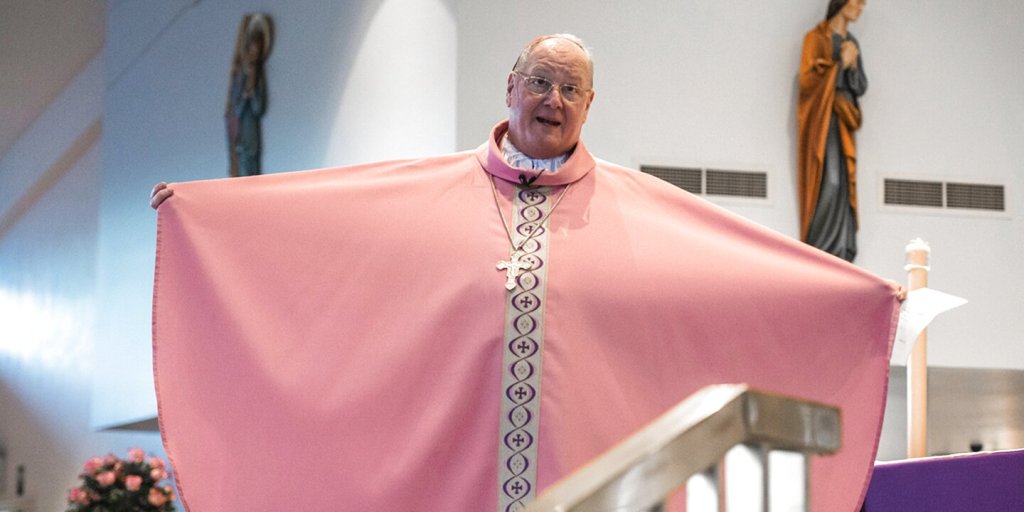
There is a more exuberant emotion, too, the third theme of Advent. There is joy! It is so important, many churches use a pink- or rose-colored candle to mark the third Sunday of Advent. In some traditions the clergy even wear matching vestments, like these:

Just in case you’re wondering, I don’t want to wear that.

I do, however, want to celebrate joy! And when we talk about biblical joy, we mean an emotion that resides in us in all circumstances, even when we are experiencing what otherwise might be thought of as “bad times.”

“Rejoice in the Lord always; again, I will say, rejoice,” Paul told the church at Philippi. (Philippians 4:4.)

Why? Think what we have been given:

Eternal life!

The promise that all that has gone wrong, is going wrong and will go wrong will be made right.

The experience of God in this life, now.

Therein lies our joy. We are able to look at any negative situation and say, “You know what? That has already been defeated.”

Lord, may our experience of joy be as emotional as it is intellectual. And again, may others see in us what you are offering them. Amen.

Fuel for the Fire

By Chuck Griffin
LifeTalk Editor

Acts 2:37-42 (NRSV)

Now when they heard this, they were cut to the heart and said to Peter and to the other apostles, “Brothers, what should we do?” Peter said to them, “Repent, and be baptized every one of you in the name of Jesus Christ so that your sins may be forgiven; and you will receive the gift of the Holy Spirit. For the promise is for you, for your children, and for all who are far away, everyone whom the Lord our God calls to him.” And he testified with many other arguments and exhorted them, saying, “Save yourselves from this corrupt generation.” So those who welcomed his message were baptized, and that day about three thousand persons were added. They devoted themselves to the apostles’ teaching and fellowship, to the breaking of bread and the prayers.


We used this text as the basis for a devotional Aug. 4, but it bears further exploration. This time around, let’s consider how we stretch a moment into a lifetime.

Filled with the Holy Spirit, Peter had preached the first fully developed Christian sermon. About 3,000 people accepted Christ as Savior and were baptized. What a day! They would carry memories of that day for the rest of their lives.

Most of us who accept the moniker “Christian” have a similar point in time where the work of Jesus Christ on the cross became very personal. We were “cut to the heart,” expressing sorrow for our sins while simultaneously understanding Jesus gave us a way to put them behind us. We knew God had lovingly committed to save us, so we committed to following God.

I also know from my own experience and the shared experiences of others that it is not unusual over time to feel a little lost again. A day comes when we crave that spiritual fire in the belly we once felt, and simply remembering the specific day we turned toward Christ isn’t enough to fan the flames.

Think of it this way: Christians are like cavemen without fire-making tools. When we find fire, we want to keep it burning through all circumstances, and the only way to do that is to feed it the fuel it needs.

Remember, these early Christians experienced works of the Spirit that astonished them. Yet even they knew what was required to continue their burning faith.

“They devoted themselves to the apostles’ teaching and fellowship, to the breaking of bread and the prayers.”

There’s the fuel for spiritual fire. We are blessed to now have the apostles’ wisdom and experiences captured in the Holy Bible.

Fellowship and the “breaking of bread” are a little more difficult for us right now, but thank God for the technology that keeps us connected, if only we make a small effort.

And of course, we can pray anywhere and anytime. The most totalitarian governments in the world have yet to figure out how to stop people who want to pray from doing so.

If you’re feeling a little cool, feed the flame God placed within you!

Lord, forgive us when we neglect the great gift you have given us, the gift of life lived now with you. Where we have gone very cold, reignite us once again—you are the sole source of spiritual fire. Amen.

Primary Source

By Chuck Griffin
LifeTalk Editor

1 Thessalonians 2:13-16 (NLT)

Therefore, we never stop thanking God that when you received his message from us, you didn’t think of our words as mere human ideas. You accepted what we said as the very word of God—which, of course, it is. And this word continues to work in you who believe.

And then, dear brothers and sisters, you suffered persecution from your own countrymen. In this way, you imitated the believers in God’s churches in Judea who, because of their belief in Christ Jesus, suffered from their own people, the Jews. For some of the Jews killed the prophets, and some even killed the Lord Jesus. Now they have persecuted us, too. They fail to please God and work against all humanity as they try to keep us from preaching the Good News of salvation to the Gentiles. By doing this, they continue to pile up their sins. But the anger of God has caught up with them at last.


Is it from God?

Whenever we hear a pronouncement from another human being regarding what we should believe or do, “Is it from God?” is the obvious question any Christian needs to answer.

All sorts of people claim to speak truth, supposedly looking out for the best interests of their audiences. These people can be quite eloquent at times. Hearing them, we can find ourselves moved intellectually or emotionally.

The Christians of Thessalonica came to their beliefs while living in a politically important trade center, a place where ideas would have flowed as easily as goods. There was much to be heard, and there were many ways to live.

Paul commended them because in the midst of all of that, they had recognized the declaration of Jesus Christ as Lord and Savior to be a message from God, changing their lives accordingly despite the ongoing persecution they experienced.

Paul and his colleagues obviously had help from the Holy Spirit, whom we believe goes ahead of us as we spread the Good News. With their hearts readied by God’s constant-if-subtle grace, some of the people of Thessalonica were able to perceive Paul’s words about Jesus Christ to be from God. They heard the Christian message despite the general buzz around them.

If a miracle is God intervening in the normal course of events, then it’s a miracle any time such conversion happens. Non-Christians encountering the message of Jesus Christ as Lord have a tough time stepping toward belief. They have to decide first of all if the existence of a loving God makes sense to them.

They then must figure out if they can trust that God loves them despite their sins and accompanying sense of unworthiness. None of us can reach such a state of belief without a little prodding and guidance from the Holy Spirit, and help from Spirit-inspired people.

Having accepted Christ as Savior, we should have an easier path, assuming our discipleship has gone well. “Is it from God?” can be answered using sources we have learned to trust, in particular God’s word as revealed in the Holy Bible.

Once we have established a broad understanding of the Bible’s message, and especially after working our way through the nuances of some of the finer details of Scripture, we have a kind of touchstone, a way to test the purity of what we encounter in the world.

Let’s just remember to use it, particularly in these trying times.

Lord, we thank you that you love us so much that you have revealed yourself repeatedly through the centuries. We recommit ourselves today to the idea that all truth is rooted in action, the work of Jesus Christ on the cross. Amen.

Scoffers to the End

By Chuck Griffin
LifeTalk Editor

Jude 17-23 (NLT)

But you, my dear friends, must remember what the apostles of our Lord Jesus Christ predicted. They told you that in the last times there would be scoffers whose purpose in life is to satisfy their ungodly desires. These people are the ones who are creating divisions among you. They follow their natural instincts because they do not have God’s Spirit in them.

But you, dear friends, must build each other up in your most holy faith, pray in the power of the Holy Spirit, and await the mercy of our Lord Jesus Christ, who will bring you eternal life. In this way, you will keep yourselves safe in God’s love.

And you must show mercy to those whose faith is wavering. Rescue others by snatching them from the flames of judgment. Show mercy to still others, but do so with great caution, hating the sins that contaminate their lives.


Like many pastors, I get this question now and then: “So, do you think we are near the end of time?”

In response, I usually say, “I can guarantee one thing. We are one day closer today than we were yesterday.” Most people don’t seem to find that very satisfying, though.

The question usually arises because of strife in the world: wars and rumors of wars, or in 2020, a pandemic combined with particularly tense U.S. politics and civil unrest. I try to keep all of that turmoil in perspective, though.

Look at it this way. Would you trade living right now for a life in 14th-century Europe during the Black Plague? Would you instead choose the World War I era (capped off by the Spanish flu pandemic) or World War II?

No doubt, Christians have thought to themselves many times, “This is it—this must be the end!”

Jude obviously wrote his letter to an audience struggling with such thoughts. The date of writing is hard to nail down precisely, but the letter would have been delivered just before or not long after the destruction of the Jewish Temple in Jerusalem, which was preceded by insurrection and followed by ethnic dispersion and brutal horrors.

What Jude had to say is interesting, however, not because it is rooted in a particular time, but because it is good advice for all times. In his day, and in the centuries to follow, the church, local or global, has had a basic problem. There always are “scoffers” hanging around the edges or even lurking within as false teachers.

They live for themselves, to satisfy their own desires, so very naturally they bring division to any group of Christians they find.

As Jude said, the cure is relatively straightforward. Christians must worship and live so they remain true as a group to their Savior, Jesus Christ. They must disciple themselves so their churches are guided by the Holy Spirit in all that they do.

We are particularly blessed in our era because we have God’s word so freely available to us in the Bible. Discipleship has a lot of competition in our busy, media-saturated world, but at the same time, discipleship through prayer and the study of God’s word has never been easier.

And while Jude counsels vigilance against those who would tear the church apart, he emphasizes mercy and love for people needing to know Jesus Christ as Lord and Savior. That would include those scoffers, who simply are aggressive sinners who got through the door.

Keep sin and the encouragement to sin out of the church, but keep Christ’s mercy continually available to all in need. That’s a strategy to sustain us until the end of time, regardless of when that may be.

Lord, give us discernment to see both obvious and subtle strains of sin, and as we find these in our midst, may we trust in your Holy Spirit to gently guide us toward holiness. Amen.