Confident Hope

Rejoice in our confident hope. Be patient in trouble, and keep on praying.

—Romans 12:12 (NLT)


By Chuck Griffin

If we are able to understand what our confident hope is, this becomes a simple verse to live by.

Paul wrote these words in a chapter of Romans where he also talked about making our bodies a living and holy sacrifice. Paul regularly spoke of Christ’s sacrifice on the cross as the central message of Christianity, and it is clear he wants us completely “sold out” on the idea, committed to its meaning in good times and bad.

The cross, of course, means freedom for us. Think of your sins for a moment; briefly experience them as the crushing weight they should be. (I feel a slight shudder when I do this.) Now remember, that weight has been lifted by Jesus’ sacrifice on the cross! Sin should lead to death, but both have been defeated by Christ.

Thus, the resurrection, the Easter event. It is our proof the cross is effective, and a promise of what is in store for us.

The cross also is the source of our confidence. We certainly will experience negative and even frightening moments in this life, but the fear they are somehow terminal, a full-stop end, is unjustified. We will pass through—life goes on, even after our bodily deaths.

This great truth of Christianity should shape every moment of our lives. Even in sorrow, joy lingers nearby because the truth of our salvation is constant.

Romans 12:12 is a simple Bible verse worth memorizing.

Lord, keep the cross before us in all circumstances. Amen.

In the Thicket

Micah 7:14 (NLT)

O Lord, protect your people with your shepherd’s staff;

    lead your flock, your special possession.

Though they live alone in a thicket

    on the heights of Mount Carmel,

let them graze in the fertile pastures of Bashan and Gilead

    as they did long ago.


By Chuck Griffin

This particular verse in Micah arises as part of a lament over sin and a longing for better days.

We can process this desire to be led back to the good life on so many levels. As a people, we can always look to aspects of a national past we believe to be better, the good old days, although we do have to be careful. People have a tendency to remember the good and forget the bad.

My wife and I like movies from the 1950s and early 1960s, the ones that fill the screen with images just a little too early for us to have seen with our own eyes. Think of the New York City street scenes in “Breakfast at Tiffany’s,” or Doris Day at the Automat, or Cary Grant in a finely tailored suit. How nice it would be to go back in time and experience all that—without polio, the Korean and Vietnam wars, racism, sexism bordering on misogyny, and those ever-present clouds of cigarette smoke, of course.

We can have similar longings on an individual level, too, desiring that “better time,” whenever that might have been—maybe when we were in high school, or first married, or when the kids were little. If we get stuck in that longing, the here-and-now can seem very much like a briar-filled thicket.

We cannot go back in time, and we probably would not want to do so, were we to think it through. What we can do is take the best of our past experiences, as a people or as a person, and find a way to carry what we learn from them forward. That’s where this verse from Micah becomes useful.

Followers of God know that the best of times always happen in conjunction with a deep relationship with God. When we are with God, we are tapping into promises of eternal joy, timeless truths that color any present moment for the better.

Whatever thicket we find ourselves in, God can lead us out, usually through fellowship with others who follow God. The Great Shepherd has even gone to the cross so we can forever escape the deadly consequences of sin.

Lord, as we walk with you, give us great optimism for the future, knowing you are leading us toward fertile pastures. Amen.

Joy

Yesterday, I mentioned how biblical peace describes the current relationship between God and humanity, a state made possible by Jesus’ sacrifice on the cross. Bliss is a perfectly appropriate response to that peace.

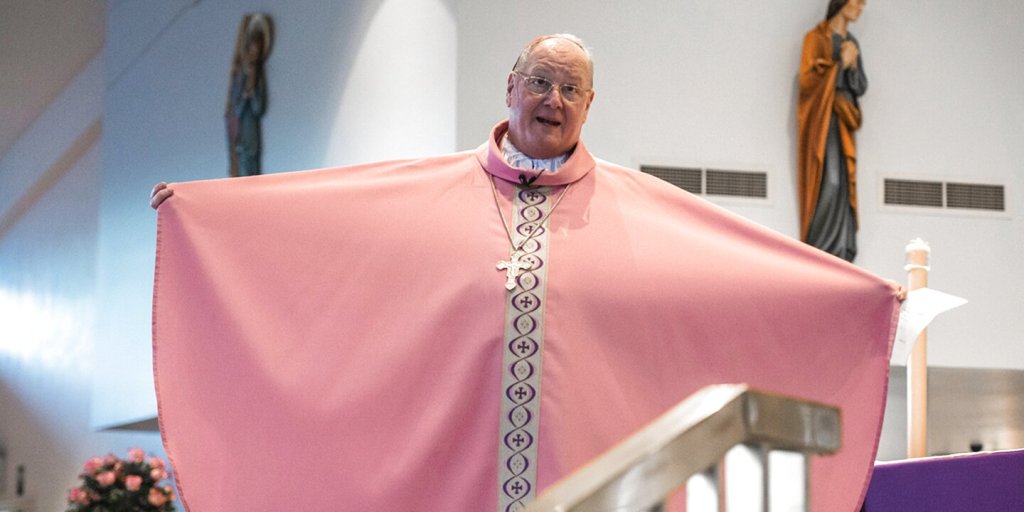
There is a more exuberant emotion, too, the third theme of Advent. There is joy! It is so important, many churches use a pink- or rose-colored candle to mark the third Sunday of Advent. In some traditions the clergy even wear matching vestments, like these:

Just in case you’re wondering, I don’t want to wear that.

I do, however, want to celebrate joy! And when we talk about biblical joy, we mean an emotion that resides in us in all circumstances, even when we are experiencing what otherwise might be thought of as “bad times.”

“Rejoice in the Lord always; again, I will say, rejoice,” Paul told the church at Philippi. (Philippians 4:4.)

Why? Think what we have been given:

Eternal life!

The promise that all that has gone wrong, is going wrong and will go wrong will be made right.

The experience of God in this life, now.

Therein lies our joy. We are able to look at any negative situation and say, “You know what? That has already been defeated.”

Lord, may our experience of joy be as emotional as it is intellectual. And again, may others see in us what you are offering them. Amen.

Hope

For the rest of this week, let’s consider the four themes of the Advent season—hope, peace, joy and love—which are usually captured in readings during the lighting of candles on the Advent wreath each Sunday.

As odd as it might seem, Romans 5:1-4 ties hope among the believers to suffering:

“Therefore, since we have been justified by faith, we have peace with God through our Lord Jesus Christ. Through him we have also obtained access by faith into this grace in which we stand, and we rejoice in hope of the glory of God. Not only that, but we rejoice in our sufferings, knowing that suffering produces endurance, and endurance produces character, and character produces hope, and hope does not put us to shame, because God’s love has been poured into our hearts through the Holy Spirit who has been given to us.”

I find it helpful to realize that suffering can have a point, so long as we continue in our faith that God’s promises have come true and will continue to come true.

Whatever we are experiencing, we learn to say in stronger and more authoritative ways, “Yes, this situation is bad, but it is temporary. God has promised that evil and all of its effects will be overcome.”

The light at the end of the tunnel isn’t a train. There’s no trick in store for us. The light of Christ is bearing down on us, coming to our rescue.

Hope also serves as a great evangelism tool. When people look at a Christian and say, “I want what that person has,” odds are the believer is exhibiting hope. People long to know that there is a potential happy ending to every story, and they particularly want to know how to ensure they can take part in that ending.

It is the basic role of every Christian to project hope where people may find themselves in despair. Where will we demonstrate hope today?

Lord, we don’t like to suffer, but thank you for being there in the midst of suffering, helping us to turn it into something good on behalf of your kingdom. Amen.

Shout to the Lord

By Chuck Griffin
LifeTalk Editor

Psalm 98:4-9

Shout to the Lord, all the earth;
    break out in praise and sing for joy!
Sing your praise to the Lord with the harp,
    with the harp and melodious song,
with trumpets and the sound of the ram’s horn.
    Make a joyful symphony before the Lord, the King!

Let the sea and everything in it shout his praise!
    Let the earth and all living things join in.
Let the rivers clap their hands in glee!
    Let the hills sing out their songs of joy
before the Lord,
    for he is coming to judge the earth.
He will judge the world with justice,
    and the nations with fairness.

I am not a musical person. You don’t want me to lead the singing; my year of piano lessons was at best inauspicious. Whenever I was supposed to be practicing, the weather outside always seemed so nice.

But dear Lord, how I do love the music during worship. I particularly love the singing, as it is the one place I can comfortably join in, hiding my off-key efforts among the better voices near me. (It helps to be standing near the choir.)

And dear Lord, how I miss the singing in unison right now. I understand the science behind how Covid-19 spreads, and I know why we should not be projecting our voices on those Sundays we are able to gather. We so want to shout to you, though!

I’m reminded of a story a friend of mine in the Czech Republic told me. She was brought up secretly in a church considered illegal under Soviet rule. Throughout her childhood and into her early adult years, she and her fellow church members gathered in a room, shutters closed, and whispered their hymns.

What a glorious day it was when the Iron Curtain fell, and they were able to throw open the shutters and sing out loud!

We aren’t nearly as oppressed, but I expect we will experience a similar joy and sense of renewal when we can burst forth in the hymns, the Gloria Patri, and the Doxology.

We will shout to the Lord, and I promise, I’ll try not to throw those around me off key.

Lord, in this odd time when we have to choose our love for one another over shouting to you, may we continue to worship you well in our hearts. May our love for you be evident. May our quiet praise be enhanced by your Holy Spirit. Amen.

Candy Kingdom

By Chuck Griffin
LifeTalk Editor

lot of people hate the advertising on their web browsers, but I’ve been unusually happy with mine the last few days. Earlier in the week, a relative was trying to remember what a circus peanut looks like, so I searched for a picture of one on my phone.

The software that pokes around in my browser took note that I had an interest in candy. Now I’m getting ads for candy of all kinds. My web pages regularly come decorated with bright jelly beans, gumdrops, gummy bears, nonpareils, and of course, circus peanuts in pink, yellow, white and classic orange.

I’m so happy with this result, I make sure I click on the ads from time to time, just so they will continue popping up. Thanks, Criteo!

Last night, I was showing my wife an unusually pretty offering of brightly colored “fruit slice” jelly candies for sale. It reminded me of the sleeve of fruit slices my mother would buy me at the candy counter in Sears before we went to a movie.

“Remember how candy was a very serious, very important subject when we were kids?” I asked my wife. “As I get older, I realize just how right we were.”

I know: Waistline, risk of diabetes, tooth decay, etc. But those concerns aside, there is simple joy—bright primary colors, explosive flavors, the heady rush of sugar. They all draw you very much into the present moment.

And being a pastor, I’m reminded of Jesus’ words in Mark 10:14-15: “Let the children come to me. Don’t stop them! For the Kingdom of God belongs to those who are like these children. I tell you the truth, anyone who doesn’t receive the Kingdom of God like a child will never enter it.”

The Kingdom of God is, after all, the sweetest truth. This broken world can really hurt us, but there’s a new way dawning, an eternal life free from the havoc wrought by sin, and we can taste that new life now. When we sense the Kingdom of God breaking into this world—perhaps in a song, a story, or a relationship—that moment can be a real rush, and we naturally want more.

Christianity is exhilarating stuff, and like a child, we should take what we’re being offered very seriously.

Lord, thank you for those moments when your plan becomes so evident, all we can do is smile. Amen.