Bread Offered Every Day

By Chuck Griffin
LifeTalk Editor

John 6:25-35 (NLT)

They found him on the other side of the lake and asked, “Rabbi, when did you get here?”

Jesus replied, “I tell you the truth, you want to be with me because I fed you, not because you understood the miraculous signs. But don’t be so concerned about perishable things like food. Spend your energy seeking the eternal life that the Son of Man can give you. For God the Father has given me the seal of his approval.”

They replied, “We want to perform God’s works, too. What should we do?”

Jesus told them, “This is the only work God wants from you: Believe in the one he has sent.”

They answered, “Show us a miraculous sign if you want us to believe in you. What can you do? After all, our ancestors ate manna while they journeyed through the wilderness! The Scriptures say, ‘Moses gave them bread from heaven to eat.’”

Jesus said, “I tell you the truth, Moses didn’t give you bread from heaven. My Father did. And now he offers you the true bread from heaven. The true bread of God is the one who comes down from heaven and gives life to the world.”

“Sir,” they said, “give us that bread every day.”

Jesus replied, “I am the bread of life. Whoever comes to me will never be hungry again. Whoever believes in me will never be thirsty.”


You can live for the moment, or you can seek forever in the moment.

The crowds followed Jesus in part because he had demonstrated an ability to provide for their immediate needs. They hoped for ongoing provisions, along the lines of what the Israelites received in the desert for 40 years.

Now, let’s be clear—when people have immediate, pressing needs, it is hard for them to focus on much else. “How will I feed my children?” can be an overwhelming question.

That’s why James wrote, “Suppose you see a brother or sister who has no food or clothing, and you say, ‘Good-bye and have a good day; stay warm and eat well’—but then you don’t give that person any food or clothing. What good does that do?” (James 2:15-16)

For the simple sake of goodness, we are called as Christians to get people beyond worrying about their basic needs. Such relief also directly supports the mission of the church. Where basic needs are met, people can then more easily think about broader concepts, like a relationship with God and salvation.

A lot of this sounds like Maslow’s Hierarchy of Needs. The Bible basically came up with the idea first. Jesus’ Matthean concept of the judgment amounts to a call to lift people out of their day-to-day worries.

Once we’ve acknowledged the basic relief we should provide, we then must stay very conscious of that all-important next step, understanding who we are in relation to God. Having our daily bread, it’s important to move on to a contemplation of the Bread of Life, God’s gift to us.

Through Jesus Christ, we are offered a daily experience of God and his eternally life-altering plan, and once we’re on the way to grasping what this means, we need to invite others to explore and accept salvation, too.

It’s all so exciting, so mind-boggling, that we might even find ourselves forgetting to eat.

Lord, where we see earthly needs, may we respond quickly, and where we see openings to offer your eternal grace, may we move with utmost speed. Amen.
The Meaning of Manna

By Chuck Griffin
LifeTalk Editor

Exodus 16:1-8 (NLT)

God gave the Israelites a lot of signs and miracles in Egypt and on their way out of Egypt—plagues on their captors, a pillar of cloud and fire to lead and guard their exit, the parting of the Red Sea and the drowning of the Egyptian army. We might think they would have been ready to trust God once in the desert. Trust faded as soon as they got really hungry, however.

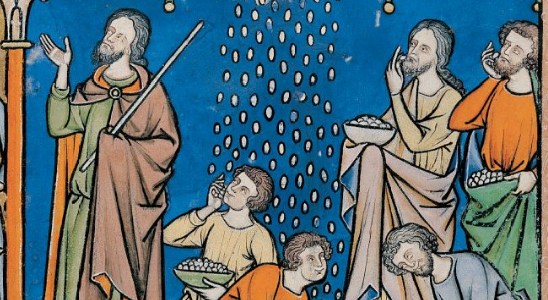
God faithfully responded with the promise of provision. The Israelites didn’t even need to carry food with them on their journey. Instead, food rained down as quail and manna, described as a substance that makes me think of Frosted Flakes. (I like cereal, so my interpretation may be biased.)

The lesson was simple: God will provide. In fact, God wanted the Israelites to go to bed every night trusting his provision would be there for them the next day—no long-term planning needed on this journey. There was work to be done in the gathering of the food, but they always had enough. The weekly exception was when God sent them enough food for two days in anticipation of the Sabbath. God also wanted them to rest!

God still seeks the same kind of trust from us today. Pray this prayer with me: “Our father, who art in heaven, hallowed be thy name. Thy kingdom come, thy will be done, on earth as it is in heaven. Give us this day our daily bread … .” Stop right there just a second.

Do we mean it? Do we live it? What does it mean to live as if we trust our bread will come on a daily basis?

The idea certainly conflicts with our 401K/pension plan/Roth IRA mindsets. We’re taught to store provisions for use 40 years or more into the future, with all of that planning affecting when we can retire. We’re sometimes even left with the strange concern that we might live too long, running out of money in the process. Can we reconcile these two very different world views?

As I ponder this, I’m first reminded of one of Jesus’ parables. He begins telling it at Luke 12:16:

“A rich man had a fertile farm that produced fine crops. He said to himself, ‘What should I do? I don’t have room for all my crops.’ Then he said, ‘I know! I’ll tear down my barns and build bigger ones. Then I’ll have room enough to store all my wheat and other goods. And I’ll sit back and say to myself, ‘My friend, you have enough stored away for years to come. Now take it easy! Eat, drink, and be merry!’

“But God said to him, ‘You fool! You will die this very night. Then who will get everything you worked for?’

“Yes, a person is a fool to store up earthly wealth but not have a rich relationship with God.”

Then, turning to his disciples, Jesus said, “That is why I tell you not to worry about everyday life—whether you have enough food to eat or enough clothes to wear.”

Luke 12:16-22 (NLT)

As bad as his hoarding was, the rich man’s real problem was the way he deluded himself about how much control he had, in the process failing to understand his basic relationship to God.

Preparation is prudent, but we should never let go of this basic truth: We don’t control the future. Planning  and stored provisions cannot eliminate our need for God.

There also is the issue of how we use the resources we are given. Do we live as if this life is the only one that counts? Or do we live as people who believe something greater is happening? After all, we believe that God’s kingdom is truly arriving, and that the kingdom is where we store our true treasures and live out eternity.

John Wesley had a sermon, “The Danger of Riches,” that explained his idea of how to balance proper planning and trust in God. (Wesley was working from 1 Timothy 6:9.)

In the sermon, Wesley said that God provides for the roof over our heads, food, and other basic needs. We should even save to ensure the well-being of our families and businesses we may own. Beyond those provisions, everything we are given counts as riches, and they have been given to us to use “to the glory of God.” Often, this means using our riches to help those who are less blessed materially, playing a role in God’s provision for people’s basic needs.

Even for a tither, this is a concept that requires thought. It forces a reassessment of every decision we make regarding how we handle our income and possessions, simply because we learn to say, “It’s not really mine, anyway.”

When we learn to make decisions about money and other resources in the light of God’s dawning kingdom, we not only trust God daily, we begin to participate actively in the kingdom’s growth. We let God work through us so others see their daily bread arrive.

When all Christians adopt such an attitude, God’s presence will be as visible in this world as a pillar of cloud in the sky and manna on the ground.

Lord, give us this day our daily bread, and let us be content with your gracious provisions. Amen.