Expect Christ: Day 22

Welcome to the fourth Sunday of Advent. Next Sunday is Christmas Day! As part of your Sabbath, I pray you are able to attend or participate in group worship in some way. Proper formal worship will incorporate all the aspects of our daily prayers. As I’ve said before, the prayer patterns established over six days of the week lead us to a Sabbath of constant spiritual communion with God.

Here’s a text for today, one you may hear in worship:


Luke 1:46-55

Mary said,

“With all my heart I glorify the Lord!
    In the depths of who I am I rejoice in God my savior.
He has looked with favor on the low status of his servant.
    Look! From now on, everyone will consider me highly favored
        because the mighty one has done great things for me.
Holy is his name.
    He shows mercy to everyone,
        from one generation to the next,
        who honors him as God.
He has shown strength with his arm.
    He has scattered those with arrogant thoughts and proud inclinations.
    He has pulled the powerful down from their thrones
        and lifted up the lowly.
He has filled the hungry with good things
    and sent the rich away empty-handed.
He has come to the aid of his servant Israel,
        remembering his mercy,
    just as he promised to our ancestors,
        to Abraham and to Abraham’s descendants forever.”

What a joy for Mary, full of the Spirit that has conceived the divine child inside her. She is able to glimpse the effects Jesus will have on the world. Some of these effects we still anticipate today.

Where has God met us in our lowliness and meekness?

Expect Christ: Day 15

Welcome to the third Sunday of Advent. Again, you are encouraged to treat Sunday as a true Sabbath, attending worship, where we have many opportunities to pray. Also, disconnect from the patterns of the week as much as possible! Believe it or not, God actually encourages us to do nothing of worldly importance from time to time. Ideally, the prayer patterns established over six days of the week lead you to a Sabbath of constant spiritual communion with God.

Here’s a text to consider today, as we move closer to the story of the incarnation.


Luke 1:67-69
John’s father Zechariah was filled with the Holy Spirit and prophesied,

“Bless the Lord God of Israel
    because he has come to help and has delivered his people.
He has raised up a mighty savior for us in his servant David’s house,
    just as he said through the mouths of his holy prophets long ago.
He has brought salvation from our enemies
    and from the power of all those who hate us.
He has shown the mercy promised to our ancestors,
    and remembered his holy covenant,
        the solemn pledge he made to our ancestor Abraham.
He has granted that we would be rescued
        from the power of our enemies
    so that we could serve him without fear,
        in holiness and righteousness in God’s eyes,
            for as long as we live.
You, child, will be called a prophet of the Most High,
    for you will go before the Lord to prepare his way.
You will tell his people how to be saved
    through the forgiveness of their sins.
Because of our God’s deep compassion,
    the dawn from heaven will break upon us,
    to give light to those who are sitting in darkness
    and in the shadow of death,
        to guide us on the path of peace.”

Here are some questions I would suggest as you dwell on these words. If you’re not familiar with Zechariah, father of John the Baptist, you might want to back up in Luke and understand his full story.

What would it be like to prophesy about your own child’s future?

Do we see how Christ marks a new dawn, one that guides us on the path to peace?

Expect Christ: Day 8

Welcome to the second Sunday of Advent. Again, you are encouraged to treat Sunday as a true Sabbath, attending worship, where we have many opportunities to pray, and disconnecting from the patterns of the week as much as possible. Ideally, the prayer patterns established over six days of the week lead you to a Sabbath of constant spiritual communion with God.

Here’s the text I plan to preach this second Sunday of Advent.


Philippians 4:4-9 (Common English Bible)

Be glad in the Lord always! Again I say, be glad! Let your gentleness show in your treatment of all people. The Lord is near. Don’t be anxious about anything; rather, bring up all of your requests to God in your prayers and petitions, along with giving thanks. Then the peace of God that exceeds all understanding will keep your hearts and minds safe in Christ Jesus.

From now on, brothers and sisters, if anything is excellent and if anything is admirable, focus your thoughts on these things: all that is true, all that is holy, all that is just, all that is pure, all that is lovely, and all that is worthy of praise. Practice these things: whatever you learned, received, heard, or saw in us. The God of peace will be with you.


Here are some questions I would suggest as you dwell on these words:

Does the idea of constant gladness or rejoicing seem feasible to you?

Few of us are physically violent, but does that mean we are always gentle?

Am I praying in times of turmoil in a way where I find peace?

Have a blessed Sabbath day, one that truly changes the rest of your week.

Thanksgiving and Advent Prayers

By Chuck Griffin

I pray you all have a happy and joyous Thanksgiving tomorrow! This Sunday is an important day, too, marking the first Sunday of Advent, that season of expectation and preparation as we move toward the Christmas season.

During Advent, I am going to provide a daily prayer guide, written along the lines of what was offered throughout September. There will be morning, noon and evening prayers, daily Scripture readings (mostly from the Revised Common Lectionary), and other resources.

Blessings on all of you as we give thanks and move into a time where we celebrate hope, peace, joy and love.

Here’s a prayer I’ve written for use on Thanksgiving Day with family and friends:

Dear Lord, we come to you in this blessed gathering bound by love. As we pause to give thanks, we first consider the great gift you offer us, the gift of eternal life! Thank you for Jesus Christ’s sacrifice on the cross. Sin and death are defeated, and the abundant grace we are offered in their place is almost beyond comprehension. We also give thanks for the blessings we have now in this temporary world: shelter, plenty of food, and possessions and security that go far beyond our request for our daily bread. As we count our rich blessings this day, help us to consider how you may call us to be a blessing on your behalf in the lives of others. We pray all of this in Jesus Christ’s name. Amen.

Unity in What?

Acts 9:31 (NLT)

The church then had peace throughout Judea, Galilee, and Samaria, and it became stronger as the believers lived in the fear of the Lord. And with the encouragement of the Holy Spirit, it also grew in numbers.

By Chuck Griffin

I have been in professional ministry 20 years this year, including my time as a licensed pastor while in seminary. I keep wondering what it must feel like to experience a church at peace.

The ridiculously named United Methodist Church is in great turmoil, of course, having argued over scriptural authority for decades now. Yes, I know, liberals describe the dispute as being about the ordination of practicing homosexuals and the ritualizing of same-sex marriage. The deeper problem, however, is that a significant part of the UMC does not treat the Holy Bible as the primary rule and authority for faith, morals and service.

If you don’t think there’s an underlying doctrinal problem, just watch how our denominational divide will broaden in the coming months as the national debate over abortion grows.

A flimsy “unity” bandage offered by progressives and institutionalists is supposed to bring healing. They apply it with assertions that we are better together than apart. Their message begs a question, however: Unity in what?

As best as I can tell, the answer is unity in the preservation of an institution that began shrinking in this country from the moment it formed. This shallow call for unity comes largely from those who benefit financially from the institution’s ongoing existence: its administrators, the pastors of large churches lacking sound doctrinal moorings, and liberals desperate to maintain their financial connections to conservatives’ more dedicated giving commitments.

I saw deep, true unity last Friday and Saturday as the Wesleyan Covenant Association held important annual meetings near Indianapolis. Despite the large numbers of people involved, the work was handled seriously but swiftly, and the worship was driven by a Constant Joyous Presence.

All that happened for a simple reason. We had unity in our understanding of God the Father, God the Son and God the Holy Spirit, an understanding derived from that primary rule and authority for faith, morals and service I mentioned earlier. You see, when conservative Methodists are together, they can say words like “resurrection” and “Jesus Christ is Lord” and know no one is off to the side redefining core Christian concepts to suit a personal agenda.

It was, I think, a taste of what is to come in the Global Methodist Church, which the WCA has helped establish. We will have earnest debates about polity and procedures in the GMC, of course, but we will have an advantage. We will all be working from the same doctrinal foundation, rooted in fear of the Lord—not cringing fear, but heartfelt awe and humility naturally experienced in the presence of one so holy, powerful and loving.

I so wish the path to the GMC could be easy for traditional Methodist churches. It appears less and less likely that it will be, with bureaucracy and worldly stratagems filling the hearts of those who could make it easy. I wonder if they remember what it was like to be young men and women who went to seminary because they were so overwhelmed by God’s incredible life-giving grace.

As traditional Methodists, we have some difficult decisions to make in the next few weeks. Do not despair, though. Trusting in the Bible’s promises, we will be encouraged by the Holy Spirit. And one way or another, we will inhabit a new expression of Methodism, one at peace with itself and ready to engage with a broken world.

Dear Lord, may the Holy Spirit guide us moment by moment, and may we all remember those first hours where we followed you as Savior, receiving your grace and submitting to you without concern for money or position in this world. Amen.

Wrist Holds and Grace

1 Peter 5:1-5 (NLT)

And now, a word to you who are elders in the churches. I, too, am an elder and a witness to the sufferings of Christ. And I, too, will share in his glory when he is revealed to the whole world. As a fellow elder, I appeal to you: Care for the flock that God has entrusted to you. Watch over it willingly, not grudgingly—not for what you will get out of it, but because you are eager to serve God. Don’t lord it over the people assigned to your care, but lead them by your own good example. And when the Great Shepherd appears, you will receive a crown of never-ending glory and honor.

In the same way, you who are younger must accept the authority of the elders. And all of you, dress yourselves in humility as you relate to one another, for “God opposes the proud but gives grace to the humble.”


By Chuck Griffin

Today’s Bible passage from the daily lectionary was written by a church leader to leaders, encouraging care of the flock through suspension of self-interest and a focus on humility. The timing is most excellent.

More than anything today, I wanted to be sure readers of this LifeTalk blog have had an opportunity to read an April 23 article by the Rev. Carolyn Moore, a Georgia pastor and one of the leaders of the Wesleyan Covenant Association. Entitled “There Is a Simple Solution,” Rev. Moore makes a gentle, grace-filled appeal to United Methodist bishops, saying they have the power to end the painful struggle we find ourselves in, allowing churches wanting to leave the denomination to do so with their property and without punitive costs.

I’ll let her article make her appeal. I can add to it only by way of analogy.

I have practiced martial arts for four decades as of this year. As part of that practice, we spend time learning various ways to escape all sorts of grabs and holds.

One of the most basic holds we learn to deal with is the wrist hold, where someone grabs your wrist to prevent you from escaping whatever attack might follow. There are lots of ways, some simple, some elaborate, to free yourself from a wrist hold.

For example, if you raise your grasped wrist high, turning your palm in, it’s easy to use your other hand to take hold of the back of the attacker’s hand, free yourself, and then use both your hands to apply painful pressure to the attacker’s wrist. If you’re standing, you can use your own body weight to drive your opponent backward into the ground.

If the attack proves to be ongoing and powerful, the defensive responses inflict higher levels of pain and violence. For example, if the attacker locks down really hard, making it difficult to get loose, a swift kick or stomp will allow the release to work, a technique known as “loosening.”

Here’s what we don’t bother practicing in a martial arts class: Always presuming we prepare for violence, we don’t waste time looking at the opponent and saying, “Would you please let go of my wrist?”

Reading Rev. Moore’s article, I had a realization. Progressives, institutionalists and traditionalists in the United Methodist Church have been circling each other as if we are presuming violent intent. We strategize, we project ideal outcomes, and we take defensive or offensive postures over the issue of church property. 

Church is not a martial arts class, however. As peaceful, grace-filled Christians, we should be able to look at each other and say, “Please, let go of my wrist,” and receive a graceful response.

That’s what Rev. Moore asks in her article. The trust clause, which the bishops control, has become the wrist hold binding traditional Methodists to a system they want to escape.

It’s a simple request. Please, let go of our wrists.

Lord, in times of strife, let grace and mercy among brothers and sisters in Christ reign. Amen.

The Christian Presence

1 Peter 3:8-9 (NLT)

Finally, all of you should be of one mind. Sympathize with each other. Love each other as brothers and sisters. Be tenderhearted, and keep a humble attitude. Don’t repay evil for evil. Don’t retaliate with insults when people insult you. Instead, pay them back with a blessing. That is what God has called you to do, and he will grant you his blessing.


You may have heard this St. Francis of Assissi quote: “Preach the gospel at all times. If necessary, use words.”

Nearly short enough to fit on a bumper sticker, the saying stays with us. And frankly, it sometimes is misused as an excuse to not speak the Good News when the opportunity arises, giving the quote more play than it might receive otherwise.

St. Francis did have a point, though, one rooted in what the Apostle Peter emphasized in his letter. Every day, Christians have the opportunity through attitude and behavior to inject a little of their faith into the world.

The secular world isn’t going to pay much more than lip service to Peter’s principles. Worldliness dictates that when push comes to shove, people had better be ready to demand their rights, defend their positions, and dish out more than they receive.

As Christians, we don’t want to be pushovers to the point of accommodating evil, but on the vast majority of our days on this earth, we have the opportunity to change hearts simply by injecting blessings in the midst of conflict.

Tenderheartedness and a humble attitude do much to create a fertile environment for the gospel, and a few words can then become very effective.

Lord, as we are confronted today by conflict, let us be the ones who bring calm and blessing to the situation. Amen.

Fate of a Nation

Job 12:23-25 (NRSV)

He makes nations great, then destroys them;
    he enlarges nations, then leads them away.
He strips understanding from the leaders of the earth,
    and makes them wander in a pathless waste.
They grope in the dark without light;
    he makes them stagger like a drunkard.

Having watched the news yesterday, all I can do is offer a lament and a prayer for this morning.

My lament is this:

Like Job, I believe God takes a very active hand in what happens to the nations of this earth. The world remains a broken, confusing place, and we can find God inscrutable at times. It is, however, better for a nation to be aligned with God than indifferent to God or against God. A nation made up of people seeking God’s will should, for the most part, experience blessings and peace.

We find ourselves far from feeling blessed or at peace. That alone should tell us something is wrong with our national relationship with God. Not all Americans are Christian, and being Christian is not a requirement to be an American. But enough of us call ourselves Christian that our beliefs should be having more of an impact on national events.

Deliberate efforts to manipulate people with misinformation have triggered anger and fear in a significant part of the population, driving yesterday’s events. Such tactics do not align with Jesus Christ’s teachings or with thoughtful Christianity, where truth and a desire for peace should reign.

Let’s never forget Jesus’ warnings regarding the danger of acting in anger, or his repeated post-resurrection statement, “Fear not.” What have we to fear, knowing Christ has died for us, knowing his power is within us?

I am convinced that current events are a result of declining Christian evangelism, combined with a lack of discipleship and spiritual depth in the American church. Too many of us are failing to look in our Bibles, absorb what we find and then apply those truths in daily life.

That’s my lament. I root my prayer in the light that has come into the world, a light to overcome the darkness and keep us from staggering through history like drunkards.

Lord Jesus Christ, speak to the hearts of all people so a desire for peace and righteousness fills us and overwhelms us as a nation. Give special power and understanding to the people who make up your church. Let us be the first and best examples of what it means to follow you. Amen.

When Push Comes to Peace

Luke 6:27-31 (NRSV)

“But I say to you that listen, Love your enemies, do good to those who hate you, bless those who curse you, pray for those who abuse you. If anyone strikes you on the cheek, offer the other also; and from anyone who takes away your coat do not withhold even your shirt. Give to everyone who begs from you; and if anyone takes away your goods, do not ask for them again. Do to others as you would have them do to you.”


I suspect a lot of good Christians wince at this radical teaching of Jesus, immediately imagining a dozen or more scenarios where these precepts seem impractical.

We are in good company. The church—by that, I mean the great, historic, traditional church stretching back to the earliest days of Christianity—has always struggled with how to live into Jesus’ teachings while contending directly with a world full of dangerous evil.

Facing imminent attack? Well, you may find Just War Theory helpful. And there are many other situations where theologians have acknowledged it can be more loving to take a naturally repulsive action than to take no action at all.

For example, turning the other cheek is a noble response, but if in doing so you endanger the lives of people dependent on you, then a different strategy may be in order. Much of what Jesus said is about witnessing to others, and allowing unnecessary harm to happen makes for a poor display of Christ’s love.

Let’s not, however, turn those rare compromises into an excuse for avoiding what Jesus would have us do. It’s particularly important we follow these teachings when a pacifist response could transform another’s soul.

Verbally assaulted? Be the one who responds with kindness.

Confronted with great need? Do something about it, even if the people in need somehow seem unworthy by worldly standards.

As we deliberately practice Jesus’ teachings in everyday situations, perhaps we will find new and creative ways to apply them to major conflicts.

Dear Lord, help us to identify opportunities to practice what you have preached, swallowing our emotional responses so we may instead demonstrate your love. Amen.

Joy

Yesterday, I mentioned how biblical peace describes the current relationship between God and humanity, a state made possible by Jesus’ sacrifice on the cross. Bliss is a perfectly appropriate response to that peace.

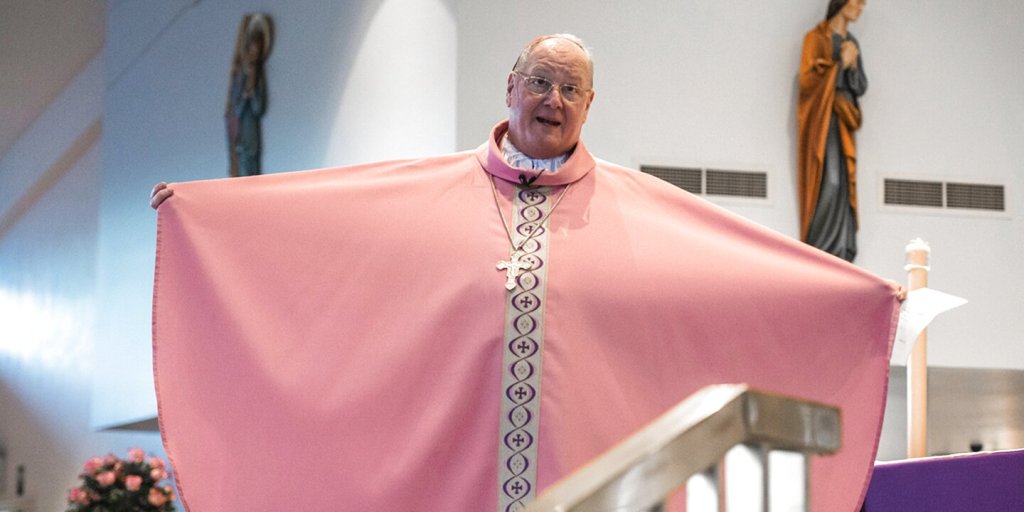
There is a more exuberant emotion, too, the third theme of Advent. There is joy! It is so important, many churches use a pink- or rose-colored candle to mark the third Sunday of Advent. In some traditions the clergy even wear matching vestments, like these:

Just in case you’re wondering, I don’t want to wear that.

I do, however, want to celebrate joy! And when we talk about biblical joy, we mean an emotion that resides in us in all circumstances, even when we are experiencing what otherwise might be thought of as “bad times.”

“Rejoice in the Lord always; again, I will say, rejoice,” Paul told the church at Philippi. (Philippians 4:4.)

Why? Think what we have been given:

Eternal life!

The promise that all that has gone wrong, is going wrong and will go wrong will be made right.

The experience of God in this life, now.

Therein lies our joy. We are able to look at any negative situation and say, “You know what? That has already been defeated.”

Lord, may our experience of joy be as emotional as it is intellectual. And again, may others see in us what you are offering them. Amen.