Watch!

Luke 21:34-36

By John Grimm

Every year it seems like Christmas comes before we are ready.  We are going to work.  We are doing our daily and weekly routines at the store, with our family, and with the church.  Suddenly, there it is.  It is Christmas (again)!  How did we not notice it creeping up on us?

Jesus warned the disciples and all the people (Luke 20:45) to be on guard.  We can be weighed down with the concerns of work and home.  We can be drunk on how well our college tournament brackets are going to perform.  We can even be worried about how high the gas prices will go.

Life can trap us., so much so that we may actually miss out on what God is doing around us.  Heaven forbid if we miss what God is doing in our lives!  Our social media feed will not get us caught up with what we missed from God.  What can we do?

We pray.  We are alert in prayer as we ask Jesus for strength to prepare us for the destruction Jesus foretold in Luke 21:5-33.  The power of the Holy Spirit can get us to the point where we can stand before the Son of Man.

Until Jesus Christ returns, we can be praying.  That will be the best posture for Jesus to find us in when that day happens.

Almighty God, we know not when Jesus Christ will return.  Until that day arrives, we read that Jesus wants us to be on guard.  Thank you that we can meet you in prayer.  May all the troubles of this life and the destruction to come not trap us, making us unready for when Jesus returns.  Holy Spirit, give us the strength we need to make it through that day.  We ask this request in the name of Jesus Christ.  Amen.

A Prayer of Faith

Habakkuk 3:17-19
Though the fig tree should not blossom,
    nor fruit be on the vines,
the produce of the olive fail
    and the fields yield no food,
the flock be cut off from the fold
    and there be no herd in the stalls,
yet I will rejoice in the Lord;
    I will take joy in the God of my salvation.
God, the Lord, is my strength;
    he makes my feet like the deer's;
    he makes me tread on my high places.

By Chuck Griffin

Monday, we looked at how the prophet Habakkuk wrestled with his era’s version of the problem of evil, the questions that arise about God when bad people seem to prosper. The context was very different from our own—God’s chosen people were overrun by brutal conquerors—but the frustration and confusion expressed by the prophet were similar to what we might experience today.

We stopped at Habakkuk 2:1, the point where the prophet took a stand, seemingly demanding answers.

And God answered. Rooting the vision he offered Habakkuk in a seemingly distant but certain end to the divine plan, God asserted that the “righteous shall live by faithfulness.” He also assured Habakkuk that our perception of right and wrong is correct. Those who build wealth out of their own strength and corruption, making idols of objects in this world, will fail, although the patience of the righteous will be required.

It was enough to launch Habakkuk into prayer. We might even say song, as the third chapter has embedded in it instructions that there be musical accompaniment.

Habakkuk shows us the right attitude to maintain, even when the answers aren’t at first satisfying. He declared the greatness of God, poetically recounting the actions of the one who is clearly over all creation.

And even in pain, with all around him seeming lost, the prophet made it clear that God would continue to be worthy of honor and worship. “I will take joy in the God of my salvation,” he said (3:18).

How blessed are we that we have seen so much of God’s great plan play out! With the coming of Christ, we see how the cross marks the end of sin and death, even if we must wait patiently for Christ’s work to come to full fruition.

We will tread the high places.

Dear Lord, when we experience our own times of woe, help us to have the faith and perseverance of Habakkuk, trusting in the end of your plan to come. Amen.

Finding Our Watchposts

Note: I’m going to try something a little different for at least a few months. Normally, I’ve developed devotions based on daily readings found in the lectionary, but I thought it would be enlightening (at least for me) to focus on Scripture I’ve tended to neglect. I’ve been writing for this blog for nearly two years, and by my count, there are 13 books of the Bible I have never even referenced, much less explored. Let’s begin by looking at a portion of Habakkuk.

Habakkuk 2:1
I will take my stand at my watchpost
    and station myself on the tower,
and look out to see what he will say to me,
    and what I will answer concerning my complaint.

By Chuck Griffin

The precise details about when Habakkuk made his prophetic statements, or who he was, are unclear. We can tell, however, that he lived in a woeful time. The people who were certain they were God’s Chosen were experiencing ongoing conquest and oppression, causing them great confusion.

Habakkuk opens with an expression of that confusion, and in the process the prophet points out a core problem we wrestle with today: How can a holy and loving God allow sin and violence to take hold so deeply that justice is perverted?

Habakkuk finds God’s initial answer unsatisfying. Essentially, God says he has raised up these invaders, clearly describing their efficiency in war and their ability to plunder at will.

While acknowledging God uses these brutal people to bring judgment and reproof on the disobedient, Habakkuk also wonders how God can tolerate ongoing evil, saying in verse 1:13, “You who are of purer eyes than to see evil and cannot look at wrong, why do you idly look at traitors and remain silent when the wicked swallows up the man more righteous than he?”

It’s a question many all around the world ask today. Yes, we are imperfect, but must we continually suffer at the hands of people who are clearly evil?

Rather than moving on to the rest of Habakkuk, I want to stop where we hear today’s focus verse, which begins the second chapter. The prophet makes a declaration that some might find impudent: I will stand like a sentry, eyes forward, expecting more of an answer from the Lord.

I respect the prophet’s dutiful stance, and I have no doubt God wants to meet us and answer us in these moments. As evidence, I would note that the Holy Spirit-inspired Bible offers us several psalms that, when recited, allow us to loudly lodge a complaint. For example, Jesus quoted a portion of Psalm 22 from the cross: “My God, my God, why have you forsaken me?”

We will spend more time in Habakkuk this week, hearing more of God’s response, and what Habakkuk says from there. For now, let’s consider this: Where are we confused? Do we have the courage to climb dutifully onto our watchtower, that place of prayer that will be different for each of us?

From there, can we admit our inner turmoil to God, listening for his reply, regardless of what it might be?

Lord, make us brave enough to hear what you say so that your words change us, shaping us into the holy beings you would have us be. Amen.

A Prayer for the New Year

Lord, join our hearts with your Spirit as we pray for 2022.
No matter what happens, we give all glory to you.
     We know the hard work has been done for us on the cross.
May the pandemic end.
May the church in America and beyond find renewal,
     spreading word of salvation in new ways.
May our nation be blessed and shine more brightly as a beacon for you.
May our communities be safe places for the resident and the stranger.
May our hearts grow in holiness as we study your word
     and make our lives more prayerful.
It is in the name of Jesus Christ we pray. Amen.

Happy Thanksgiving!

Devotions from Methodist Life will return next week.

Psalm 34:1-8

I will bless the Lord at all times;
    his praise shall continually be in my mouth.
My soul makes its boast in the Lord;
    let the humble hear and be glad.
O magnify the Lord with me,
    and let us exalt his name together.

I sought the Lord, and he answered me,
    and delivered me from all my fears.
Look to him, and be radiant;
    so your faces shall never be ashamed.
This poor soul cried, and was heard by the Lord,
    and was saved from every trouble.
The angel of the Lord encamps
    around those who fear him, and delivers them.
O taste and see that the Lord is good;
    happy are those who take refuge in him.

Thanksgiving

Psalm 63:5-9 (NRSV)

My soul is satisfied as with a rich feast,
    and my mouth praises you with joyful lips
when I think of you on my bed,
    and meditate on you in the watches of the night;
for you have been my help,
    and in the shadow of your wings I sing for joy.
My soul clings to you;
    your right hand upholds me.

By John Grimm

We are ready!  We have our minds set on turkey and fixings.  We are looking forward to the pie—whether it be pumpkin, pecan, apple, or mincemeat!  We are glad it is time to feast. 

Why are we ready to feast?  God has been providing for us!  We are satisfied by God in our waking—whatever time we are awake.  For when we awaken in the middle of the night and can not get back to sleep, it is prime time to concentrate on the Lord.  This time is when we have a rich feast, and our mouths are full of praise.

I believe the hymn title is: “Count Your Blessings.”  God shelters us, and that’s a blessing we can count multiple times!  We cling to God by noticing how much the Lord does for us.  There is nothing like knowing God’s right hand upholds us!

Lord God, thank you satisfying our souls.  Lying in bed, thinking of you and your work in our lives brings joy to us.  As we know you, may our friends and family notice our contentment in you.  May we have more reasons to be thankful as friends and family find satisfaction in you.  In the name of Jesus Christ, we pray for joy for our friends and family this Thanksgiving.  Amen.

God in Art

Today, LifeTalk introduces a new feature. Occasionally, rather than a written devotion, you will receive a work of art depicting a story from the Bible or some other aspect of our relationship with God.

If you’ve ever read Henri J.M. Nouwen’s “Return of the Prodigal Son,” a meditation on Rembrandt’s depiction of the moment of reunion, you will understand how to approach this opportunity. In fact, we will begin with that same work of art, based on the story found in Luke 15:11-32. Starting here seems appropriate on the heels of ‘Debo Onabanjo’s recent efforts to explore this parable.

The art you receive will be in the public domain or used with the permission of the artist. Submissions of original art are welcome, by the way. Send them in a large format to chuck@methodist.life.

Lord, reveal new truths to us as your holy word inspires the artists around us. Amen.

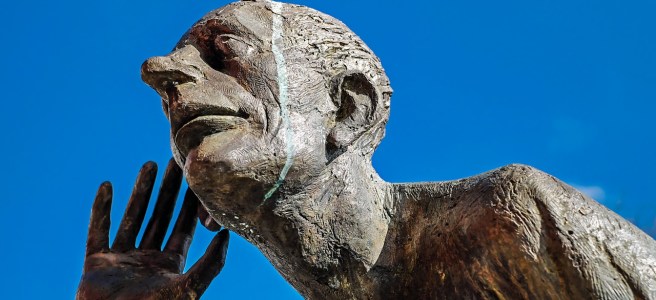
Open Up!

This Sunday’s sermon at Holston View UMC in Weber City, Va., will be “Demons and Deafness.” It will be based on Mark 7:24-37. If you want to view the sermon but cannot be present, the entire worship service will be available through Holston View UMC’s web page.

Today’s preparatory text: Mark 7:32-35 (NRSV)

A deaf man with a speech impediment was brought to him, and the people begged Jesus to lay his hands on the man to heal him.

Jesus led him away from the crowd so they could be alone. He put his fingers into the man’s ears. Then, spitting on his own fingers, he touched the man’s tongue. Looking up to heaven, he sighed and said, “Ephphatha,” which means, “Be opened!” Instantly the man could hear perfectly, and his tongue was freed so he could speak plainly!


By Chuck Griffin

You’re most likely reading this on the internet in some fashion, through Facebook, email or directly on the Methodist Life site. If you’re like me, this is not always the most conducive environment for slowing down and spending time with God.

A computer or smartphone can buzz with activity. Other windows, apps or browser tabs may be open, streaming music or television. Little pop-ups may be appearing and disappearing, telling you “important email” or alerting you to an incoming text or instant message.

Try something before you read any further. What you’ll experience is really important as we look at today’s text. Find a way to sit in silence, even if just briefly—say, five minutes. It helps to take some deep breaths.

Go ahead. I’ll wait.

My premise today is a simple one. We are like the deaf man in our story in Mark. We’re just deaf for a different reason. He had a physical problem. We have an environmental problem that causes spiritual deafness.

Something had stopped up his ears. Perhaps it was a disease. Perhaps it was a head injury. He began to speak as soon as he was healed, so he apparently remembered sound and speech. But at some point in his life, the sound had no longer come in and intelligible words had stopped coming out.

The cure was not a simple one, not even for Jesus the miracle worker. This was no time for a spectacle. Jesus pulled the man aside to a private place. (It strikes me that the deaf man must have had little understanding of what was going on; he had to trust Jesus.)

Put your pandemic-induced anxieties aside for a moment and imagine what it would feel like to have Jesus stick his fingers in your ears. Imagine what it would be like to have him take his spit and put it on your tongue.

Imagine what it would be like to have Jesus pray for you in the common Aramaic his very common followers spoke, a prayer so deep that it comes out in a groaning command: Ephphatha. Open up!

When it comes to hearing Jesus, to really hearing what God has to say to us, we’re stopped up, too. The world is in our ears. We’re clogged with work, sport and school schedules, with plans, with worries, with diversions like television and video games. We’re so stopped up that we’re in danger of remaining deaf to God’s continuing call on our lives until the day we die.

This deafness also makes us spiritually mute. How can we declare what we have not recently heard?

May we go to private places with Jesus long enough that our ears be unstopped. May we hear his message well. And may we declare the message of Jesus Christ as Lord and Savior with great excitement.

Dear Lord, give us the same healing command: Ephphatha!

Struggling for You

Colossians 2:1-5 (NRSV)

For I want you to know how much I am struggling for you, and for those in Laodicea, and for all who have not seen me face to face.  I want their hearts to be encouraged and united in love, so that they may have all the riches of assured understanding and have the knowledge of God’s mystery, that is, Christ himself, in whom are hidden all the treasures of wisdom and knowledge.  I am saying this so that no one may deceive you with plausible arguments.  For though I am absent in body, yet I am with you in spirit, and I rejoice to see your morale and the firmness of your faith in Christ.


By John Grimm

Watching cars and SUVs go by is fascinating.  Each vehicle is heading hither or yon, maybe to an appointment or on a work assignment. The kids might be going to or coming back from ball practice. And as we race about, we’re all potentially in need of assistance, grateful to receive it when in need. 

We who are part of the church on occasion might have someone offer us spiritual assistance, by way of prayer and other means.  As we read about Paul’s compassion for the church in Colossae and in Laodicea, it is not an occasional gesture that he gives.  As we know Christ Jesus is interceding for us right now, Paul is encouraging us, by his example, to struggle for other Christians.  Why would we want to struggle in such ways?

We struggle for other Christians so their hearts may be encouraged, and they would be united in love.  It is difficult to have the assured understanding and the knowledge of Christ himself when we feel disconnected from other Christians.  It is the Holy Spirit who connects every disciple of Jesus Christ.  This connection can be found in every local church, across international borders, and across denominational boundaries.  We grow in wisdom and knowledge of Jesus Christ as we experience Christian connectedness.

It also is good to see the morale and the firmness of other Christians’ faith in Christ, as it refreshes our own faith in Christ!  A single stalk of corn cannot produce a good yield by itself.  It takes multiple rows of corn to pollinate each other for a good yield to be produced.  That is how it is with Christians.  As we struggle for the sake of other Christians, we all are encouraged.

Almighty God, thank you for the disciples of Jesus Christ on this planet.  As sisters and brothers in Christ are perplexed, struggling, battered, and feeling abandoned, we lift them up to you.  May each disciple and each church know Christ in full.  We ask that you strengthen us all, so we know we grow firm in our faith.  Amen.

What Must Be Done

Ezra 9:5-9 (NRSV)

At the evening sacrifice I got up from my fasting, with my garments and my mantle torn, and fell on my knees, spread out my hands to the Lord my God, and said,

“O my God, I am too ashamed and embarrassed to lift my face to you, my God, for our iniquities have risen higher than our heads, and our guilt has mounted up to the heavens. From the days of our ancestors to this day we have been deep in guilt, and for our iniquities we, our kings, and our priests have been handed over to the kings of the lands, to the sword, to captivity, to plundering, and to utter shame, as is now the case. But now for a brief moment favor has been shown by the Lord our God, who has left us a remnant, and given us a stake in his holy place, in order that he may brighten our eyes and grant us a little sustenance in our slavery. For we are slaves; yet our God has not forsaken us in our slavery, but has extended to us his steadfast love before the kings of Persia, to give us new life to set up the house of our God, to repair its ruins, and to give us a wall in Judea and Jerusalem.”


By Chuck Griffin

Ezra dropped to his knees to do what must be done from time to time, to do what the people as a whole had failed to do. He repented and sought forgiveness.

Because of their sins, God’s chosen people found themselves enslaved, their way of life decimated. But a glimmer of hope had appeared, the potential to rebuild what had been a glorious temple. And yet, Ezra observed, the people of Israel continued to defy God.

The specific sin causing Ezra grief sounds strange to us today. The Israelites were to be a people set apart, a lesson in holiness to all the world. But instead they had begun to intermarry with the people around them, in the process adopting other gods and unholy practices. The real problem was that they had moved away from God and toward idolatry.

The principle remains the same for us. We are to search for what pleases God and what displeases God, practicing the former and avoiding the latter. Our Holy Bible gives us our baseline for understanding sin, something our broken minds cannot sort out on their own. In our New Testament, we receive refined guidance about sin from Jesus Christ and the Holy Spirit working within the early Christian church.

Ignoring this guidance brings grave danger. Our best response is to search our actions and even our thoughts to see where we may deviate from what God desires. We truly practice a religion of the heart.

Such an examination of ourselves should lead us where Ezra went—on our knees, in a state of repentance. Living much later than Ezra in God’s grand story of redemption, we know that because of the work of Jesus Christ, forgiveness, change and hope lie ahead.

A call to such piety is not popular, I know. Sadly, there are people among us who have established themselves as preachers while preaching the opposite.

Their opinions do not change the word of God, however, and they do not remove the need for thoughtful searching of our souls and serious repentance.

Lord, reveal to us through your holy word and directly in prayer where we displease you, and then show us a better way. Amen.