Psalm 23: Holy and Fearless

By Chuck Griffin
LifeTalk Editor

Our devotionals yesterday, today and tomorrow are all from the 23rd Psalm, “A Psalm of David,” considered in small meditative bites.

Verse 3b
He guides me along right paths,
    bringing honor to his name.

As his sheep, we follow his lead, behaving as the shepherd would have us behave. Sometimes the concept of Christian holiness is made to sound complicated, but it really is that simple.

We are known as his flock, and we do not want to embarrass him by wandering down paths not leading to eternity. For thousands of years, he has shown us his will through his word, recorded in the Holy Bible. This is how he tells us left or right, stop or go.

Yes, the noise of the world sometimes makes his call a little harder to discern, but if we take time to focus on Scripture in a thoughtful and prayerful way, we will know what to do.

And when we follow the right paths, people do notice. They are astonished when the harm they were expecting from us does not occur, or when they receive unexpected goodness.

And when they seek to know why we behave in such an unworldly way, we earn the right to tell them, “Because I stay in love with God—you can too!”

Verse 4
Even when I walk
    through the darkest valley,
I will not be afraid,
    for you are close beside me.
Your rod and your staff
    protect and comfort me.

Our shepherd is so loving, we can forget how strong he is. He has all the tools and weapons he needs to fend off the most terrifying threats.

The rod, a type of club worn at the belt for quick access, proves our shepherd’s willingness to go on offense when we are threatened. Evil will be crushed. The staff can be used with devastating effect in a fight, too. It also is a tool of rescue, capable of lifting lost sheep out of the most difficult circumstances.

We are reminded of the Great Shepherd, Jesus Christ. The truth he spoke acted like a bludgeon against the lies and deceptions of the world, and the day will come when Christ’s truth shreds evil like the keenest of blades. The cross became his tool for lifting us out of despair and death and into eternal life.

With a shepherd like that, why would we ever be afraid?

Lord, guard us in this life and lift us into the next, and may anxiety never keep us from heeding your call. Amen.

Psalm 23: Content and Rested

By Chuck Griffin
LifeTalk Editor

This Sunday, Lord willing, I will preach on the 23rd Psalm at Holston View United Methodist Church. I want to invite you to spend the rest of our week meditating on this “Psalm of David.” To jolt our thought processes a little, I’m using a less-familiar translation, the New Living Translation.

These meditations are based on devotionals I wrote for Luminary UMC in April, during the early days of the pandemic continuing to affect us. If you want, you can split each day into two devotionals, one for morning and one for evening.

Verse 1
The Lord is my shepherd;
    I have all that I need.

What a beautiful opening. But is this what we really believe?

One of the most difficult mindsets to achieve in this life is contentment, the ability to say, “My needs are covered.” And as the psalmist is trying to tell us, there is but one place to find contentment.

By calling the Lord “shepherd,” we say we trust God to care for our needs. We declare that what he gives us will be enough.

We understand the folly of listening to other voices, worldly shepherds telling us, “It’s really better over here. Happiness is on my side of the fence.”

False shepherds call to us for their own selfish reasons. Perhaps they need our votes or they need us to consume for their own profit, regardless of whether our consumption is good for us. Follow them, and in the end we likely find ourselves used up and alone.

It is best to be content in the care of the one who loves us so much that he will seek us out wherever we are.

Verses 2-3a
He lets me rest in green meadows;
    he leads me beside peaceful streams.
    He renews my strength.

Certainly, the shepherd urges us forward from time to time, for our own benefit and for the larger benefit of the kingdom. (Never forget, our shepherd is also a king!) Following him, we can grow tired. But there always is rest.

The need for contemplative rest—Sabbath—is built into the very fabric of the universe. And if we trust God’s plan, we can gain much from the times of rest we are offered.

There is sustenance in God’s word, as rich and spiritually nutritious to us as green meadows are to the sheep. By consuming what we find there, we grow. We also drink from the stream of life when we open ourselves to his grace, poured out through a variety of openings. Our prayers, our time in communion, and our fellowship with one another are just a few examples, and enough grace pours forth through these encounters to soak us thoroughly.

In the right cycle of service and rest, we grow spiritually stronger over time, even as our physical vigor fades. God always is willing to give us more than we have given. We simply must remember to stop and receive.

Lord, help me to recognize when you place opportunities for contentment and rest before me, and allow me to grow in my delight of you through the influence of your Spirit. Amen.

Stop Shoving

By Chuck Griffin
LifeTalk Editor

Ezekiel 34:17-23 (NLT)

“And as for you, my flock, this is what the Sovereign Lord says to his people: I will judge between one animal of the flock and another, separating the sheep from the goats. Isn’t it enough for you to keep the best of the pastures for yourselves? Must you also trample down the rest? Isn’t it enough for you to drink clear water for yourselves? Must you also muddy the rest with your feet? Why must my flock eat what you have trampled down and drink water you have fouled?

“Therefore, this is what the Sovereign Lord says: I will surely judge between the fat sheep and the scrawny sheep. For you fat sheep pushed and butted and crowded my sick and hungry flock until you scattered them to distant lands. So I will rescue my flock, and they will no longer be abused. I will judge between one animal of the flock and another. And I will set over them one shepherd, my servant David. He will feed them and be a shepherd to them.”


I am guessing that when most of us think of judgment, sheep and goats, we think of Jesus’ words in Matthew 25:31-46. Jesus, however, was expanding on words spoken by a prophet 600 years earlier.

At this point in Ezekiel’s prophecy, God already had condemned the callous “shepherds,” the Israelite kings who failed to care for their people. He then went on with the metaphor, issuing an internal warning to the flock regarding how its members treated one another.

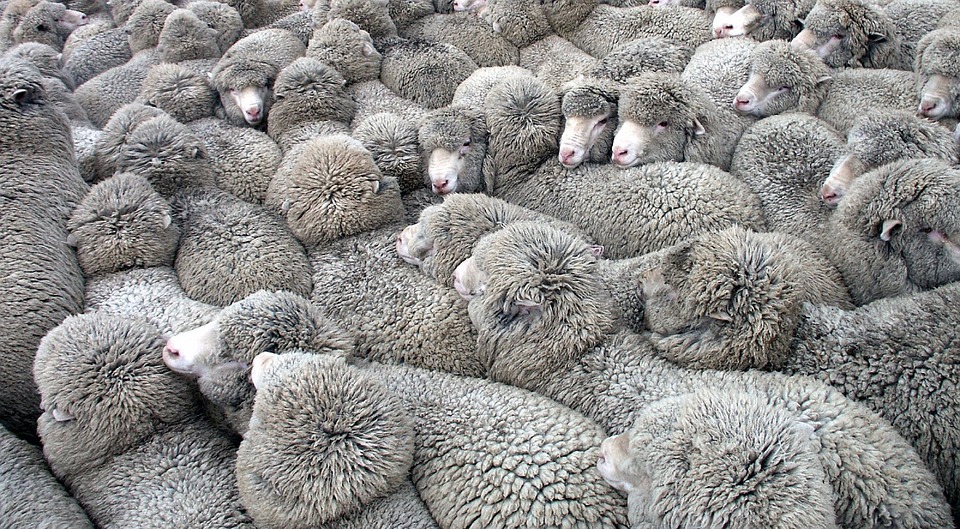
In short, they were shoving and grasping, the strong taking from the weak. There was no care being taken to ensure those most in need had their share of the basics.

All that shuffling and stomping during the hoarding of resources did a lot of damage, too. Where there is hoarding, there often is spoilage, and what could have benefitted others is wasted.

The message is pretty straightforward: Stop shoving and grasping, thinking only of yourself. Look around. To draw from a story in John 5: Who needs help reaching the pool of Bethesda?

In both the Ezekiel prophecy and in Jesus’ teaching, the concern is for the people on the margins of society, the “least of these,” the ones most damaged by the brokenness of the world. And remember, these images are all presented in “last days” judgment style—in Matthew, the lesson is conveyed by the one who will do the judging!

How we treat people pushed to the margins becomes a very serious litmus test for how effectively we have absorbed the idea that Jesus Christ is Lord and Savior. In response to this idea, people have devised a lot of schemes through the centuries regarding what governments should do. Some of those might even be worthwhile strategies.

None of that planning, however, eliminates our responsibility to look around and assess what we need to do as individual Christians. As God says through Ezekiel, “I will judge between one animal of the flock and another.”

Lord, give us eyes to see, ears to hear and a willingness to provide. Amen.