Restore Us, O God

Psalm 80:1-3 (NRSV)

Give ear, O Shepherd of Israel,
    you who lead Joseph like a flock!
You who are enthroned upon the cherubim, shine forth
    before Ephraim and Benjamin and Manasseh.
Stir up your might,
    and come to save us!

Restore us, O God;
    let your face shine, that we may be saved.

By Chuck Griffin

What we now call the Old Testament is full of oscillation, the relationship between God and his chosen people moving in and out of harmony.

God’s abundant love and astonishing holiness never change, of course. It is people, then and now, who draw near to God in works of mercy and piety or run away from God as they sin. Sometimes we run so far that God seems to have slumbered or even poured out wrath.

For the fallen—and we all have been among the fallen—that plea, “Restore us, O God,” is an excellent starting point. Of course, we cannot say “restore us” as we continue to run away. We have to at least turn toward God, like the prodigal son climbing out of the pig sty and taking his first step on the walk home. We have to repent.

While sin deeply offends God’s holiness, God’s love keeps our creator alert to our return. Through his chosen people, he has even made the return easy, ready to embrace us with outstretched arms. He came among us while we were deep in sin, living among us and ultimately paying for those sins on the cross.

“Stir up your might, and come to save us!” the people prayed in Psalm 80. And God did, in ways with far greater global impact than they likely imagined.

Can we lift up the same cry, in our own lives and on behalf of our own people, whomever they may be?

Lord, let us see a turning toward you, moving us into a time when your grace abundantly flows, bringing healing and salvation to all. Amen.

Old Memories, Renewed Vision

By Chuck Griffin

Haggai 2:1-5 (NLT)

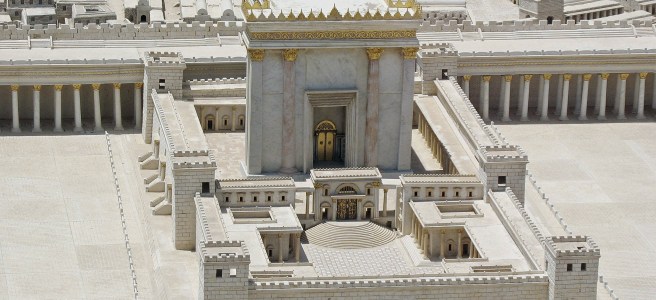
Then on October 17 of that same year, the Lord sent another message through the prophet Haggai. “Say this to Zerubbabel son of Shealtiel, governor of Judah, and to Jeshua son of Jehozadak, the high priest, and to the remnant of God’s people there in the land: ‘Does anyone remember this house—this Temple—in its former splendor? How, in comparison, does it look to you now? It must seem like nothing at all! But now the Lord says: Be strong, Zerubbabel. Be strong, Jeshua son of Jehozadak, the high priest. Be strong, all you people still left in the land. And now get to work, for I am with you, says the Lord of Heaven’s Armies. My Spirit remains among you, just as I promised when you came out of Egypt. So do not be afraid.’”


See if you recognize this scenario. The best days seem to be in the past. People around us seem too disillusioned or disinterested to seek a better world. When someone says, “Think about the future,” a mental picture takes form in shades of black and gray.

What people in such circumstances need is a prophet like Haggai. About 520 years before Jesus’ birth, the Jews of Jerusalem suffered under the Persian empire, with some of God’s people having returned only recently from exile.

God used Haggai to first instruct the leaders to rebuild what had once been a glorious temple, and then to inspire them when their faith began to flag. Haggai was an encourager centuries before Barnabas showed up to spread the Good News.

Yes, the Lord said through Haggai, the temple is a sad sight when compared with what some of the oldest among you remember. But even while the splendor of the building is gone, the glory of the Lord remains among you. And the temple will again reflect that glory.

Three simple words summarize Haggai’s message to the Jews. As we wring our hands about the secularization of our own culture—developments that seem to mark a decline in Christianity—those same words are applicable today.

Get to work.

The Christian vision remains the same. By loving God (through works of piety) and loving each other (through works of mercy), our savior’s glory is made visible, and the kingdom naturally grows toward fullness. Yes, the work seems difficult at times, but it is holy work, and therefore never pointless or low-priority.

If there is no Haggai in your church community, talk to the Lord about whether you are called to the role. Frankly, no church can have too many.

Lord, raise up within our churches people who passionately pursue holy action, and color our view of a future where you already exist and await us. Amen.

Means of Grace, Day 1

By Chuck Griffin
Editor, LifeTalk

Acts 1:8 (NLT): “You will receive power when the Holy Spirit comes upon you.”

In my Sunday sermon at Holston View United Methodist Church, I mentioned what are sometimes called the “means of grace.” That’s a very Methodist phrase for spiritual practices that create an encounter with God.

An encounter with God should bring about very positive change, of course. I would compare the offer God is making us to a rich man saying, “Any time you come to the corner of Church and Clonce streets, I will give you a bag of cash.” We likely would go to that obscure intersection quite often.

God is offering us much more, saying, “Meet me in these spiritual practices, and I will mold you for eternal life, letting you experience its joy now.” All the cash on the planet cannot match the value of eternal life! If we can better grasp what is being offered, we will regularly engage in these spiritual practices.

John Wesley talked about many different ways we can encounter God, but I’m going to focus the rest of the week on what he called “works of piety.” We will begin with the tremendous impact Scripture can have on our lives.

Paul told a young pastor in 2 Timothy 3:16, “All Scripture is inspired by God and is useful to teach us what is true and to make us realize what is wrong in our lives. It corrects us when we are wrong and teaches us to do what is right.” And Paul was referencing just the Old Testament—remember, as he wrote this letter, he was creating an early piece of what would become the New Testament.

Bibles used to be hard to come by, but that’s no longer true in our digital culture. We can carry multiple translations on our phones, and if you have a little trouble reading—for example, I have friends with dyslexia—there are audio versions.

We also need to be sure we are working from a plain-English translation we can understand. Again, there are many options. I’m particularly fond of the New Living Translation, and Bible Gateway will let you explore a huge list of translations.

With all the resources we have available, encountering God in Scripture mostly is about taking time out of our too-busy lives.

The Bible is a library, meaning you cannot read it the way you would read a novel, but if you’ve never read it from start to finish, I would encourage you to do so. It helps to start with the big picture, understanding the library and its broad themes. Read just three chapters a day, and you’ll finish in a little more than a year. Don’t get bogged down on the lists, like the census data in the Book of Numbers. Where necessary, skim!

You will walk away with a deeper understanding of some basic truths. God is our creator. Creation rebelled by sinning, rejecting God’s will. God loves his creation so much, however, that he began to work to restore us, despite our sins. Through a particular people, the Israelites, a savior eventually came into the world, God among us in flesh. He died to free us from sin, and then rose from the dead to prove his victory. The Spirit of God sustains us now, until such time as God completes his work and we are restored to him in full.

Once you have those concepts in mind, you can dive into the individual books and letters, developing a deeper understanding of these life-changing truths. We are talking about a lifetime of study—you just keep going deeper and deeper.

It does take a little work to learn to process Scripture. The chapter numbers and verse numbers, which are not in the original manuscripts, make the Bible look like a book full of rules to be cited, but don’t be misled. There are powerful stories and mysteries to meditate upon. God wants to use all of Scripture to reach deep within our souls, helping us understand there’s so much more to life than what we simply have experienced.

It also is good to come alongside more experienced Christians. Find a small group of people committed to continuing the great traditions of the church as they delve into the gift God has given us all.

The other means of grace we will consider this week are prayer, fasting, the Lord’s Supper, and participation in the life of the church. Stay with me this week. I pray we will see how all of this comes together to give us a much fuller experience of God.

Lord, may your word work in us in new ways, making us better equipped to be citizens of your eternal kingdom. Amen.