A Widow’s Trust

2 Kings 4:1-7 (NRSV)

By John Grimm

Can we trust one another?  Can we trust God when times are lean? 

These questions come to mind when we read about a prophet’s widow and her two children.  Yes, there are times that husbands die and the family cannot pay a creditor.  Yes, there are creditors who do not care about the situation. 

It is the prophet Elisha who conveys the trust for the widow.  She trusted him to find a way forward for her and her children.  This miracle of the oil could come only from God.  By speaking what could only come from God, Elisha shows the amount of trust the widow could have.  We need not know how much olive oil that was poured into the borrowed vessels.  We need only to know that all the debts were paid and the widow, with her children, could live on the rest.

We can trust God for our lives.  It is by depending upon the Lord that we can live.  When we believe in Jesus Christ, our life becomes an abundant life.  Maybe our situations are not like this widow’s situation.  Are we willing to trust a prophet today?  Are we willing to trust God when we are deep in debt?  Are we willing to trust God when a loved one dies? 

It could be that we learn to fear the Lord, like the deceased prophet had done. 

God, our lives can end unexpectedly.  Our families can be left owing much to creditors.  Increase our faith now so we can trust you like the widow did.  May our fearing of you strengthen as we see how trustworthy you are.  In the name of Jesus Christ, may we find the abundant life you have for us.  Amen.

Empty Space

By Chuck Griffin

In this season of Lent, the word “repent” comes up on a regular basis. Repentance requires more commitment than we may realize.

In the third chapter of Luke, we see how crowds of people responded to John the Baptist’s call to repent and prepare the way for Jesus’ coming. But when they showed up to be baptized, he called them a “brood of vipers.”

Clearly, there’s a little more to repentance than just showing up. As we read on in Luke, we see more clearly what the hairy, locust-chomping prophet was expecting: a true change of heart, the kind of transformation that results in a change of behavior.

The crowd asked, “What then should we do?”

John the Baptist’s answer was simple. If you’ve got plenty, and the poor around you have none, share! Stop being so greedy. He must have sensed there were a few folks in the crowd who planned to keep their extra cloaks and food despite being baptized.

If you have a job, particularly one where you have power over others, then perform your duties honestly, he went on. The soldiers and tax collectors whom he addressed directly were notorious for abusing their power to commit theft and extortion. Again, he must have seen the desire for sinful gain still glimmering in their eyes.

These were just examples. His main point was, you cannot say “I repent” but then go on with your old, sinful ways. “Repent” means that you regret your past actions and put them aside. Without true repentance, all the water in the Jordan River won’t help you.

Salvation is simple. All you have to do is believe that Jesus’ death on the cross is sufficient to pay for your sins. True belief by its very nature requires a repentant heart, however. If you don’t think the concept of sin, and in particular, your individual sins, are a problem, how can you take seriously the need for the cross?

Think of it this way: Ongoing sin fills up places in you where God needs to be. True repentance creates empty spaces, allowing God to rush in.

Anyone in church knows that we still have much to repent. Sadly, even the really obvious sins—murderous anger, adultery, theft, deception—go on among Christians, within what we call the body of Christ.

And then there’s the more subtle stuff—gossip, slander, greed and refusals to forgive, just to name a few—that can do as much damage long-term as murder can do short-term.

Yes there’s always plenty of repentance needed, even among those who have submitted to the water and taken on the name of Christ. I won’t go so far as to call us a “brood of vipers,” but I wonder if John the Baptist might.

Fortunately, we worship a patient, loving God, one who will grant us the power to change, if only we repent and ask for God’s help.

Lord, as we open ourselves to you, search us and show us what needs to be surrendered. Amen.

Unneeded Silence

Psalm 32 (NRSV)

By John Grimm

I did it again.  I kept my sin to myself.   Well, at least I thought I did.  Did people notice how short I was with them?  How much did my losing battle with sin show up in my life?

The psalmist is blessed, even happy, that the Lord has not charged him with iniquity.  Why is this state possible for the psalmist?  The psalmist has not tried to be deceitful regarding the wrong actions and words the psalmist has performed.  The psalmist is honest with God.

I, too, have noticed this phenomenon in my life.  Telling God my transgressions has been a freeing experience.  Otherwise, I keep my wrongdoing bottled up.   When that happens, the “woe is me” attitude is one of the ways my body wastes away.  The bottled-up truth of my sin will come out eventually, for my strength has limits.

After I have told God my sin and transgressions, he teaches me how I can live.  His steadfast love, his love that knows no bounds, is around me.  He gives me the ability to shout for joy because his forgiveness has allowed me to be upright in heart.  It is when I have unneeded silence in my life, because of bottling up my sins, that I fail to know and experience the steadfast love of God.

God, during these forty days I grow closer to you by being honest with you.  I have sinned.  I have gone against you and hurt myself, and others.  Hear my confession.  It is you who forgives my sins against you.  May I have the time and space to tell others how you have forgiven me.  In the Name of Jesus Christ, I ask that I may know the ways your steadfast love surrounds me. Amen.

Every Generation

2 Corinthians 4:16-18 (NRSV)

So we do not lose heart. Even though our outer nature is wasting away, our inner nature is being renewed day by day. For this slight momentary affliction is preparing us for an eternal weight of glory beyond all measure, because we look not at what can be seen but at what cannot be seen; for what can be seen is temporary, but what cannot be seen is eternal.

By Chuck Griffin

America and many parts of the rest of the world have embedded in their culture a love of youthfulness. In the media and elsewhere, we often glorify the young people of our world, even as we get older on average.

As Christians, we of course value young people deeply. Every new generation is in danger of missing out on the precious message of Jesus Christ as Savior, so we want to do all we can to reach the children and young adults around us. Sadly, American Christians as a group have not done a very good job of transmitting the message to younger people the past few decades.

As we realize our failure, some among us panic, and that can cause church leaders to fall into a kind of ageism. While wishing for more young people among us, they also begin to disdain all that white and silver hair that still arrives every Sunday.

It’s as if some church leaders are thinking, “These old people are the problem, and without them, everything would be okay.” This, of course, is silly—a lot of churches would end up with a mostly empty building.

As Jesus said, “The harvest is plentiful, but the laborers are few.” (Matthew 9:37.) And certainly, we shouldn’t chase away the workers we already have.

We do slow down some as “our outer nature is wasting away.” Older people, however, have an advantage, particularly if they have been in the faith a long time. Many have a deep sense of inner renewal—what we might call spiritual depth—and the life experiences they bring to a church’s outreach can be invaluable.

These people not only know how to plan and execute, they also often have more free time than your typical young adult! We also have to acknowledge that with medical advances and a better understanding of lifestyle choices, there are people in their seventies who can run circles around some people in their thirties when it comes to work.

Church leaders, don’t push these active older people away, even if they seem a little disengaged at times. Have you drawn them into the heart of your plans? Do you treat their worldview as something that remains relevant?

Once these experienced Christians are equipped with a proper understanding of the Great Commission (something lost on so many churchgoers for too long now), they can be a tremendous force for the kingdom.

Several years ago, I was doing ministry work in the Czech Republic. Senior Christians there were unusual because Soviet-enforced atheism had dominated their society and their minds for so long. The young Czechs proved to be more open to the gospel shortly after the Iron Curtain fell.

One Sunday, I worshiped with a small church made up mostly of families with young children. There was a white-haired exception among them, however. After the service, she asked me through an interpreter, “In your country, are there many older Christians, people like me?”

I suppressed a smile as I replied, “Oh, yes—most of the people in our churches are about your age.”

“Ah,” she said. “Wouldn’t that be wonderful!”

It is wonderful. Let’s never stop valuing what we have, and let’s get all the folks we have with us recommitted to the mission.

Lord, you work in our lives from the womb to beyond the grave, and every person is precious in your sight while here in this world, young or old. Give us the vision and the energy we need to grow your kingdom now. Amen.

Muzzled

Psalm 39 (NRSV)

By John Grimm

I do not like to be silent.  It is my vocation that allows me to speak.  However, there are times to be silent.  As a Christian, there are times that my mouth can get me into trouble.  It is when I speak my piece that life falls to pieces!

Yes, I have been known to create problems for myself, and others, when I open my mouth.  It occurs to me that God may not want or need me to use the breath he has given me for all the purposes that I intend to voice.  Knowing the difference is necessary.   

My days will only be so long.  They are but a breath compared to the days of the Lord.  Then it is up to me to be silent.  I cannot speak and deliver myself from the trouble I have caused.  People would say, when you are done digging the hole you are in, put the shovel down!  If my hope is in God, then I can use my breath to state my hope is in God (v. 7). 

When God corrects me, I accept his chastisement.  God only corrects me so that I may be better, even holy as he is holy.  It is when I am going through the chastisement that I speak much.  My story about God chastising me need not be told to everyone while God is chastising me!  Only after God’s chastisement do I need to speak by giving praise to God.

It is a wise idea to speak more with God than with others, especially while God is chastising me.  Then I can speak to God how I have broken the peace between myself and others.  Others will know that I muzzled myself for my own good.  The speaking that is appropriate is praise of God.  It would be wise for me to know this truth. 

God, my relationship with you is important.  When I speak with others about my travails and my situation with the wicked, I realize I need to muzzle myself!  It is you who are capable and willing to get me through my travails and my being with the wicked.  I can trust you all my days.  Thank you for chastising me when I have needed such.  Thank you that I can speak your praises.  May I know the times I can take off the muzzle and let others know of how good you have been to me in my short life.  In the name of Jesus, I pray for such wisdom.  Amen.

An Honest Searching

Psalm 39
For Jeduthun, the choir director: A psalm of David.
I said to myself, “I will watch what I do
    and not sin in what I say.
I will hold my tongue
    when the ungodly are around me.”
But as I stood there in silence—
    not even speaking of good things—
    the turmoil within me grew worse.
The more I thought about it,
    the hotter I got,
    igniting a fire of words:
“Lord, remind me how brief my time on earth will be.
    Remind me that my days are numbered—
    how fleeting my life is.
You have made my life no longer than the width of my hand.
    My entire lifetime is just a moment to you;
    at best, each of us is but a breath.”        Interlude

We are merely moving shadows,
    and all our busy rushing ends in nothing.
We heap up wealth,
    not knowing who will spend it.
And so, Lord, where do I put my hope?
    My only hope is in you.
Rescue me from my rebellion.
    Do not let fools mock me.
I am silent before you; I won’t say a word,
    for my punishment is from you.
But please stop striking me!
    I am exhausted by the blows from your hand.
When you discipline us for our sins,
    you consume like a moth what is precious to us.
    Each of us is but a breath.        Interlude

Hear my prayer, O Lord!
    Listen to my cries for help!
    Don’t ignore my tears.
For I am your guest—
    a traveler passing through,
    as my ancestors were before me.
Leave me alone so I can smile again
    before I am gone and exist no more.

By Chuck Griffin

This season of Lent is, again, a time for spiritual searching. Today’s psalm is a powerful example of how that search can whip one to and fro, triggering a range of emotions including stoicism, anger, despair and humility.

If you just skimmed over the psalm, please, slow down, or wait until you have time to slow down, and read it carefully. When you reach the words translated as “Interlude,” take time to breathe and to ponder what has been said thus far.

We also could say that the psalmist moves from an effort at self-control to something more valuable—willing surrender to God, to God’s majesty and undeniable power.

And remember, God does not ignore our tears. In fact, he refuses to ignore us, even if we plead with him to do so. Christ came not to ignore us, but to rescue us. There is no reason to fear that we will be gone, that we will exist no more.

Lord, this is a somber time in the Christian year, but we also feel ourselves being pulled toward hope. In our humility and despair, help us to anticipate the freedom to come. Amen.

A Sermon: “Headed Home”

Here’s a Monday Extra for Methodist Life readers. As some of you are aware, this blog began as part of outreach efforts by the Holston Wesleyan Covenant Association. The link below will take you to the manuscript of a sermon I preached last Saturday during worship, before our Holston chapter’s annual business meeting.

Headed Home”

Words to Strengthen

Revelation 2:8-11 (NLT)

“Write this letter to the angel of the church in Smyrna. This is the message from the one who is the First and the Last, who was dead but is now alive:

“I know about your suffering and your poverty—but you are rich! I know the blasphemy of those opposing you. They say they are Jews, but they are not, because their synagogue belongs to Satan. Don’t be afraid of what you are about to suffer. The devil will throw some of you into prison to test you. You will suffer for ten days. But if you remain faithful even when facing death, I will give you the crown of life.

“Anyone with ears to hear must listen to the Spirit and understand what he is saying to the churches. Whoever is victorious will not be harmed by the second death.”

By Chuck Griffin

The Book of Revelation features messages from our risen Christ to seven churches in various states of spiritual formation or decline. The church at Smyrna, located in what is now Turkey, was spiritually strong but heavily persecuted.

As I read this, my mind goes to the power of supportive words. Imagine a direct word from Jesus telling you to persevere—stick with it—hold fast to your beliefs! Even a tortured soul could weather any storm, knowing the promise of eternal life.

It’s amazing how God shows up in the small places, too. I was grumpy (again) on a recent Sunday morning. There’s no need to go into what made me grumpy, as it was silly, certainly nothing along the lines of the big threats the Christians at Smyrna were facing. But I do know this: It’s not good for a pastor to be grumpy right before preaching time.

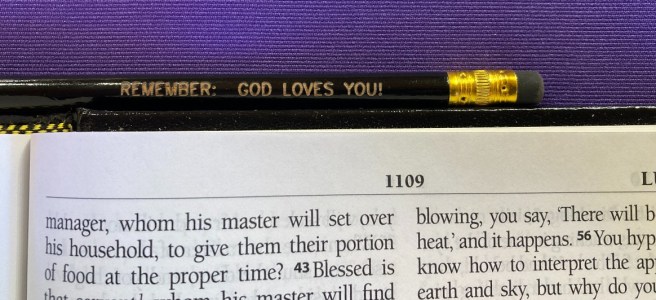
Words from God snapped me out of it. Not words from the Bible, but words on the side of a black pencil, one I had snatched up in haste from a random spot to mark my pulpit Bible. As I laid it down, these words, printed in gold, stared up at me: “REMEMBER: GOD LOVES YOU!”

I took a deep breath, and I knew things were going to be okay.

I am grateful for that little pencil, and the person who had the wisdom to order that phrase to go on it and its No. 2 box mates.

A couple of days later, I was again feeling stressed, this time over a critically important meeting. While waiting, I picked up the mail from the day before, and among the bills and advertisements was a note from two friends offering me words of encouragement.

During that meeting, the note was in my shirt pocket, a token of God’s love passed along by others.

The Bible is full of encouragement, sometimes carried into the world by angels. But don’t be surprised if a pencil or a friend steps in to deliver the message of God’s love when you need it the most.

Lord, thank you for the way grace flows into our lives in surprising ways. Keep us mindful of our role in channeling your love to those in need. Amen.

One in Twenty-Five

By Chuck Griffin

As we come out of this pandemic, the church where I serve as pastor, Holston View United Methodist in Weber City, Va., is in a time of discernment. As part of that, we are going to spend some time discussing and then, I hope, practicing evangelism.    

That’s caused me to think about basic evangelism principles I have learned through the years. If you’ve been a Christian for any significant time, I’m confident someone has shared with you the general mandate for all Christians: We are to bring others to a belief in Christ.

This act is rooted most strongly in Jesus’ words recorded at the end of the gospel of Matthew.

“Go therefore and make disciples of all nations, baptizing them in the name of the Father and of the Son and of the Holy Spirit, and teaching them to obey everything that I have commanded you,” Jesus said.

Knowing we’re supposed to evangelize and actually evangelizing are two different things, however. The idea is intriguing, but its execution can be intimidating, particularly if we begin to imagine the hostile responses we might receive.

I struggled with this until I was in seminary, when I was blessed with a very effective professor of evangelism, Dr. Robert G. Tuttle Jr. A couple of his key ideas really helped me.

The first principle helps us to remember that evangelizing is not manipulative. It is compassionate.

“I do not love in order to evangelize. I evangelize because I love,” Tuttle would say.

If we’re struggling with evangelism, we may also be struggling with our relationship with God. Growing in love for God and our neighbors by praying, worshiping, reading the Bible and being in fellowship with those in our community is essential to effective evangelism.

The second principle helps us to deal with what is basically a fear of failure. It gets us to stop expecting every encounter with a non-Christian to result in that person falling to his or her knees, calling on Christ for salvation.

Tuttle called this principle “1 in 25,” which comes from a jailhouse ministry experience he had as a young pastor. After he had witnessed to inmates one day, one of them declared his desire to follow Christ.

Tuttle said he went back the next day, obviously quite proud of himself. The inmate told him this: “Tuttle, I lay awake all last night, thinking. Suddenly it occurred to me that it takes an average of 25 different witnesses before any real encounter with God takes place. Just because you were number 25, you think you did it all, and you stink.”

When you tell someone about Christ, you may be witness number 3, or number 7, or number 22. What’s important is that you move that person forward in his or her understanding of Jesus Christ.

These two principles don’t deal with every aspect of evangelism, of course. There are entire books written on how to find common ground with people so we can talk about Christ in a natural way. Most of these books focus on the need to listen before we speak.

I pray, however, that Tuttle’s two principles will help relieve some of the fears you may experience as you share the good news about the love of Jesus Christ.

Lord, As we go about fulfilling the most basic duty you have given us, give us a sense of peace, knowing you arrived on the scene ahead of us, preparing the way. Amen.

From There

Philippians 3:17-20

By John Grimm

“I am not good enough to be in heaven.” 

Did that sound humble?  For that is the truth.  Admitting that I need a savior to come from heaven is a humbling statement.  It is to admit that I have been an enemy of Jesus, an enemy of God! When we turn from our belly (which has become our god), and escape our shame (which we used to brag about), we also turn to heaven (before, our minds were focused on what is below our feet). 

Turning to heaven is to turn where Jesus Christ is located now.  We humble ourselves because we were not focused on his glory.  Now that we have turned to heaven, we see that Jesus transforms us!  As we continue to look to Jesus, he works so that we match up to his glorious body.  Jesus does this work in us.

Jesus came the first time to die for our sins.  Jesus will come the second time on this planet so that we may be fitted to live with him for all time.  Between Jesus’ first and second arrivals on Earth, we decide.  We choose either to humble ourselves or to not humble ourselves.  The apostle Paul and numerous other Christians have given us examples to live.  What will be our decision?

Father Almighty, we are getting to the point in which we know we need a savior.  We are sinners.  As we find healthy Christians in our midst, may we see how to stop living as enemies of the cross.  Prepare us for Jesus’ second arrival on earth.  Allow Jesus to use his power so we may match up with his glorious body when he returns.  In the name of Jesus Christ, we pray.  Amen.