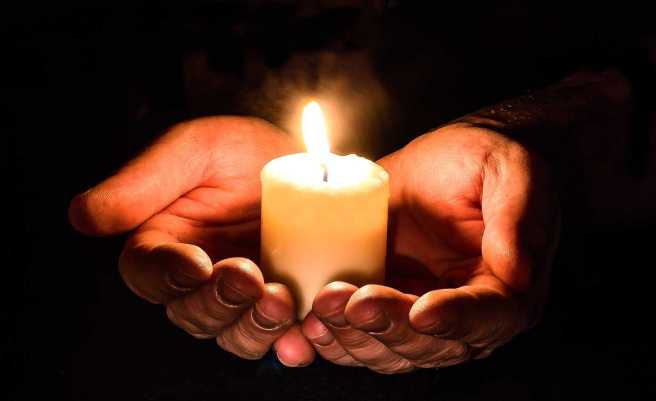
Peace

Romans 5:1: “Therefore, since we have been justified by faith, we have peace with God through our Lord Jesus Christ.”

Let’s continue exploring the four big themes of the season of Advent. Today, we will consider the concept of peace.

When we talk about biblical peace, we don’t just mean a feeling of bliss. Biblical peace is more akin to peace between nations that have been at war. When they agree to peace, they end hostilities and seek new possibilities for their relationship.

Through his sacrifice, Jesus ended the state of war between God and humanity. Humans brought on this terrible situation by sinning against God, creating a state of unholiness that called for our destruction. Through Jesus Christ, God made a unilateral offering of peace, restoring our ability to relate to our creator.

To accept the offer, we simply look to the cross and believe, accepting that the work done there is complete and irrevocable.

Now, don’t get me wrong, a state of peace does also bring a feeling of bliss. The threat of destruction is removed.

In terms of emotional responses, there’s more, too. But that’s for tomorrow.

Lord, thank you for the tremendous offer of peace made to us when you had all the power and divine privilege. Amen.

Hope

For the rest of this week, let’s consider the four themes of the Advent season—hope, peace, joy and love—which are usually captured in readings during the lighting of candles on the Advent wreath each Sunday.

As odd as it might seem, Romans 5:1-4 ties hope among the believers to suffering:

“Therefore, since we have been justified by faith, we have peace with God through our Lord Jesus Christ. Through him we have also obtained access by faith into this grace in which we stand, and we rejoice in hope of the glory of God. Not only that, but we rejoice in our sufferings, knowing that suffering produces endurance, and endurance produces character, and character produces hope, and hope does not put us to shame, because God’s love has been poured into our hearts through the Holy Spirit who has been given to us.”

I find it helpful to realize that suffering can have a point, so long as we continue in our faith that God’s promises have come true and will continue to come true.

Whatever we are experiencing, we learn to say in stronger and more authoritative ways, “Yes, this situation is bad, but it is temporary. God has promised that evil and all of its effects will be overcome.”

The light at the end of the tunnel isn’t a train. There’s no trick in store for us. The light of Christ is bearing down on us, coming to our rescue.

Hope also serves as a great evangelism tool. When people look at a Christian and say, “I want what that person has,” odds are the believer is exhibiting hope. People long to know that there is a potential happy ending to every story, and they particularly want to know how to ensure they can take part in that ending.

It is the basic role of every Christian to project hope where people may find themselves in despair. Where will we demonstrate hope today?

Lord, we don’t like to suffer, but thank you for being there in the midst of suffering, helping us to turn it into something good on behalf of your kingdom. Amen.

Ready

Occasionally, a piece of Scripture is so clearly instructional that a preacher or a devotional writer mostly needs to get out of its way and let the original author continue doing his holy work.

Ephesians 6:10-17 is one of those texts. I’ll offer a few starter questions here and there, but please, take time to meditate on the words and hear what they say to you. What a great way to start a work week during a difficult year!

A final word: Be strong in the Lord and in his mighty power.

Do we genuinely believe we can draw strength from God? It’s not difficult to see God as simultaneously mighty and inaccessible. How do we know his power is fully available to us?

Put on all of God’s armor so that you will be able to stand firm against all strategies of the devil. For we are not fighting against flesh-and-blood enemies, but against evil rulers and authorities of the unseen world, against mighty powers in this dark world, and against evil spirits in the heavenly places.

We tend to imagine other humans when we think of our enemies. How does it affect our outlook when we acknowledge there are unseen powers at work around us, and that these powers are the real enemy?

Therefore, put on every piece of God’s armor so you will be able to resist the enemy in the time of evil. Then after the battle you will still be standing firm.

Are we bothered by the idea of this being a “battle”? What do warlike images say to us about the focus and commitment required of every Christian? How does God’s armor differ from our own?

Stand your ground, putting on the belt of truth and the body armor of God’s righteousness. For shoes, put on the peace that comes from the Good News so that you will be fully prepared. In addition to all of these, hold up the shield of faith to stop the fiery arrows of the devil. Put on salvation as your helmet, and take the sword of the Spirit, which is the word of God.

These verses continue the battle imagery, but we also need to think about them more literally. How will truth-telling, truth-seeking, and the pursuit of righteousness improve our chances in this world?

Does the story of Christ’s crucifixion and resurrection give us lasting peace? If not, have we considered the story from start to finish recently?

When faced with evil, do we first trust that our faith in Jesus Christ is enough to protect us? Do we have a sense of assurance about our faith that gives us great confidence?

And lastly, do we know and trust God’s word enough that we are confident we can use it to defeat evil?

Dear Lord, thank you for reminding us that we are a people fully equipped to face whatever might come our way. Help us to be a people who trust and tap into the power you offer us every day, making a difference for your kingdom. Amen.

Under Water

Chuck Griffin
LifeTalk Editor

Psalm 107:28-30 (NRSV)
Then they cried to the Lord in their trouble,
    and he brought them out from their distress;
he made the storm be still,
    and the waves of the sea were hushed.
Then they were glad because they had quiet,
    and he brought them to their desired haven.

In yesterday’s devotional, I explored how to breathe during prayer, particularly when we find ourselves anxious. Today, I’m going to teach you a particular visualization technique to enhance your connection with God.

Put the two techniques together, and you have a kind of meditative prayer, something a lot of people in our culture don’t practice regularly. Our other, more familiar ways of praying—where we speak our praises, thanks and petitions to God, perhaps focusing on Scripture or a devotional as part of the process—remain critically important to our prayer lives. You may find, however, that meditative prayer techniques are particularly helpful in developing a sense of God’s constant presence.

There are uncountable ways to enter a state of meditative prayer. This is just one I like. I do not remember where I first learned it.

Imagine yourself sitting (or standing or lying, depending on your preferred posture) at the bottom of a deep, clear pool of water. Here’s the good news: God has granted you the ability to breathe comfortably and freely while there. Remember to breathe as discussed yesterday.

If this were a class in Zen meditation, someone might tell you to empty your mind. We’re doing the opposite. We want to be filled with God, and only with God.

As you begin, it helps to think of a word representing what you seek in that holy relationship. I’ve heard people make all sorts of choices: “peace,” “love,” “forgiveness” or “discernment,” for example. I’ve even heard people choose “Jesus” as their word, apparently as they tried to better fathom what it means to be in a personal relationship with God through Christ.

Go ahead and accept that worries and random thoughts will intrude on this time. We’re not going to fight them. Instead, take hold of them, examine them for a brief moment, and then release them, allowing them to float to the surface, far above you. Say your chosen word as part of the next exhale, and settle back into experiencing God.

That’s the technique. Simple, huh?

By the way, the more you do this, the longer you will spend in this state before deciding to surface. In just a few tries, you may have a meditative prayer session where you are surprised at how long you’ve been “under”—half an hour or even an hour might feel like 15 or 20 minutes.

What’s important is that you find yourself deeply aware of God’s presence.

Lord, thank you for the way you meet us in the midst of storms and in quiet places. Amen.

Escape for a Moment

By Chuck Griffin
LifeTalk Editor

This crisis in which we find ourselves seems so exhausting, I think, because thoughts of it lurk somewhere in our minds all day. In my case, it’s as if I have an annoying tickle in my brain.

The tickle is chronic enough that I actually notice when I’ve not been thinking about our situation for a short time. That moment usually comes in the evening, when Connie and I take time to watch a movie or a favorite television show, or if I read a book of fiction. For just a little while, I get lost in whatever story is before me.

As you might expect, I spend a lot of time in the Bible, but the tickle doesn’t really go away. The lessons of Scripture are usually so applicable to this viral outbreak and our fears that I cannot help but place the verses in our current context. The tickle remains, although I’m grateful for the answers the Bible gives regarding how to live in such times.

There is some “escapist” literature in the Bible, however, and I want to encourage you to find it. I’m going to point out a favorite one of mine—in fact, it’s so out of this world that some people avoid it. I prefer to relish it.

To get the full picture, you’ll need to read at least the first three chapters of Ezekiel, although you will miss much if you stop there. This essentially is a prophet being called to his work, but in a most unusual way. If you’ve read much science fiction, the story can border on readings from that genre, although we are to understand it as a symbol-filled vision of God, who cannot be adequately described with words.

There are angels in the sky, steering what look like wheels within wheels, carrying above them the likeness of a throne. And then there is the vision of the throne and the one upon it:

And above the dome over their heads there was something like a throne, in appearance like sapphire; and seated above the likeness of a throne was something that seemed like a human form. Upward from what appeared like the loins I saw something like gleaming amber, something that looked like fire enclosed all around; and downward from what looked like the loins I saw something that looked like fire, and there was a splendor all around. Like the bow in a cloud on a rainy day, such was the appearance of the splendor all around. This was the appearance of the likeness of the glory of the Lord. (Ezekiel 1:26-28)

There’s so much more in Ezekiel. I’m simply trying to encourage you to take a little time apart from the world today. Read it. Get lost in it. There’s nothing wrong with that.

I’m also curious what Bible stories you might consider escapist. By that, I mean you get so caught up in them you forget everything else for a time. Feel free to post your favorites in the comments section.

Lord, we thank you for the power of your word: its power to teach, its power to comfort, its power to enliven our imaginations. Amen.

Keep Reading

By Chuck Griffin
LifeTalk Editor

Psalm 149 (NLT)

Praise the Lord!

Sing to the Lord a new song.
    Sing his praises in the assembly of the faithful.

O Israel, rejoice in your Maker.
    O people of Jerusalem, exult in your King.
Praise his name with dancing,
    accompanied by tambourine and harp.
For the Lord delights in his people;
    he crowns the humble with victory.
Let the faithful rejoice that he honors them.
    Let them sing for joy as they lie on their beds.

What a lovely little psalm. There is singing and dancing, the air alive with the sound of instruments. Day and night, the people rejoice. The psalm continues, too!

Let the praises of God be in their mouths,
    and a sharp sword in their hands—
to execute vengeance on the nations
    and punishment on the peoples,
to bind their kings with shackles
    and their leaders with iron chains,
to execute the judgment written against them.
    This is the glorious privilege of his faithful ones.

Praise the Lord!

Hmmmm. Suddenly, Psalm 149 is a little less lovely. Swords, shackles and vengeance bring a kind of darkness to this psalm we might not have expected.

The Bible is full of sudden turns like this. A lot of devotionals and sermons deal with these startling disparities simply by stopping short, ending the selection of verses before the disturbance brought on by the new thought begins. I understand why—for the sake of brevity, and in an effort to get one clear point across without muddying the devotional or sermon too much, stopping short is sometimes necessary.

We still need, however, to learn to deal with these incongruities, so we are better equipped as believers to help seekers who naturally may be put off by such passages.

Perspective is important. Remember, these texts are very old, meaning they were written in a time when a lot of our ideas about what constitutes civilized behavior had yet to develop. The psalm we’re reading today is at least 2,500 years old, and maybe older.

Understanding this, we’re starting in the wrong place if we critique these texts from a modern viewpoint. Texts like our psalm carry within them what were at the time new revelations about how God’s people should relate to their creator and to one another.

Many of those ideas grew to become the basis of what we now think of as modern, civilized behavior. We should not be critical of the people who first began to comprehend revelations of God’s holiness and God’s desire to save a remnant from the effects of sin.

As Isaac Newton said, “If I have seen further than others, it is by standing on the shoulders of giants.”

When Jesus came on the scene centuries after this psalm to expand our understanding of God’s love and grace, he was not afraid to draw on what had been taught through his Jewish culture thus far. God is over all things and above all things. God redeems his people, and Jesus came as God in flesh to prove this point.

And yet, even in gentle Jesus’ teachings, it is clear that what is opposed to God ultimately will face God’s wrath. God has never wavered on that point.

Jesus used a metaphorical sword, and he expected us to pick it up and use it against the enemies of God. I am talking about speaking the truth of who God is and what God is doing through Jesus Christ to restore a broken world. This truth cuts through the political machinations and outright lies of the worldly nations.

This “sword of truth” imagery is most vivid in the final book of the Bible, Revelation, where the author has a vision of Christ completing his work in the world.

“Then I saw heaven opened, and a white horse was standing there. Its rider was named Faithful and True, for he judges fairly and wages a righteous war. His eyes were like flames of fire, and on his head were many crowns. A name was written on him that no one understood except himself. He wore a robe dipped in blood, and his title was the Word of God. The armies of heaven, dressed in the finest of pure white linen, followed him on white horses. From his mouth came a sharp sword to strike down the nations. He will rule them with an iron rod. He will release the fierce wrath of God, the Almighty, like juice flowing from a winepress. On his robe at his thigh was written this title: King of all kings and Lord of all lords.” (Revelation 19:11-16.)

The ancient Israelites felt called to take up their swords and impose shackles in obedience to God, delivering primitive lessons about holiness in what we now consider primitive times. We are called to do similar work with restorative words and sacrificial acts, following Jesus’ lead as the bringer of truth. And God’s truth shall reign.

Lord, thank you for the revelations you have given humanity about your nature since before recorded history began. May the truth of Jesus Christ as Lord and Savior be evident to all very soon. Amen.